
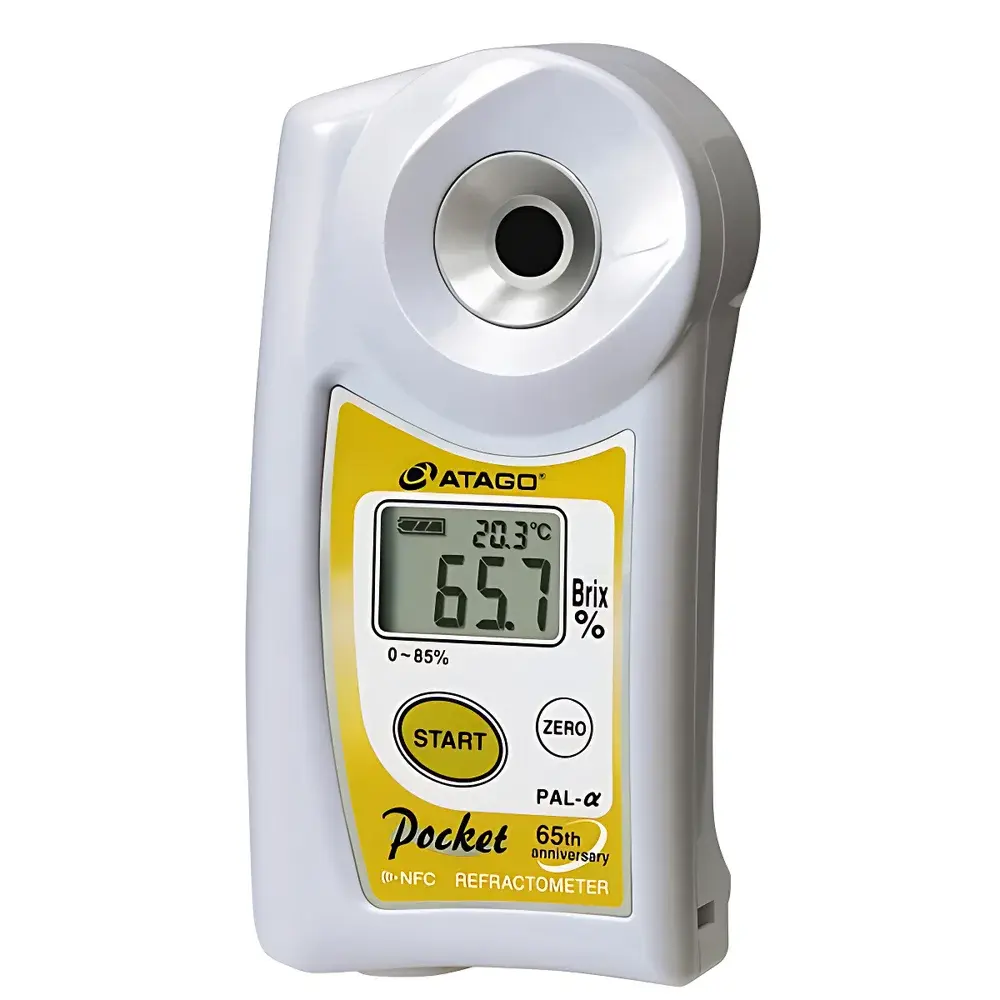
ATAGO PAL-α Wide-Range Portable Digital Refractometer
| Brand | ATAGO |
|---|---|
| Origin | Japan |
| Model | PAL-α |
| Measuring Range (Brix) | 0.0–85.0% |
| Resolution | 0.1% Brix |
| Accuracy | ±0.2% Brix |
| Temperature Compensation Range | 10–100°C |
| Sample Volume | 0.3 mL |
| Measurement Time | 3 seconds |
| Operating Temperature | 10–40°C |
| Protection Rating | IP65 |
| Dimensions | 55(W) × 31(D) × 109(H) mm |
| Weight | 100 g (instrument only) |
| Power Supply | 2 × AAA batteries |
| Instrument Type | Destructive Sampling |
Overview
The ATAGO PAL-α Wide-Range Portable Digital Refractometer is an optical instrument engineered for rapid, field-deployable determination of soluble solids concentration—expressed as Brix (% w/w)—in liquid and semi-liquid samples. It operates on the principle of critical-angle refractometry: incident light passes through a sapphire prism in contact with the sample; the angle at which total internal reflection occurs correlates directly with the sample’s refractive index, which is empirically calibrated to Brix values across a broad range (0.0–85.0%). Designed for routine quality control and process monitoring, the PAL-α delivers stable, repeatable readings without requiring optical alignment or user calibration—its factory-set scale is traceable to NIST-certified sucrose standards. The instrument features built-in automatic temperature compensation (ATC) compliant with ISO 2173 and AOAC Official Method 932.12, ensuring measurement integrity across ambient conditions from 10°C to 40°C while maintaining accuracy over a full 10–100°C sample temperature span.
Key Features
- Wide Brix measurement range (0.0–85.0%) optimized for high-sugar matrices including fruit concentrates, syrups, molasses, and industrial glycols.
- High-resolution digital display with 0.1% Brix resolution and ±0.2% Brix accuracy (at 20°C, using standard sucrose solution).
- Robust sapphire prism surface resistant to scratching and chemical erosion—suitable for aggressive solvents including cutting fluids, alkaline cleaners, and antifreeze formulations.
- IP65-rated enclosure ensures protection against dust ingress and low-pressure water jets—enabling reliable operation in production floors, cold rooms, and outdoor agricultural settings.
- Minimal sample requirement (0.3 mL) and sub-3-second measurement cycle support high-throughput screening without compromising precision.
- Energy-efficient design powered by two standard AAA batteries (typical service life: >10,000 measurements), with auto-power-off after 3 minutes of inactivity.
Sample Compatibility & Compliance
The PAL-α accommodates aqueous solutions, emulsions, and low-viscosity suspensions commonly encountered in food processing, chemical manufacturing, and metalworking fluid management. Validated applications include fruit juice blends (apple, orange, grape), dairy-based beverages, fermentation broths, ethylene glycol/propylene glycol antifreeze, alkaline parts washers, and water-miscible machining coolants. While classified as a destructive sampling instrument—requiring direct prism contact—the small volume demand minimizes material waste. The device conforms to international refractometric practice guidelines outlined in ISO 2173 (fruit and vegetable products), ISO 5725 (accuracy and precision of measurement methods), and supports GLP-compliant documentation when integrated into laboratory SOPs. No regulatory certification (e.g., FDA 21 CFR Part 11) is embedded, but audit-ready measurement logs can be manually recorded per facility-specific data governance protocols.
Software & Data Management
The PAL-α operates as a standalone, firmware-controlled instrument with no onboard memory or USB/Bluetooth connectivity. All measurement data must be transcribed manually or captured via external logging systems (e.g., LIMS, Excel, or paper-based QC forms). Its simplicity eliminates software validation burdens typically associated with regulated environments—making it suitable for Tier-2 QC labs, contract manufacturers, and R&D pilot lines where formal electronic record requirements are not mandated. For users requiring digital traceability, ATAGO offers optional accessories such as the RS-232 interface cable (Model: PAL-COM) and compatible terminal software (PAL-Link), though these are sold separately and fall outside the scope of the base PAL-α configuration.
Applications
- Food & Beverage: Brix verification of raw fruit pulp, pasteurized juices, soft drink concentrates, honey adulteration screening, and jam/gelatin setting point estimation.
- Industrial Fluids: Glycol concentration monitoring in HVAC chillers and engine cooling systems; alkalinity assessment of detergent solutions used in CIP cycles.
- Agriculture & Horticulture: Real-time sugar accumulation tracking during fruit ripening trials; sap Brix evaluation in vineyard and orchard management programs.
- Chemical Manufacturing: Quick-check verification of aqueous polymer solutions, surfactant blends, and solvent recovery streams prior to distillation or filtration.
- Academic Research: Teaching tool for undergraduate physical chemistry labs demonstrating refractive index–concentration relationships and temperature dependence effects.
FAQ
Is the PAL-α suitable for measuring viscous or particulate-laden samples?
No—samples must be homogeneous, particle-free liquids. Suspended solids or high viscosity (>100 mPa·s) may cause inaccurate readings due to incomplete prism wetting or air entrapment.
Does the PAL-α require recalibration before each use?
No. It is factory-calibrated with sucrose standards and features drift-resistant optics. Verification with distilled water (0.0% Brix) and a certified 10.0% sucrose standard is recommended daily in regulated environments.
Can the instrument measure non-sucrose-based solutions accurately?
It reports apparent Brix, which assumes a sucrose-equivalent refractive index. For non-sucrose solutes (e.g., fructose, sodium chloride, ethylene glycol), users must apply correction factors derived from published refractometric conversion tables or empirical calibration curves.
What maintenance is required for long-term reliability?
Wipe the sapphire prism with lens tissue and purified water after each measurement; avoid abrasive cleaners. Store in the supplied protective case with desiccant to prevent moisture-induced haze on optical surfaces.
Is the PAL-α compliant with ISO/IEC 17025 testing laboratory requirements?
As a stand-alone instrument, it meets metrological criteria for accuracy and repeatability. Full compliance depends on the user’s documented calibration schedule, environmental controls, and uncertainty budgeting per ISO/IEC 17025 Clause 6.4 and 6.5.




