
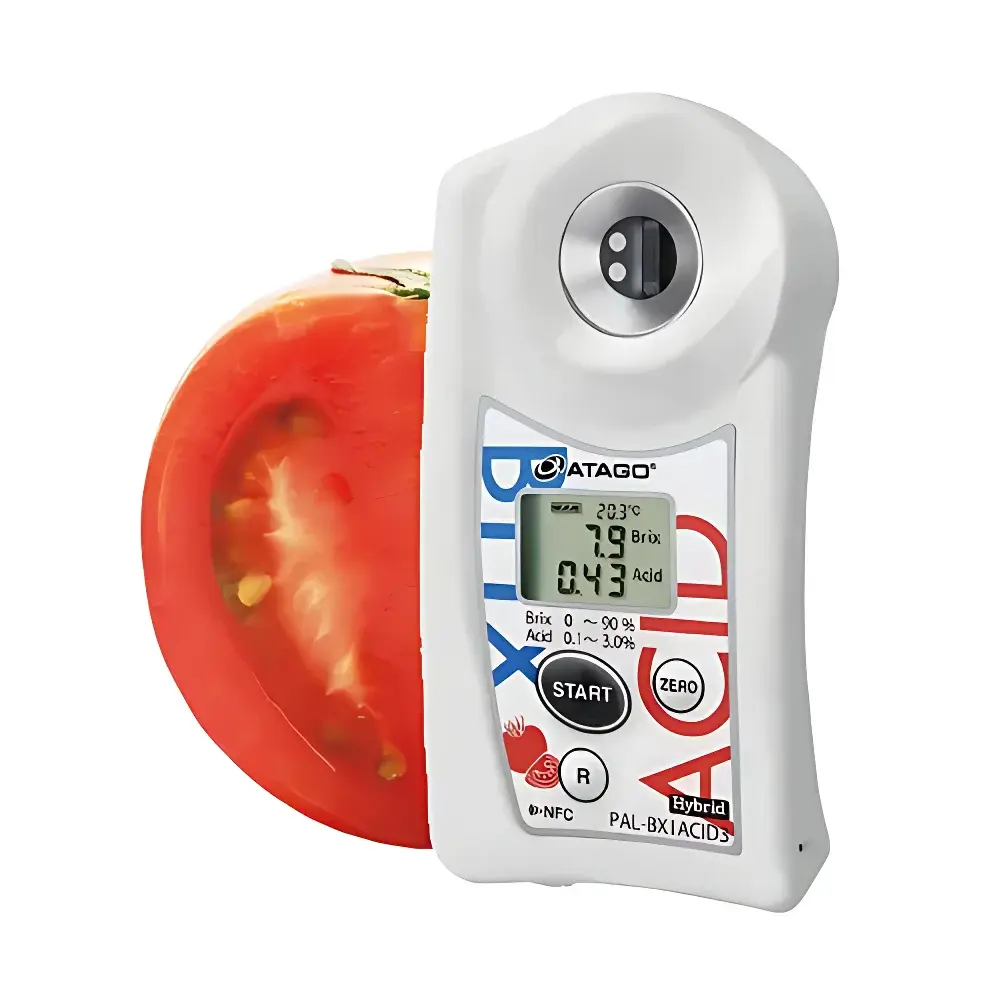
ATAGO PAL-BX/ACID 3 Tomato-Specific Brix & Titratable Acidity Meter
| Brand | ATAGO |
|---|---|
| Origin | Japan |
| Model | PAL-BX/ACID 3 |
| Measurement Principle | Refractometric Brix + pH-Referenced Titration-Equivalent Acidity Conversion |
| Instrument Type | Destructive Sampling Meter |
| Brix Range | 0.0–90.0% |
| Acidity Range (as Citric Acid) | 0.10–3.00% |
| Brix Accuracy | ±0.2% |
| Acidity Accuracy | ±0.10% (0.10–1.00%), ±10% rel. (1.01–8.80%) |
| Temperature Compensation | 10–40°C |
| IP Rating | IP65 |
| Dimensions | 5.5 × 3.1 × 10.9 cm |
| Weight | 100 g (main unit only) |
| Power | 2 × AAA alkaline batteries |
Overview
The ATAGO PAL-BX/ACID 3 is a handheld, dual-parameter optical meter engineered specifically for rapid, field-deployable assessment of tomato (Solanum lycopersicum) quality parameters—namely, refractive index-derived soluble solids content (Brix, % w/w) and titratable acidity expressed as citric acid equivalent (% w/w). Unlike general-purpose refractometers or standalone pH meters, the PAL-BX/ACID 3 integrates a calibrated optical path with an embedded algorithm that converts measured hydrogen ion activity—via a proprietary electrodeless conductivity/pH-correlated response—into standardized citric acid concentration. This enables simultaneous, non-instrumental (i.e., reagent-free) estimation of both Brix and acidity from a single diluted sample preparation. The device computes and displays the Acid-Sugar Ratio (ASR) on demand via the dedicated ‘R’ key—a dimensionless metric widely adopted in horticultural science and postharvest physiology to quantify flavor balance, ripeness progression, and varietal suitability. Its design adheres to fundamental principles of sucrose-equivalent refractometry (per ISO 2173 and AOAC 932.12) and empirical acidity correlation validated against reference potentiometric titration (AOAC 942.15), making it suitable for routine use in breeding programs, packinghouse QA/QC, and agronomic field trials.
Key Features
- Tomato-optimized optical calibration curve with built-in OFFSET correction function for alignment with laboratory titration data or alternative acid quantification methods
- Dual-parameter measurement in under 3 seconds: Brix (0.0–90.0%) and citric acid–equivalent acidity (0.10–3.00%)
- Automatic temperature compensation (10–40°C) compliant with ASTM D1078 and ISO 5725 repeatability requirements
- IP65-rated enclosure for resistance to dust ingress and water jets—validated for use in humid greenhouse, harvest-line, and outdoor field environments
- High-resolution display with dynamic ASR formatting: 0.00 (0.00–9.99), 00.0 (00.0–99.9), or 000 (≥100), preventing misinterpretation of scale transitions
- No consumables required for Brix; acidity measurement requires only distilled water dilution (1:50 w/w sample:water), eliminating need for standardized NaOH, phenolphthalein, or burettes
Sample Compatibility & Compliance
The PAL-BX/ACID 3 is validated exclusively for homogenized tomato fruit tissue (fresh or frozen-thawed), tomato paste (diluted to juice consistency), and clarified tomato juice. It is not intended for high-pulp, viscous, or fermented samples without prior centrifugation/filtration. Sample preparation follows standardized protocols aligned with USDA AMS Grade Standards for Tomatoes and EU Regulation (EC) No 1221/2008 on fruit quality assessment. While not a primary compliance instrument for regulatory submissions, its Brix measurements meet the precision criteria of ISO 2173 for routine process control, and its acidity output correlates within ±0.10% (at low-range concentrations) to AOAC 942.15 reference titrations—enabling traceable internal quality benchmarking. Device firmware supports GLP-aligned operation: all measurements are time-stamped, non-editable, and stored locally (no cloud upload), satisfying basic audit-trail requirements for GMP-adjacent agricultural QA systems.
Software & Data Management
The PAL-BX/ACID 3 operates as a standalone instrument with no Bluetooth, USB, or PC connectivity. All measurement data—including Brix, acidity, ASR, date/time stamp, and ambient temperature—are retained in non-volatile memory for up to 100 readings. Data export requires manual transcription; no proprietary software or drivers are provided. This architecture ensures electromagnetic compatibility in electromagnetically noisy packinghouse environments and eliminates cybersecurity vulnerabilities associated with networked lab instruments. For laboratories requiring digital integration, ATAGO recommends pairing the PAL-BX/ACID 3 with validated LIMS-compatible data loggers (e.g., LabVIEW-based acquisition modules using RS-232 emulation via optional serial adapter), though such configurations fall outside factory calibration scope.
Applications
- On-site screening of tomato cultivars during breeding trials to identify optimal ASR windows (typically 6.0–12.0 for fresh market types)
- Real-time maturity assessment pre-harvest using ASR trends correlated with ethylene evolution and colorimetric indices (L*, a*, b*)
- Postharvest quality sorting: segregation of fruit lots by ASR thresholds to meet retailer-specified flavor profiles
- Process validation for thermal processing lines—monitoring acidity drift in peeled tomatoes or passata to ensure microbial stability per FDA 21 CFR Part 117
- Educational use in food science curricula for teaching fundamental relationships between sugar metabolism, organic acid degradation, and sensory perception
FAQ
Is the PAL-BX/ACID 3 suitable for non-tomato fruits such as citrus or apple?
The instrument’s optical and algorithmic calibration is optimized for tomato matrix characteristics (pH ~4.2–4.8, predominant citric acid, low pectin interference). While it may yield usable Brix values for citrus, acidity results will deviate significantly due to differing acid profiles (e.g., malic dominance in apple); ATAGO does not validate or support cross-fruit use.
Does the device require recalibration before each use?
No. Factory calibration is stable for ≥12 months under normal handling. Users should verify zero-point with distilled water daily and perform Brix standard verification (e.g., 10.0% sucrose solution) weekly per ATAGO Technical Bulletin TB-2022-04.
Can the OFFSET function correct for differences between citric acid and malic acid equivalence?
No. OFFSET adjusts systematic bias relative to a user-defined reference method (e.g., titration), but does not alter the underlying citric acid conversion model. It cannot compensate for intrinsic acid-species discrepancies.
What is the minimum sample volume required?
Approximately 0.2 mL of homogenized tomato juice is sufficient after 1:50 dilution—equivalent to ≤10 mg of fresh fruit tissue.
Is the battery life documented under continuous operation?
Yes: ≥10,000 measurements per set of two AAA alkaline batteries at 25°C, verified per IEC 60086-2 cycle testing protocols.



