
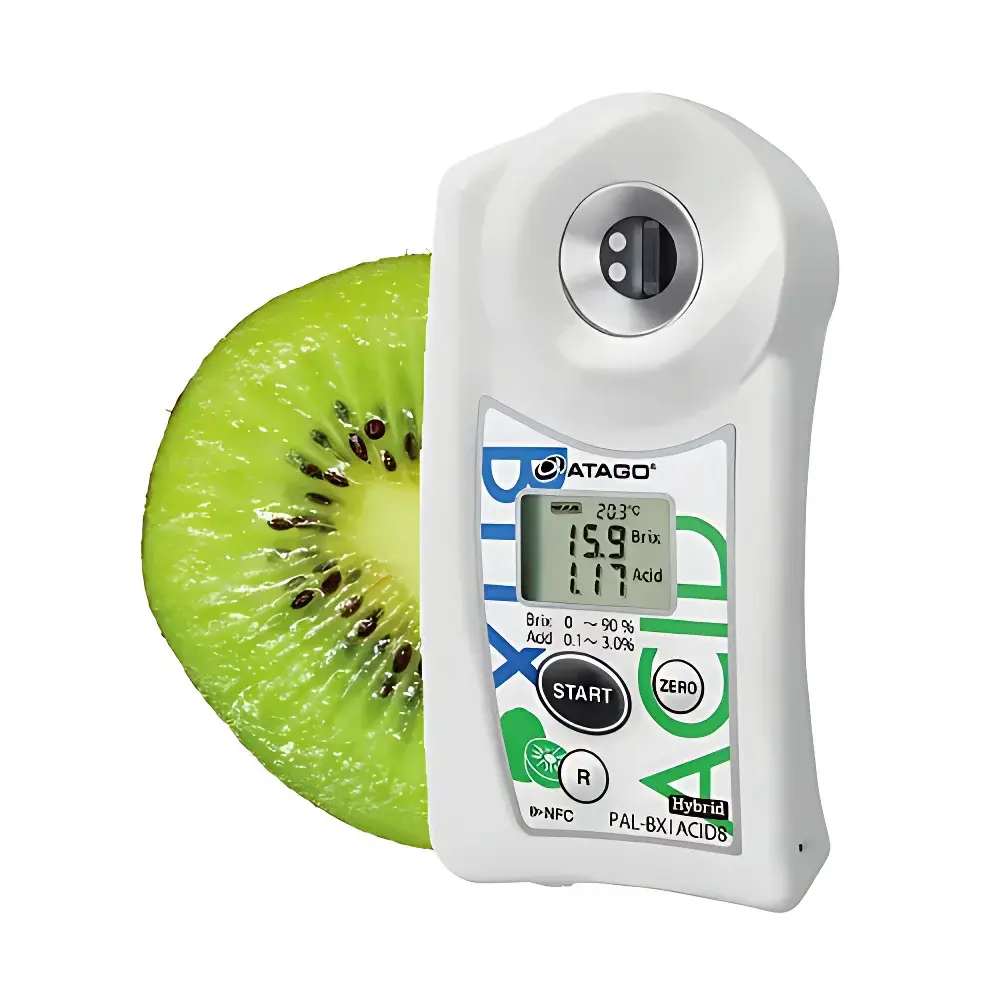
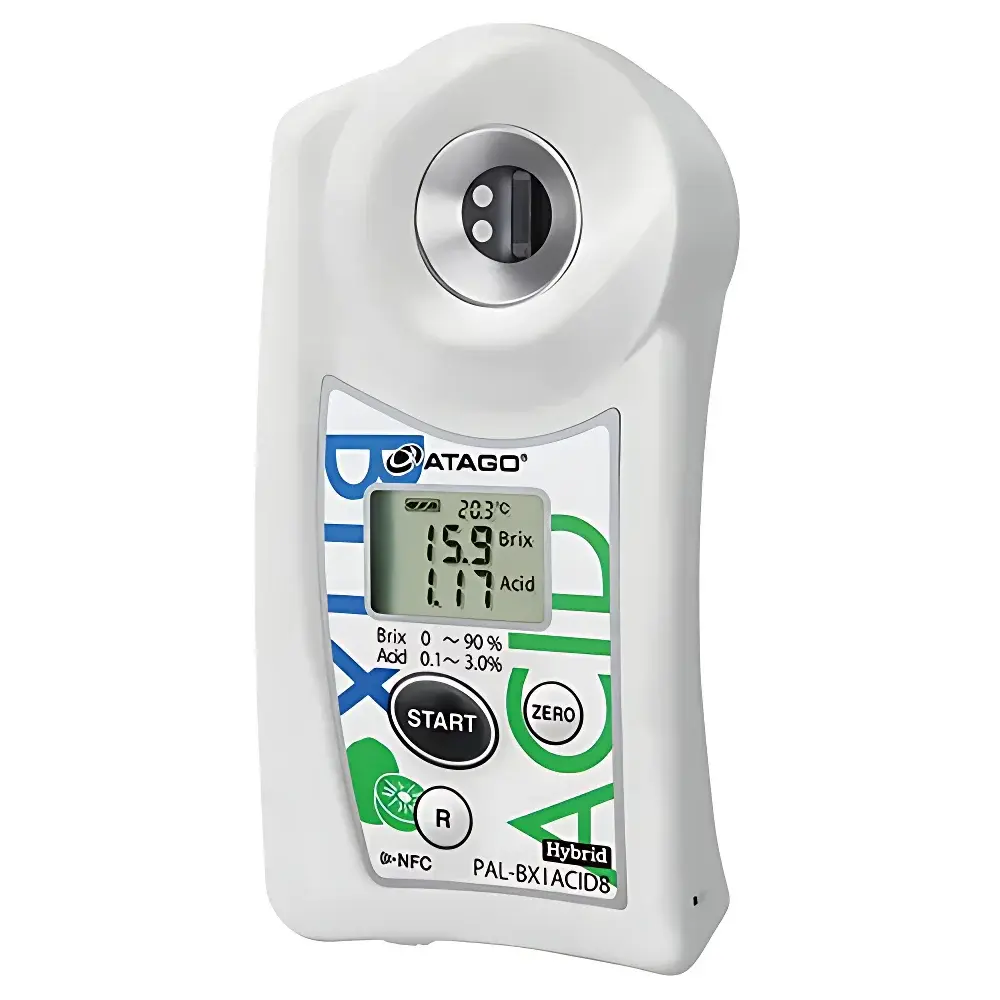
ATAGO PAL-BX/ACID 8 Kiwifruit-Specific Refractometer with Integrated Acidity Measurement
| Brand | ATAGO |
|---|---|
| Origin | Japan |
| Model | PAL-BX/ACID 8 |
| Product Type | Handheld Refractometer |
| Display | Digital LCD |
| Temperature Compensation Range | 10–40 °C |
| Brix Range | 0.0–60.0 % |
| Acid Range (as citric acid) | 0.10–3.00 % |
| Brix Accuracy | ±0.2 % |
| Acid Accuracy | ±0.10 % (0.10–1.00 %), ±10 % relative (1.01–8.80 %) |
| Resolution | Brix 0.1 %, Acid 0.01 % (0.00–9.99 %), 0.1 % (≥10.0 %) |
| IP Rating | IP65 |
| Dimensions | 5.5 × 3.1 × 10.9 cm |
| Weight | 100 g (instrument only) |
| Power | 2 × AAA alkaline batteries |
Overview
The ATAGO PAL-BX/ACID 8 is a dedicated handheld refractometer engineered for rapid, field-deployable assessment of sugar-acid balance in kiwifruit (Actinidia deliciosa and Actinidia chinensis) and related processed products. Unlike conventional single-parameter refractometers, this instrument integrates dual optical measurement principles: Abbe-type refractometry for Brix (soluble solids content) and pH-correlated spectral absorption analysis calibrated specifically for total titratable acidity expressed as citric acid equivalence. The device calculates and displays the Sugar-Acid Ratio (SAR) — defined as Brix (%) divided by acid concentration (%) — upon user command (R key), providing an objective, quantitative metric directly linked to sensory perception thresholds in kiwifruit evaluation. Its optical architecture features temperature-compensated prisms and solid-state photodiode detection, enabling reproducible measurements across ambient conditions from 10 °C to 40 °C without external calibration fluids. Designed for compliance with routine quality control workflows in orchards, packinghouses, and R&D laboratories, the PAL-BX/ACID 8 eliminates dependence on wet-chemistry titration for acidity screening while maintaining traceability to standard reference methods.
Key Features
- Dual-parameter optical measurement: Simultaneous Brix and citric acid-equivalent acidity determination in a single instrument
- Kiwifruit-specific calibration curve with OFFSET correction function for alignment with titration-derived reference values or alternative acid quantification units
- Integrated SAR calculation: Press “R” to compute and display Sugar-Acid Ratio with three-tier resolution scaling (0.00, 00.0, 000)
- Automatic temperature compensation (ATC) across 10–40 °C using built-in thermistor feedback, ensuring consistent refractive index interpretation
- IP65-rated enclosure: Dust-tight and protected against low-pressure water jets, suitable for humid post-harvest environments
- Low-power operation: Two AAA alkaline batteries support >10,000 measurements per set; auto-power-off after 3 minutes of inactivity
- Minimal sample preparation: Brix measured directly on undiluted juice; acidity requires only 1:50 (w/w) dilution with distilled water prior to measurement
Sample Compatibility & Compliance
The PAL-BX/ACID 8 is validated for use with fresh kiwifruit pulp extracts, clarified juices, purees, and minimally processed derivatives (e.g., frozen concentrates, freeze-dried reconstitutes). It is not intended for highly viscous, pulpy, or particulate-laden samples without prior centrifugation or filtration. Acid calibration is referenced to AOAC Official Method 942.15 (titrimetric determination of total acidity in fruits) and aligned with ISO 750:1998 (fruit and vegetable products — determination of titratable acidity). While not a GLP-compliant analytical instrument per se, its measurement repeatability (≤±0.2 %Brix, ≤±0.10 % acid in low-range) supports internal QC protocols under ISO/IEC 17025-accredited laboratories when used within defined operational limits and documented SOPs. Traceability is maintained via factory calibration certificates (NIST-traceable sucrose and citric acid standards) supplied with each unit.
Software & Data Management
The PAL-BX/ACID 8 operates as a standalone, firmware-based measurement system with no embedded Bluetooth, USB, or cloud connectivity. All data remain local to the device’s non-volatile memory, supporting manual transcription into LIMS or Excel-based tracking systems. The OFFSET function enables users to apply linear correction factors derived from comparative studies against reference methods — a feature commonly employed during method validation per ICH Q2(R2) guidelines. Though lacking electronic audit trails, the instrument’s fixed firmware versioning (verifiable via menu display) and battery-powered design ensure deterministic behavior required for regulated environments where electronic records are not mandated. For facilities requiring 21 CFR Part 11 compliance, external documentation of offset values, measurement logs, and calibration verification records must be maintained separately.
Applications
- Harvest timing optimization: Monitoring SAR trends during fruit maturation to identify optimal picking windows for target flavor profiles
- Post-harvest grading: Sorting kiwifruit lots into commercial categories (e.g., “sweet,” “balanced,” “tart”) based on SAR thresholds defined by retail specifications
- Varietal screening: Quantitative comparison of sugar-acid dynamics across cultivars during breeding trials
- Processing consistency: Verifying batch-to-batch uniformity in juice blends, nectars, and dried fruit products
- Research applications: Correlating instrumental SAR with descriptive sensory analysis (e.g., trained panel sweetness/sourness ratings) and physicochemical markers (e.g., malic/citric acid ratio via HPLC)
- Extension services: On-site demonstration of fruit quality parameters for grower education and certification programs
FAQ
What acid standard is used for calibration?
The PAL-BX/ACID 8 is factory-calibrated against citric acid solutions traceable to NIST Standard Reference Materials. Acid results are reported as % citric acid (w/w), consistent with AOAC and ISO fruit acidity reporting conventions.
Can the instrument measure other fruits?
While optimized for kiwifruit matrix effects (e.g., organic acid profile, pectin content), it may yield acceptable results for strawberries or gooseberries with OFFSET adjustment. It is not validated for citrus, apples, or grapes due to divergent acid composition and refractive interference.
Why is 1:50 dilution required for acidity but not for Brix?
Kiwifruit acidity falls below the native detection limit of the optical absorption channel in undiluted juice. The 1:50 dilution brings absorbance into the linear range of the photodiode detector while preserving stoichiometric proportionality to total acid load.
Is temperature compensation sufficient for high-precision work?
ATC corrects for thermal expansion of the prism and refractive index drift of water-based matrices. For metrology-grade accuracy, samples should equilibrate to 20 °C ± 0.5 °C prior to measurement, particularly when comparing against reference titration data.
How often does the instrument require recalibration?
Annual verification against certified sucrose and citric acid standards is recommended. Field recalibration is unnecessary if handled per ATAGO’s maintenance protocol (prism cleaning with lens tissue and ethanol, avoidance of abrasive solvents).





