
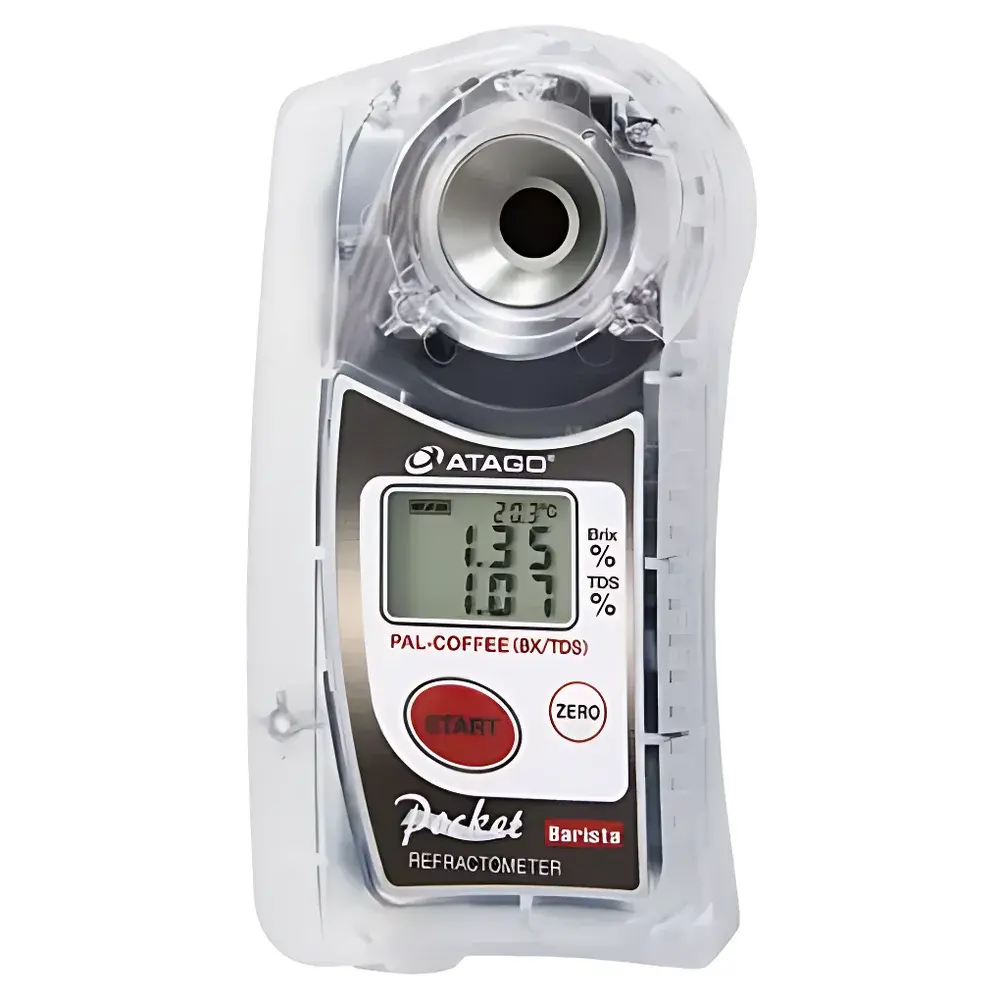
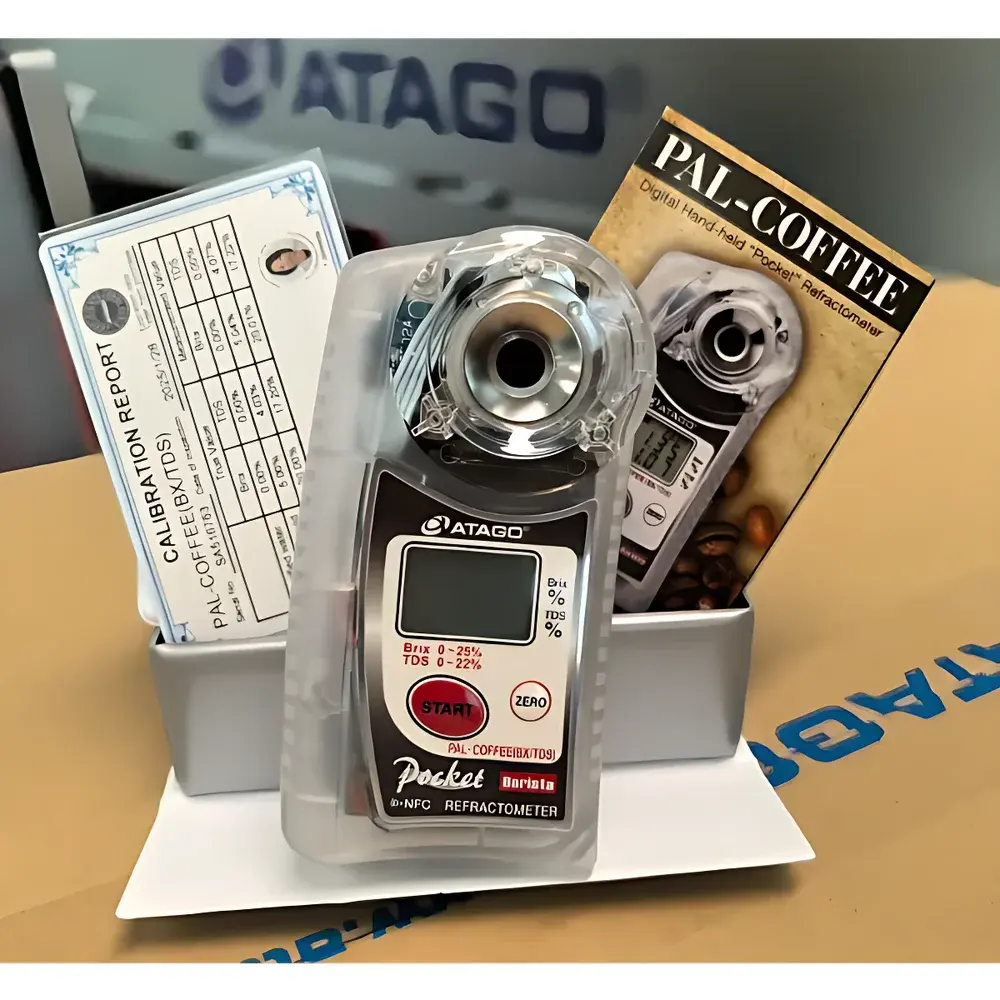
ATAGO PAL-COFFEE (BX/TDS) Handheld Digital Refractometer
| Brand | ATAGO |
|---|---|
| Origin | Japan |
| Model | PAL-COFFEE (BX/TDS) |
| Product Type | Handheld Refractometer |
| Temperature Compensation | Automatic (ATC, 10–100°C) |
| Display | Digital LCD |
| Measurement Range | Brix: 0.00–25.00%, TDS: 0.00–22.00% |
| Accuracy | ±0.10% for Brix, ±0.15% for TDS |
| Resolution | 0.01% |
| Power | 2 × AAA batteries |
| IP Rating | IP65 |
| Dimensions | 5.5 × 3.1 × 10.9 cm |
| Weight | 100 g (instrument only) |
Overview
The ATAGO PAL-COFFEE (BX/TDS) is a precision handheld digital refractometer engineered specifically for quantitative analysis of brewed coffee quality in professional roasting labs, specialty cafés, and Q-grading facilities. It operates on the principle of critical-angle refractometry: light passing through a coffee sample undergoes refraction at the prism–liquid interface, with the resulting angle directly correlating to the solution’s refractive index—and thus its total dissolved solids (TDS) concentration. Integrated automatic temperature compensation (ATC) ensures stable readings across 10–100°C, eliminating manual correction and supporting real-time measurement of hot espresso shots, pour-over brews, or cold brew concentrates. Unlike generic sugar refractometers, the PAL-COFFEE applies a proprietary calibration curve optimized for coffee matrix composition—accounting for non-sugar solutes (e.g., organic acids, melanoidins, caffeine) that influence refractive behavior differently than sucrose. This enables direct, traceable conversion from refractive index to both Brix-equivalent (%) and TDS (%), aligning with industry-standard protocols defined by the Specialty Coffee Association (SCA).
Key Features
- Dual-parameter readout: Simultaneous display of Brix (0.00–25.00%) and TDS (0.00–22.00%) with 0.01% resolution
- ATC-corrected optics: Built-in thermistor compensates for sample temperature drift within 10–100°C, conforming to ISO 2173 and AOAC 932.12 methodology requirements
- Rugged field-ready design: IP65-rated enclosure resists dust ingress and low-pressure water jets—suitable for high-humidity back-bar environments and mobile cupping sessions
- Zero-drift optical system: High-stability Abbe-type prism with anti-reflective coating ensures long-term repeatability (RSD < 0.2% over 100 measurements)
- One-button operation: No warm-up time; measurement completes in <1.5 seconds with audible confirmation tone
- Battery-efficient architecture: Two AAA cells support >10,000 measurements per set, with auto-power-off after 3 minutes of inactivity
Sample Compatibility & Compliance
The PAL-COFFEE is validated for use with filtered, espresso, AeroPress, French press, siphon, and cold brew extracts—regardless of roast level, origin, or processing method. Its optical path length and prism geometry minimize scattering effects from fine suspended particles (e.g., micro-fines below 10 µm), provided samples are free of visible sediment (centrifugation or filtration recommended for turbid cold brew). The instrument complies with ISO 2173:2003 (fruit juice refractometry), ASTM D1074-22 (bituminous materials, adapted for TDS correlation), and supports GLP documentation workflows via optional RS-232 output (with compatible data logger). While not FDA 21 CFR Part 11-certified as a standalone device, its measurement traceability aligns with SCA Cupping Protocol v2.0 and Q-Grader certification standards for TDS reporting.
Software & Data Management
The PAL-COFFEE operates as a stand-alone instrument without embedded software or cloud connectivity. All measurements are displayed locally on a high-contrast monochrome LCD with backlight (activated manually). For laboratory integration, optional RS-232 serial output (via PAL-COFFEE-PC adapter kit, sold separately) enables ASCII-formatted data streaming to Excel, LabChart, or LIMS platforms. Each reading includes timestamp, unit identifier (Brix/TDS), and temperature value—supporting audit-ready records compliant with ISO/IEC 17025 clause 7.7 (result reporting). No firmware updates or driver installation are required; the device maintains factory calibration for 12 months under normal use, with recalibration achievable using certified sucrose standards (NIST-traceable) or ATAGO’s PAL-COFFEE Calibration Solution (Cat. No. 4533-01).
Applications
- SCA Gold Cup validation: Verifying TDS (1.15–1.35%) and calculating extraction yield via [TDS × Brew Ratio] / Dose %
- Espresso profiling: Monitoring shot consistency across grinder adjustments, dose variations, and tamping pressure changes
- Batch QC in roasting facilities: Screening roast development impact on solubility and extraction efficiency
- Cupping lab standardization: Providing objective TDS baselines during sensory evaluation sessions
- Barista training: Visualizing cause–effect relationships between grind size, water temperature, contact time, and final TDS
- Research applications: Correlating refractometric data with HPLC-quantified chlorogenic acid or trigonelline concentrations in method development studies
FAQ
How does the PAL-COFFEE differentiate between Brix and TDS values?
The instrument uses two distinct calibration algorithms: one based on sucrose reference standards (Brix scale), and another derived from empirical regression against gravimetric TDS measurements of >200 roasted coffee extracts. This dual-curve approach accounts for the ~15–18% higher refractive contribution of coffee-specific solutes versus pure sucrose.
Can it measure undiluted espresso?
Yes—its extended Brix range (up to 25.00%) accommodates typical espresso TDS values of 8–12%, eliminating need for dilution and associated error propagation.
Is calibration required before each use?
No. Factory calibration remains stable for ≥12 months if stored at room temperature and cleaned with distilled water after each measurement. Daily verification with zero solution (distilled water) is recommended per SCA Best Practices.
Does ambient light affect accuracy?
No. The sealed optical path and internal LED illumination ensure immunity to external lighting conditions—including direct sunlight or dimly lit espresso bars.
What maintenance is required?
Wipe the prism surface with lens tissue and distilled water after each use. Avoid alcohol or abrasive cleaners. Store in the supplied protective case with desiccant pack to prevent humidity-induced fogging.





