
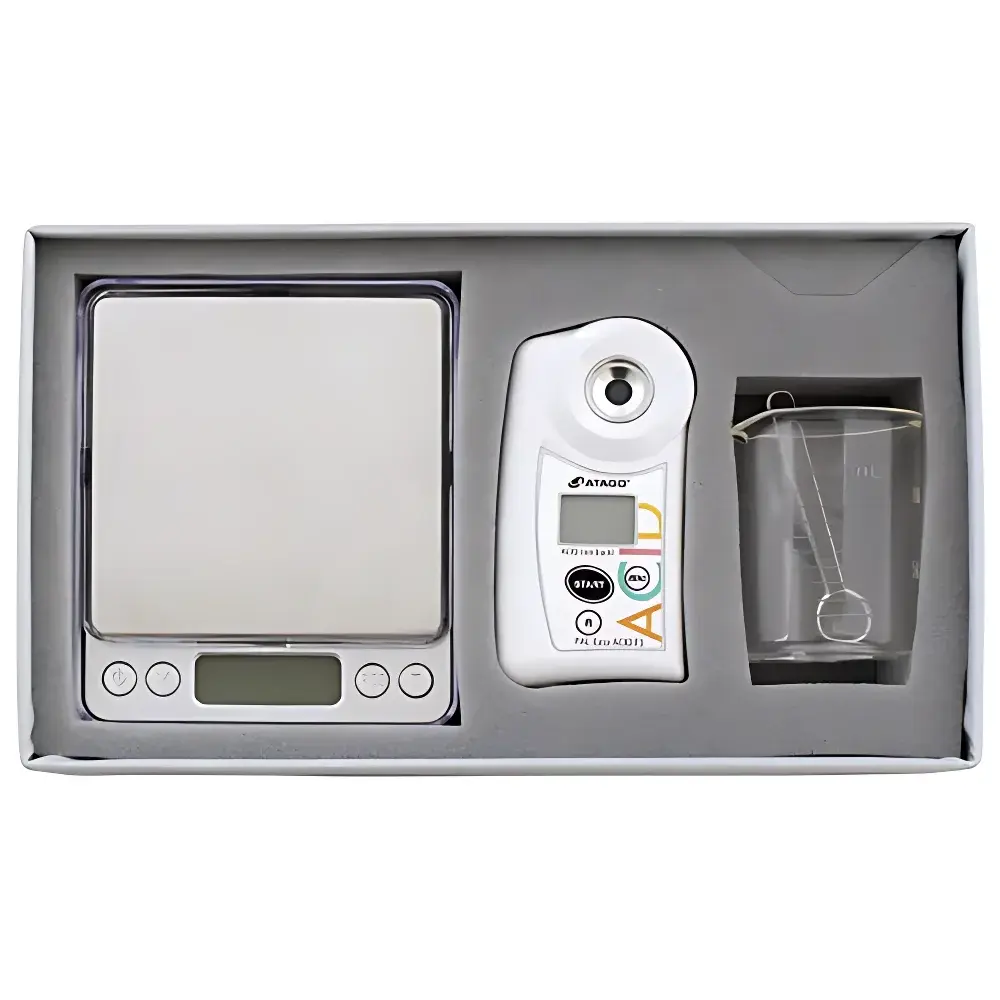
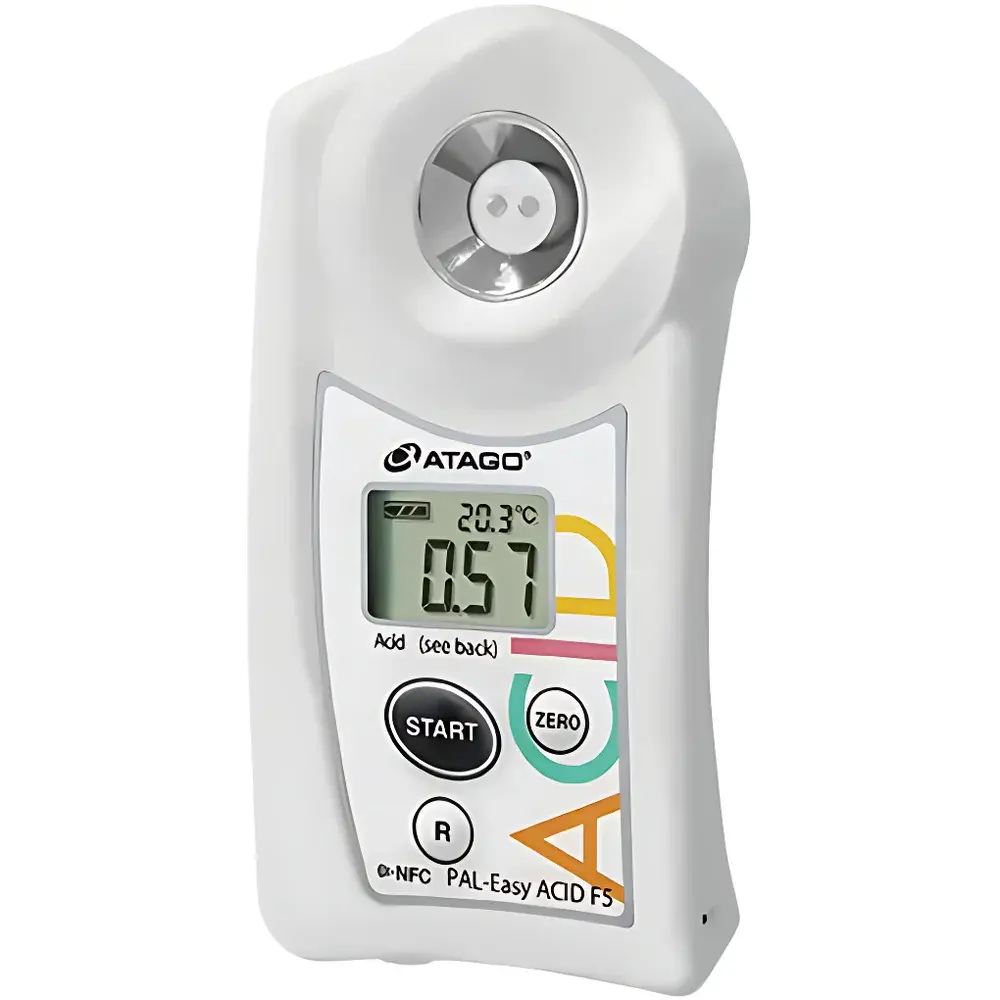
ATAGO PAL-Easy ACID F5 Portable Fruit Acidity Refractometer
| Brand | ATAGO |
|---|---|
| Origin | Japan |
| Model | PAL-Easy ACID F5 |
| Product Type | Handheld Refractometer |
| Display | Digital LCD |
| Temperature Compensation Range | 10–40°C |
| Measurement Range (Acid) | Citrus (low-acid): 0.10–4.00% |
| Citrus (high-acid) | 2.50–8.80% |
| Grape & Wine | 0.10–4.00% |
| Tomato | 0.10–3.00% |
| Strawberry | 0.10–3.50% |
| Blueberry | 0.10–4.00% |
| Accuracy | ±0.10% (0.10–1.00% acid) |
| Resolution | 0.01% (0.00–9.99%), 0.1% (≥10.0%) |
| IP Rating | IP65 |
| Dimensions | 5.5 × 3.1 × 10.9 cm |
| Weight | 100 g (instrument only) |
| Power | 2 × AAA alkaline batteries |
Overview
The ATAGO PAL-Easy ACID F5 is a dedicated handheld refractometer engineered for rapid, non-destructive quantification of titratable acidity in fresh fruits and fruit-derived liquids—including citrus, grapes, wine, tomatoes, strawberries, and blueberries. Unlike conventional titration-based methods requiring reagents, calibrated burettes, and trained personnel, the PAL-Easy ACID F5 leverages empirically validated optical correlation between refractive index and organic acid concentration (primarily citric, malic, and tartaric acids) under controlled temperature conditions. Its measurement principle is based on critical-angle refractometry: a small sample (0.3 mL) is placed on the sapphire prism; incident light undergoes total internal reflection at the prism-sample interface, and the resulting shadow line position—detected by a linear CCD sensor—is converted into an acid concentration value using pre-loaded, fruit-specific calibration curves. The instrument operates within a compensated temperature range of 10–40°C, eliminating manual correction while maintaining traceable repeatability across field and laboratory environments.
Key Features
- Fruit-specific dual-range acid measurement modes: low-acid (e.g., standard citrus, grape juice) and high-acid (e.g., concentrated citrus extracts), with independent calibration profiles stored in firmware
- Digital offset correction function (y = ax ± b) enabling quantitative alignment with reference titration data or alternative analytical units (e.g., g/L tartaric acid equivalents), supporting method transfer validation
- High-contrast backlit LCD display with automatic unit labeling (e.g., “% Acid – Citrus”) to prevent operator misinterpretation
- IP65-rated enclosure ensuring dust-tightness and resistance to water jets—suitable for humid packing houses, orchard-side grading stations, and winery crush pads
- Prism surface constructed from sapphire—chemically inert, scratch-resistant, and compatible with acidic fruit pulps without degradation over repeated use
- No consumables required: eliminates dependency on standardized NaOH solutions, phenolphthalein indicators, or pH meters subject to electrode drift
Sample Compatibility & Compliance
The PAL-Easy ACID F5 is validated for homogeneous liquid samples derived from macerated or centrifuged fruits—such as clarified grape must, filtered tomato juice, strained strawberry puree supernatant, and diluted blueberry extract. It is not intended for viscous, particulate-laden, or highly turbid suspensions without prior filtration (≤5 µm). While not certified to ISO 2173 or AOAC Official Method 978.17 (which govern titrimetric acid determination), the instrument supports GLP-aligned workflow documentation when used with its built-in offset function for correlation studies. Its design adheres to IEC 60529 (IP65) and JIS Z 8401 (numerical rounding for measurement reporting). Data output complies with basic traceability requirements for internal quality control logs, though it does not provide FDA 21 CFR Part 11–compliant electronic signatures or audit trails.
Software & Data Management
The PAL-Easy ACID F5 operates as a standalone instrument with no embedded Bluetooth, USB, or PC connectivity. All calibration parameters, offset coefficients, and measurement history are retained in non-volatile memory but are not exportable. Users manually record results in paper-based QC forms or third-party LIMS via transcription. For laboratories requiring digital integration, ATAGO recommends pairing the device with the optional PAL-PRINT portable thermal printer (sold separately) to generate time-stamped, tamper-evident result slips compliant with ISO/IEC 17025 documentation practices. Firmware updates are not field-upgradable; calibration verification must be performed using ATAGO-certified acid standard solutions (e.g., NIST-traceable citric acid reference materials).
Applications
- Rapid harvest maturity assessment: monitoring acid decline in citrus orchards to optimize picking windows
- Winery process control: verifying acid adjustment post-fermentation and pre-blending in red and white wine production
- Fruit processing QA: validating acid specifications for frozen concentrate, puree, and jam formulations per customer technical data sheets
- Research agronomy: conducting high-throughput acid profiling across germplasm trials without solvent waste or analytical turnaround delay
- Regulatory pre-screening: triaging lots that fall outside acceptable acid ranges before submission for official AOAC-certified titration
FAQ
Does the PAL-Easy ACID F5 measure pH or total titratable acidity (TTA)?
It measures TTA expressed as % w/w organic acid (citric/malic/tartaric equivalents), not pH. The correlation is empirical—not electrochemical—and requires fruit-type selection for accuracy.
Can I use it for apple or pineapple samples?
No. Calibration curves are strictly limited to citrus, grape/wine, tomato, strawberry, and blueberry. Apple and pineapple require distinct refractive–acid relationships not embedded in this model’s firmware.
Is automatic temperature compensation (ATC) equivalent to full thermoregulation?
No. ATC compensates for sample temperature-induced refractive index shifts within 10–40°C but does not actively heat or cool the prism. Samples outside this range must be equilibrated prior to measurement.
How often should I verify calibration?
ATAGO recommends daily verification using certified acid standard solutions before first use and after any prism cleaning. Full recalibration requires return to an authorized ATAGO service center.
What does the ±10% relative accuracy mean above 1.00% acid?
It reflects expanded uncertainty due to non-linear optical response at higher concentrations; users should treat values >3.50% as semi-quantitative screening indicators unless corroborated by titration.





