
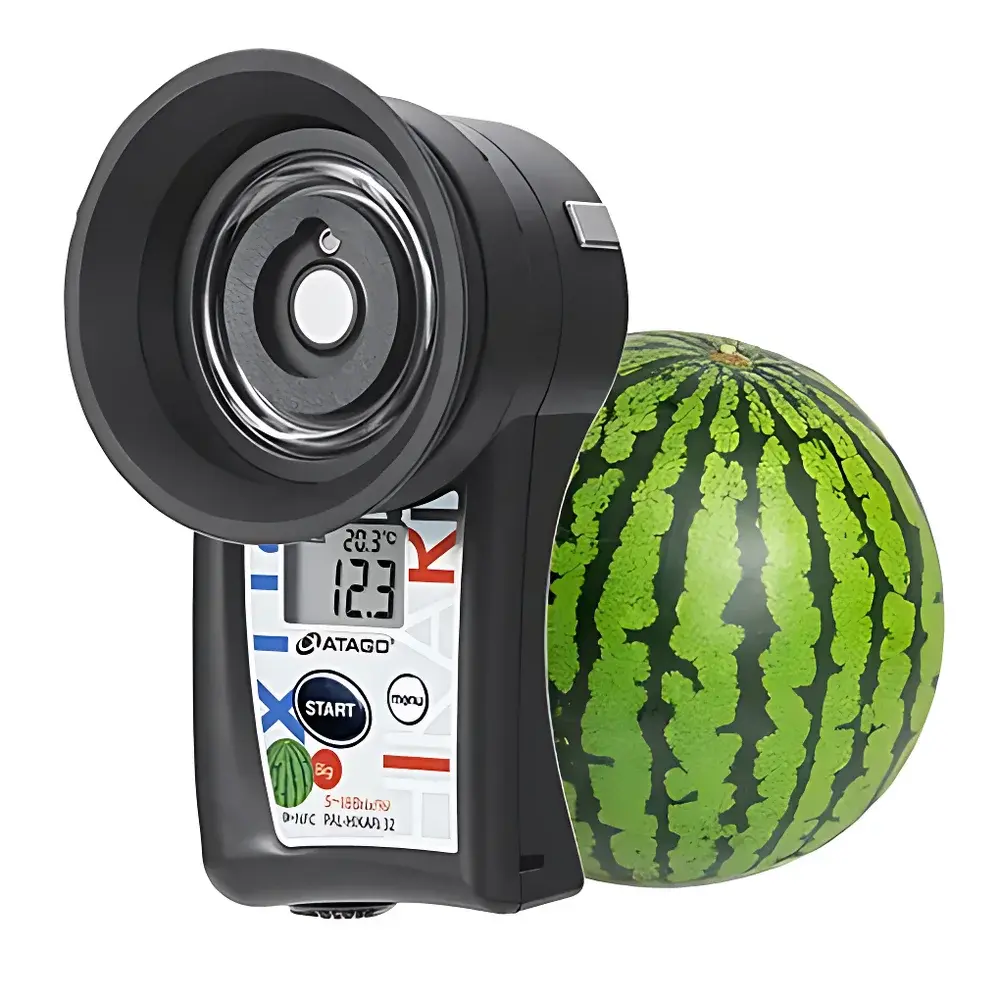
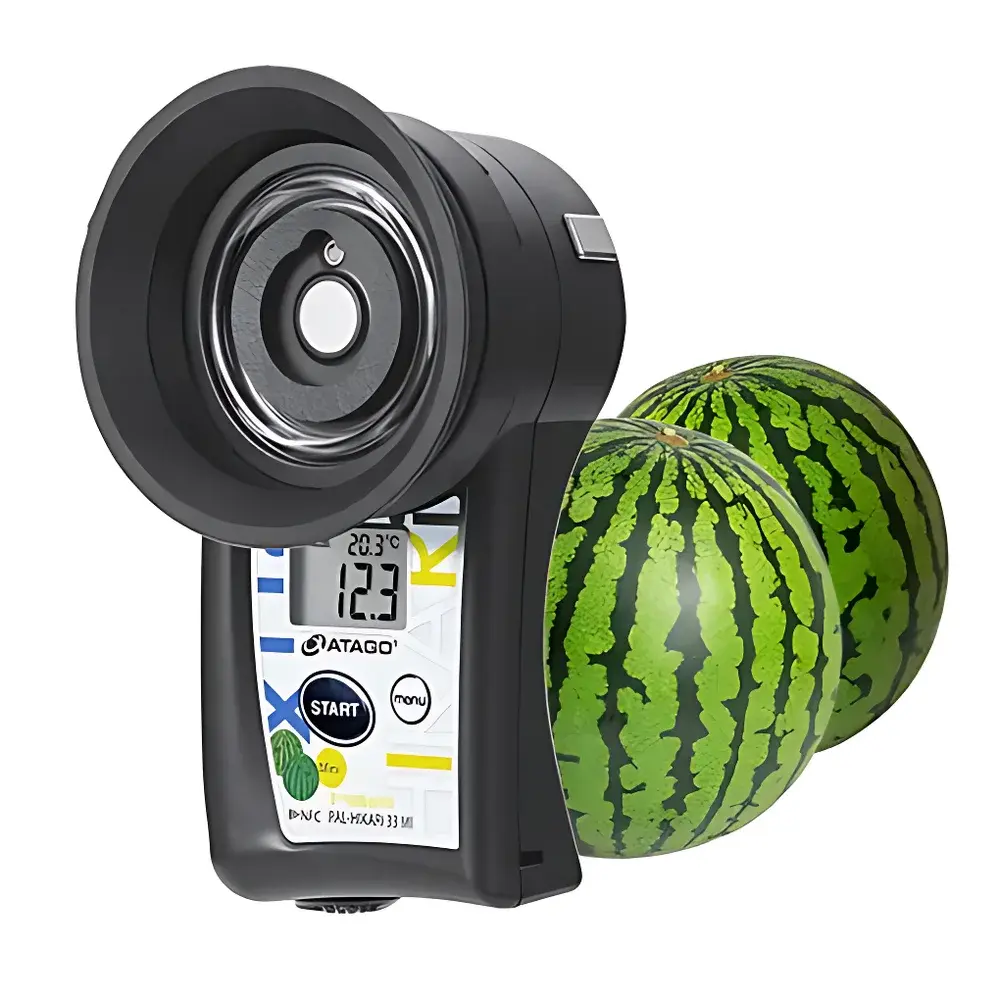
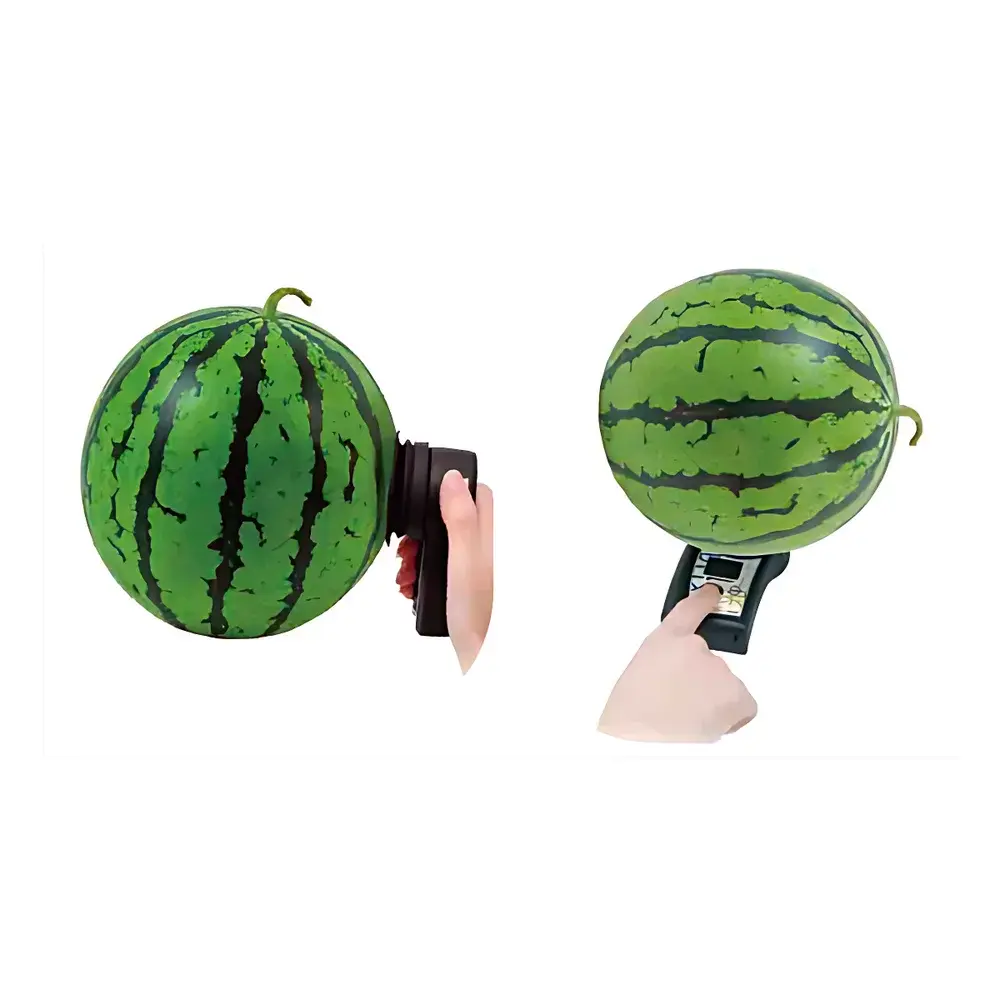
ATAGO PAL-HIKARi 32 Non-Destructive Watermelon Refractometer
| Brand | ATAGO |
|---|---|
| Origin | Japan |
| Instrument Type | Non-Destructive |
| Model | PAL-HIKARi 32 |
| Measurement Principle | Near-Infrared (NIR) Absorption Spectroscopy |
| Measuring Range | 5.0–18.0 °Brix |
| Resolution | 0.1 °Brix |
| Temperature Compensation | Automatic (10.0–40.0 °C) |
| Target Fruit Diameter | 200–250 mm |
| Operating Environment | 10–40 °C, <90% RH (non-condensing) |
| Power Source | 2 × AAA batteries |
| Weight | Approx. 180 g (with batteries) |
| Compliance | CE marked, RoHS compliant |
Overview
The ATAGO PAL-HIKARi 32 is a dedicated non-destructive refractometer engineered for rapid, in-situ sugar content (°Brix) assessment of intact watermelons. Unlike conventional handheld refractometers requiring juice extraction—or destructive near-infrared (NIR) spectrometers requiring calibration transfer across cultivars—the PAL-HIKARi 32 employs proprietary NIR absorption spectroscopy at optimized wavelengths sensitive to C–H and O–H vibrational overtones in sucrose, glucose, and fructose. The instrument operates on the principle that spectral absorbance intensity at specific NIR bands correlates linearly with soluble solids concentration in the subsurface mesocarp tissue (5–8 mm depth), provided fruit morphology and skin thickness remain within defined geometric parameters (200–250 mm diameter, smooth rind surface). This enables field-deployable, operator-independent measurement without compromising fruit integrity, shelf life, or post-harvest quality—critical for pre-harvest maturity scheduling, lot segregation, and premium-grade certification.
Key Features
- Non-invasive measurement: No cutting, piercing, or juice expression required—preserves fruit marketability and eliminates cross-contamination risk.
- Optimized optical interface: Integrated silicone-sealed probe head with conformal sponge gasket ensures consistent contact pressure and minimizes air-gap artifacts across variable rind curvature.
- Real-time temperature compensation: Built-in thermistor continuously monitors ambient and surface temperature; algorithm applies empirically derived correction coefficients per ISO 21527-1:2020 Annex B for °Brix accuracy stability across 10.0–40.0 °C.
- Ergonomic single-hand operation: Laterally positioned tactile button, low-profile housing (128 × 58 × 35 mm), and balanced weight distribution (180 g) reduce operator fatigue during high-throughput orchard or packing-line use.
- Robust environmental rating: IP54-rated enclosure resists dust ingress and incidental water splashing—suitable for humid greenhouse, field, or wet-packhouse environments.
- Battery efficiency: Dual AAA alkaline cells support ≥5,000 measurements per set; auto-power-off after 3 minutes of inactivity.
Sample Compatibility & Compliance
The PAL-HIKARi 32 is validated exclusively for intact, commercially mature watermelons (Citrullus lanatus) with diameters between 200 mm and 250 mm and uniform rind thickness (3–8 mm). It is not intended for muskmelon, honeydew, or other cucurbits due to divergent spectral absorption profiles and tissue heterogeneity. Calibration is factory-established using NIST-traceable sucrose reference standards and verified against gravimetrically prepared aqueous solutions per AOAC Official Method 932.12. Device compliance includes CE marking under Directive 2014/30/EU (EMC) and 2011/65/EU (RoHS), and conforms to IEC 61000-4-2 (ESD immunity) and IEC 60529 (IP54). While not FDA 21 CFR Part 11–certified (as it lacks audit trail or user authentication), raw measurement data may be exported via optional RS-232 interface for integration into GLP-compliant laboratory information management systems (LIMS).
Software & Data Management
The PAL-HIKARi 32 operates as a standalone instrument with no embedded firmware update capability or onboard data logging. All measurements are displayed in real time on a high-contrast LCD (128 × 64 pixels) with backlight. For traceable recordkeeping, optional ATAGO DataLink software (v3.2+) enables serial transmission of timestamped °Brix values, ambient temperature, and device ID to Windows-based PCs. Export formats include CSV and Excel-compatible .xls; metadata fields support manual entry of lot number, harvest date, and operator ID. Data integrity is maintained through CRC-16 checksum validation during transmission. No cloud connectivity or remote diagnostics are implemented—ensuring data sovereignty and alignment with industrial cybersecurity best practices (IEC 62443-3-3 Level 1).
Applications
- Pre-harvest decision support: Quantify sugar accumulation trends across vine rows to optimize harvest timing and minimize under-/over-ripeness.
- Post-harvest quality sorting: Classify watermelons into commercial grades (e.g., “Premium” ≥12.0 °Brix, “Standard” 9.0–11.9 °Brix) without yield loss from sampling.
- Supply chain traceability: Generate batch-level sweetness reports for export documentation, retailer specifications (e.g., Japanese JAS Standard for “High-Sugar Watermelon”), and consumer-facing QR-code labeling.
- Research & breeding programs: Screen germplasm for sugar inheritance traits under field conditions without destructive phenotyping.
- Extension education: Demonstrate objective ripeness metrics during grower workshops—reducing reliance on subjective indicators like tendril desiccation or ground spot color.
FAQ
Can the PAL-HIKARi 32 measure other fruits such as apples or grapes?
No. Its optical model and calibration are specific to watermelon mesocarp anatomy and rind optical properties. Using it on other species introduces unquantified bias and invalidates stated accuracy specifications.
Does surface moisture affect measurement accuracy?
Yes. Excess water on the rind causes scattering and attenuates NIR signal penetration. Wipe the measurement site dry before contact.
Is calibration verification required before daily use?
ATAGO recommends verifying performance with the included 10.0 °Brix standard gel prior to first use each day, especially when ambient temperature deviates >5 °C from prior session.
What is the measurement repeatability under controlled conditions?
At 25 °C and constant contact pressure, coefficient of variation (CV) across 10 replicate measurements on the same fruit location is ≤1.2% (n=30, across 3 instruments).
How does rind thickness influence results?
Measurements become unreliable if rind exceeds 8 mm or contains significant air pockets (e.g., hollow heart). The instrument assumes homogeneous light transmission through the rind layer—verified during factory calibration only for typical commercial cultivars (e.g., ‘Sugar Baby’, ‘Crimson Sweet’).




