
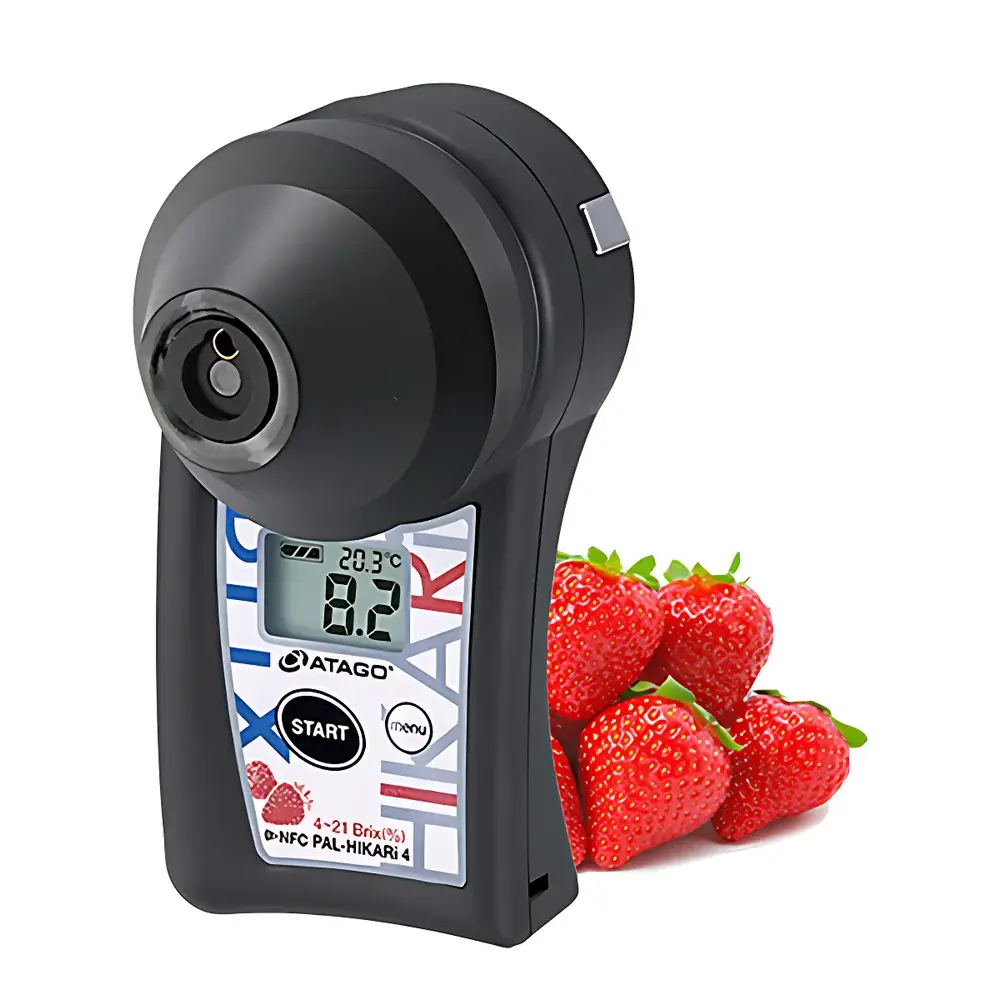
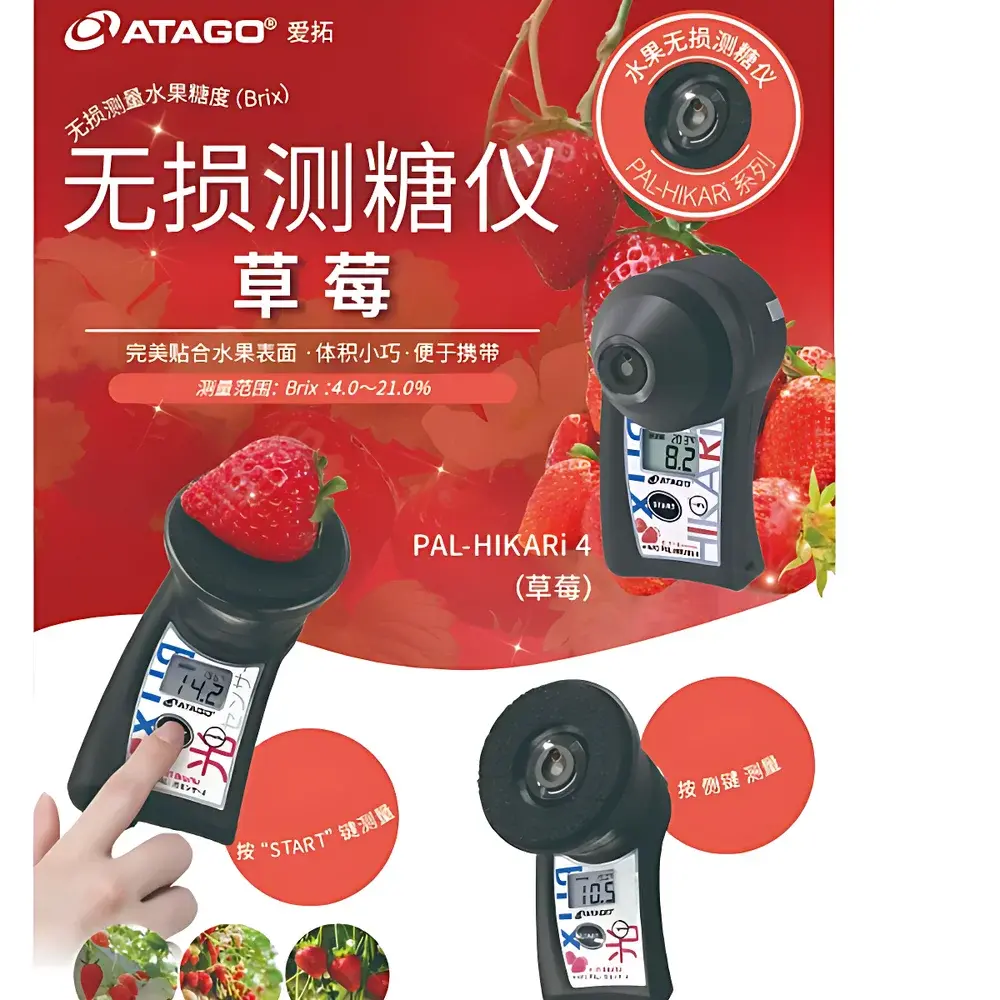
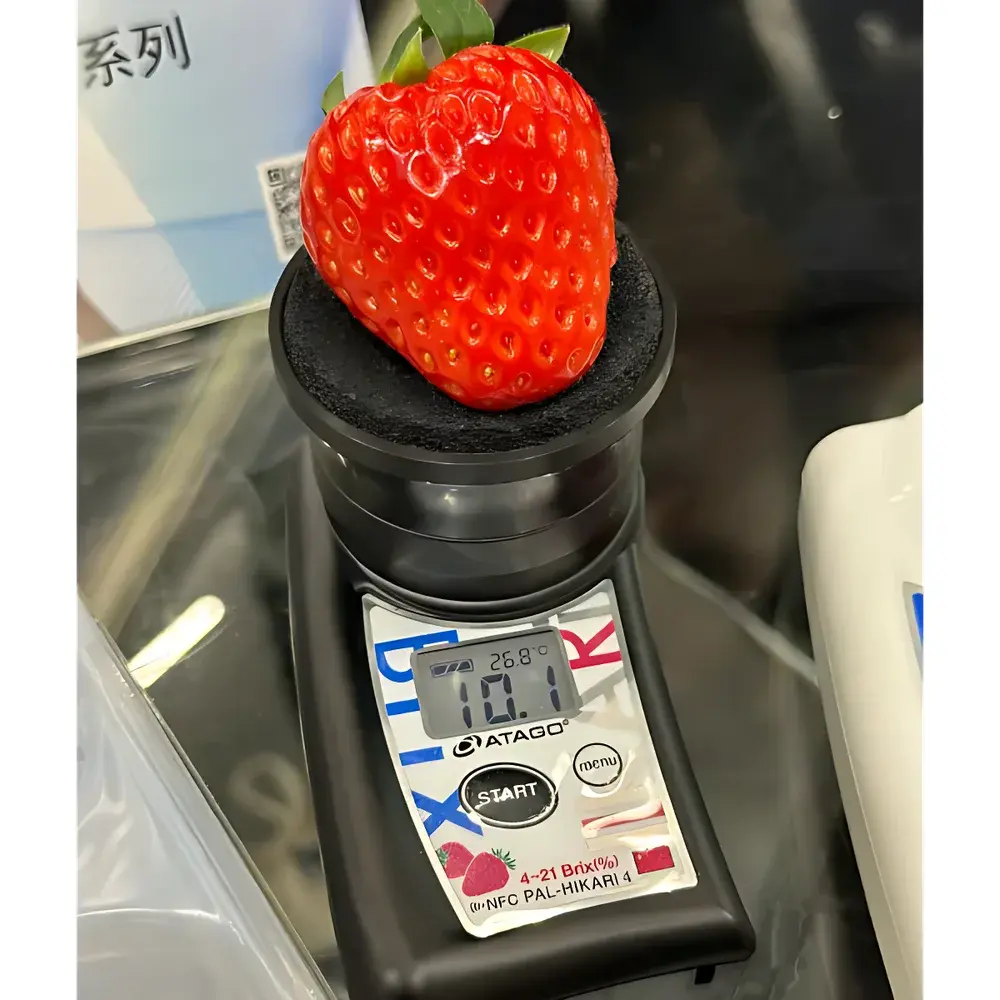
ATAGO PAL-HIKARi 4 Non-Destructive Strawberry Refractometer
| Brand | ATAGO |
|---|---|
| Origin | Japan |
| Model | PAL-HIKARi 4 (Strawberry) |
| Measurement Principle | Near-Infrared (NIR) Reflectance Spectroscopy |
| Instrument Type | Non-Destructive Saccharimeter |
| Measuring Range | Brix 4.0–21.0% |
| Accuracy | ±1.5% Brix (varies with cultivar and ambient conditions) |
| Resolution | 0.1% Brix |
| Repeatability | ±1.0% Brix |
| Automatic Temperature Compensation | 5.0–30.0°C |
| Protection Rating | IP64 |
| Power Supply | Two AAA alkaline batteries |
| Dimensions & Weight | 6.1 × 6.4 × 11.5 cm, 153 g (instrument only) |
Overview
The ATAGO PAL-HIKARi 4 Non-Destructive Strawberry Refractometer is a handheld, portable optical instrument engineered for rapid, in-situ quantification of soluble solids content (SSC), expressed as Brix (% w/w), directly on intact strawberry fruit. Unlike conventional refractometers requiring juice extraction or destructive sampling, the PAL-HIKARi 4 employs near-infrared (NIR) reflectance spectroscopy at optimized wavelengths to probe subsurface tissue optical properties—primarily absorption and scattering related to sucrose, glucose, and fructose concentrations. This non-contact, non-invasive methodology preserves fruit integrity, enabling longitudinal monitoring of ripening dynamics across orchard plots, post-harvest storage trials, and breeding programs without introducing sampling bias or accelerating spoilage. The device operates on a calibrated empirical model derived from extensive spectral correlation studies across multiple strawberry cultivars grown under controlled horticultural conditions, ensuring robustness against minor surface irregularities and natural cuticular wax variation.
Key Features
- True non-destructive measurement: No fruit puncturing, peeling, or juice expression required—ideal for high-value, pre-market, or seed-stock evaluation.
- Integrated NIR optical sensor with dual-wavelength detection optimized for anthocyanin-rich strawberry epidermis and underlying parenchyma.
- Real-time automatic temperature compensation (5.0–30.0°C) using embedded thermistor, minimizing thermal drift during field deployment.
- IP64-rated enclosure ensures resistance to dust ingress and water splashes—suitable for greenhouse, packinghouse, and open-field use.
- Compact ergonomic design (153 g) with intuitive single-button operation and LCD display for immediate Brix readout (0.1% resolution).
- Battery-powered operation (2×AAA alkaline) supports >5,000 measurements per set, with low-power standby mode and auto-shutdown after 3 minutes of inactivity.
Sample Compatibility & Compliance
The PAL-HIKARi 4 is validated exclusively for intact, mature Fragaria × ananassa fruit with typical surface morphology (e.g., ‘Albion’, ‘Seascape’, ‘Chandler’). It is not intended for other berry species, immature green fruit, or fruits exhibiting severe bruising, cracking, or fungal lesions. Calibration traceability aligns with ATAGO’s internal reference standard protocol, which cross-validates against gravimetrically prepared sucrose solutions (NIST-traceable) and homogenized fruit juice samples measured via laboratory-grade Abbe refractometry (ISO 2173:2003). While not certified for regulatory submission under FDA 21 CFR Part 11 or EU Annex 11, the instrument meets general GLP principles for field-based quality assessment when used within its defined operational envelope and documented environmental acclimation procedures (fruit equilibrated to measurement ambient for ≥15 min prior to testing).
Software & Data Management
The PAL-HIKARi 4 operates as a standalone field instrument with no onboard data logging or Bluetooth/Wi-Fi connectivity. All measurements are displayed in real time; users must manually record values or integrate with external digital notebooks. For batch documentation, ATAGO recommends pairing the device with its optional PAL-PRINT portable thermal printer (sold separately) for timestamped hardcopy output. Data export to LIMS or statistical analysis platforms (e.g., JMP, Minitab) requires manual transcription or third-party OCR integration. Firmware updates are not supported—the optical calibration is factory-sealed and immutable to preserve metrological stability over the instrument’s service life (typical MTBF > 50,000 actuations).
Applications
- On-tree ripeness assessment for precision harvest scheduling in commercial strawberry production.
- Post-harvest quality control during cold chain validation and shelf-life studies.
- Phenotypic screening in strawberry breeding programs targeting sugar accumulation kinetics.
- Extension service support for grower education on crop nutrition–SSC relationships.
- Academic research in plant physiology, postharvest science, and NIR spectroscopy method development.
- Contract testing labs performing routine SSC verification under ISO/IEC 17025-accredited scopes (when combined with documented SOPs and uncertainty budgets).
FAQ
Can the PAL-HIKARi 4 be used on other fruits such as blueberries or raspberries?
No. The optical calibration and spectral algorithm are specifically trained on strawberry tissue optical properties and are not transferable to other small fruits due to differences in skin thickness, anthocyanin distribution, and internal light scattering behavior.
Does the instrument require periodic recalibration by the user?
No. The PAL-HIKARi 4 features a sealed, factory-calibrated optical path. ATAGO does not provide user-accessible recalibration routines; recalibration must be performed by authorized ATAGO service centers using proprietary reference standards.
How does ambient lighting affect measurement accuracy?
The built-in NIR source dominates ambient visible/NIR background radiation; however, direct exposure to intense sunlight (>80,000 lux) may saturate the detector. Measurements should be taken in shaded conditions or under consistent artificial lighting for optimal reproducibility.
Is the device compliant with international food safety standards?
The PAL-HIKARi 4 is not a food safety analyzer (e.g., pathogen or pesticide detection); it measures only soluble solids. Its use supports Good Agricultural Practice (GAP) and HACCP prerequisite programs where SSC serves as a process control indicator—not a safety-critical parameter.
What is the recommended procedure for cleaning the optical window?
Wipe gently with lens-grade tissue moistened with deionized water or 99% isopropyl alcohol. Avoid abrasive cloths, acetone, or ultrasonic cleaning, which may damage anti-reflective coatings.





