
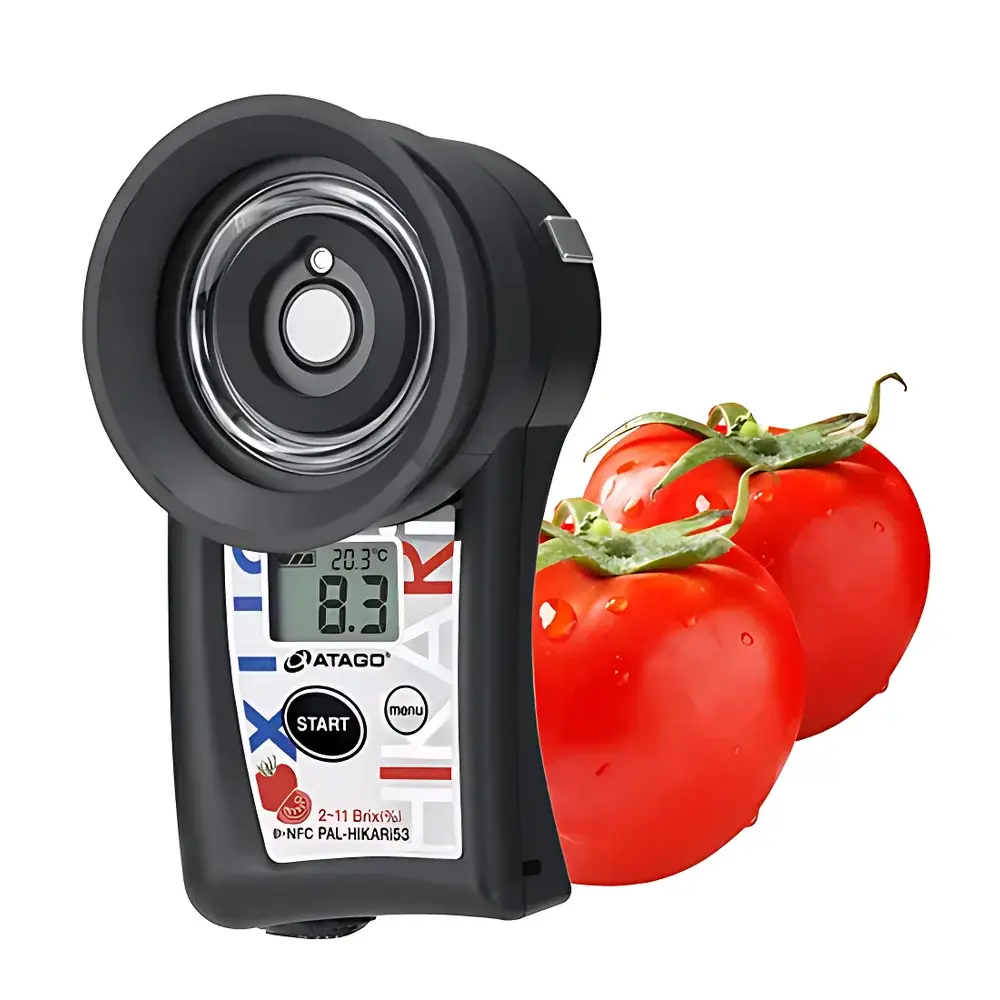
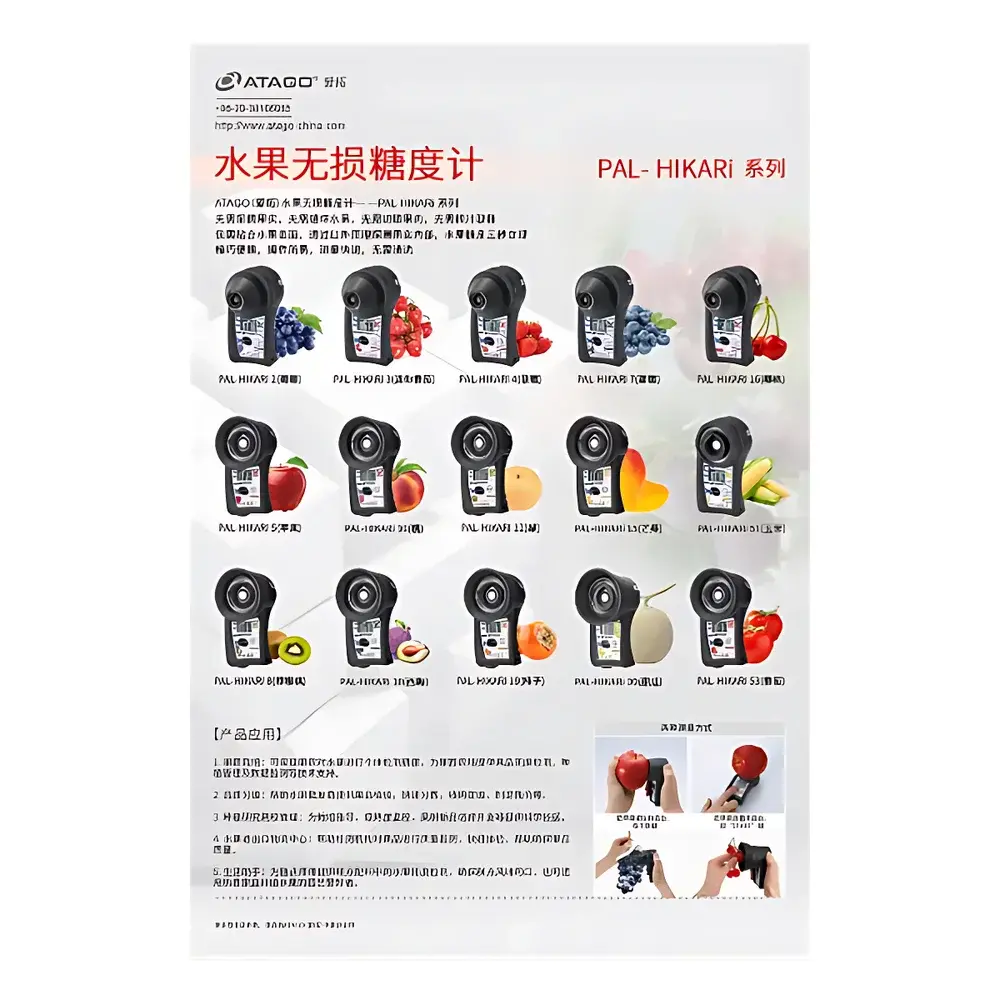
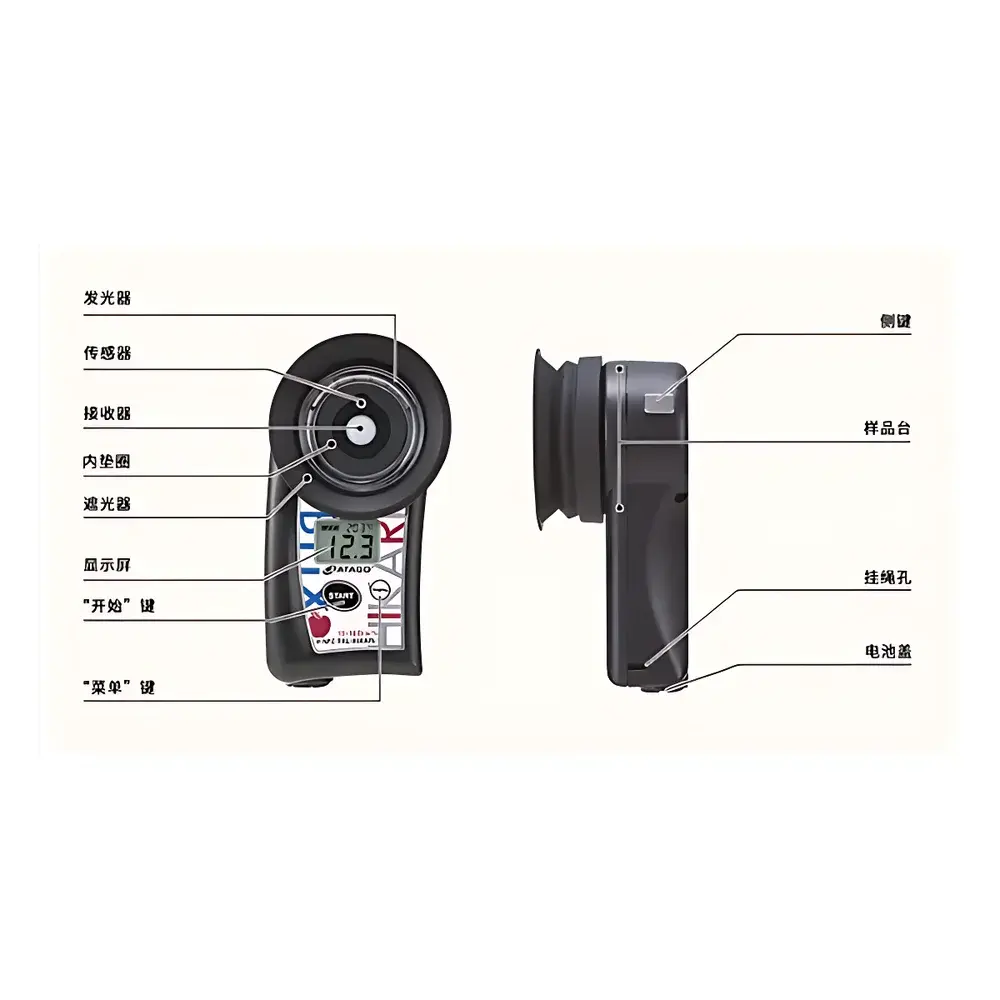
ATAGO PAL-HIKARi 53 Non-Destructive Tomato Refractometer
| Brand | ATAGO |
|---|---|
| Origin | Japan |
| Model | PAL-HIKARi 53 (Tomato-Specific) |
| Measurement Principle | Near-Infrared (NIR) Absorption Spectroscopy |
| Measurement Range | Brix 2.0–11.0% |
| Accuracy | ±1.5% Brix (varies with tomato cultivar and ambient thermal equilibrium) |
| Resolution | 0.1% Brix |
| Automatic Temperature Compensation | 15.0–35.0°C |
| Ingress Protection Rating | IP64 |
| Power Supply | Two AAA alkaline batteries |
| Dimensions (L×W×H) | 11.5 × 6.1 × 4.4 cm |
| Weight | 120 g (instrument only) |
| Instrument Type | Non-destructive, in-situ fruit sugar content analyzer |
Overview
The ATAGO PAL-HIKARi 53 is a handheld, non-destructive refractometer engineered specifically for rapid, in-field quantification of soluble solids content (SSC), expressed as Brix (% w/w), in intact tomato fruits. Unlike conventional destructive methods requiring juice extraction or tissue homogenization, the PAL-HIKARi 53 employs near-infrared (NIR) absorption spectroscopy at optimized wavelengths sensitive to C–O and O–H bond vibrations in sucrose, glucose, and fructose. The device measures diffuse reflectance from the epidermal surface without penetration, abrasion, or mechanical stress—preserving fruit integrity for post-measurement ripening assessment, shelf-life trials, or commercial sale. Its optical architecture incorporates a calibrated reference channel and temperature-compensated photodiode array, enabling stable readings across variable orchard and greenhouse microclimates. Designed for agricultural field use, it complies with ISO 2173:2003 (fruit and vegetable products — determination of soluble solids content — refractometric method) as a validated non-invasive proxy, with empirical correlation established against laboratory-grade digital refractometers (e.g., ATAGO PR-101α) using standardized tomato cultivars (e.g., ‘Ailsa Craig’, ‘Roma’, ‘Cherokee Purple’).
Key Features
- Tomato-optimized NIR optical path: Wavelength selection and calibration matrix derived from spectral libraries of >120 tomato cultivars across green-to-red ripening stages.
- Non-invasive measurement protocol: No skin puncture, no juice expression, no sample preparation—enables longitudinal monitoring of individual fruits over time.
- Integrated automatic temperature compensation (ATC): Compensates for ambient fruit surface temperature drift between 15.0°C and 35.0°C, minimizing thermal artifact in Brix estimation.
- Rugged field-ready design: IP64-rated enclosure resists dust ingress and water splashing; impact-resistant polycarbonate housing tested per IEC 60068-2-75 (hammer impact test).
- Low-power operation: Dual AAA alkaline battery configuration supports ≥5,000 measurements per set under typical field conditions (25°C, 60% RH).
- Ergonomic one-hand operation: Compact form factor (11.5 × 6.1 × 4.4 cm) and tactile button layout enable reliable use with gloves in humid or dusty environments.
Sample Compatibility & Compliance
The PAL-HIKARi 53 is validated exclusively for intact, unblemished tomato fruits with smooth, taut pericarp surfaces (diameter ≥45 mm, surface curvature radius ≥25 mm). It is not suitable for cherry tomatoes (<25 mm diameter), cracked or russeted fruit, or post-harvest storage samples exhibiting significant cuticle dehydration. Calibration traceability aligns with JIS Z 8015 (Japanese Industrial Standard for optical instruments) and supports GLP-compliant data collection when used with documented measurement SOPs. While not FDA 21 CFR Part 11 certified (as a standalone field instrument), raw Brix values generated may be imported into LIMS or ELN platforms compliant with 21 CFR Part 11 for audit-trail-enabled quality records. Meets ISO/IEC 17025:2017 clause 7.2.2 requirements for field-deployable measurement equipment used in accredited testing laboratories.
Software & Data Management
The PAL-HIKARi 53 operates as a self-contained measurement terminal with no onboard data logging or Bluetooth/Wi-Fi connectivity. All measurements are displayed in real time on a high-contrast LCD screen with backlighting (operable at ≤10 lux ambient light). For traceable recordkeeping, users may manually transcribe results into digital spreadsheets or integrate with third-party agricultural data platforms (e.g., FarmLogs, AgriWebb) via CSV export from companion desktop software (ATAGO Data Manager v3.2, sold separately). The instrument supports user-defined batch ID tagging via alphanumeric keyboard input (optional accessory), enabling linkage to orchard block, harvest date, and cultivar metadata during field surveys. Firmware updates are performed via USB-C interface using ATAGO’s certified calibration utility.
Applications
- On-farm ripeness optimization: Enables real-time SSC mapping across trellised rows to determine optimal harvest windows, reducing pre-harvest losses and improving post-harvest consistency.
- QC sampling in packinghouses: Facilitates rapid lot-level screening (n ≥30/lot) prior to grading, aligning with USDA Grade Standards for Tomatoes (7 CFR §51.1840) and EU Regulation (EC) No 1128/2010.
- Cultivar development trials: Supports quantitative phenotyping in breeding programs by tracking SSC progression across generations under controlled irrigation and nutrient regimes.
- Export compliance verification: Used by phytosanitary inspectors at border control points to verify minimum Brix thresholds stipulated in bilateral horticultural trade agreements (e.g., Japan–Australia Economic Partnership Agreement Annex 3B).
- Research-grade longitudinal studies: Permits repeated non-lethal measurements on the same fruit over 7–14 days, supporting kinetic modeling of sugar accumulation dynamics under varying light/temperature treatments.
FAQ
Can the PAL-HIKARi 53 measure cherry tomatoes or grape tomatoes?
No. The optical aperture and calibration model are validated only for standard round or oblong tomatoes (≥45 mm diameter). Smaller fruit exhibit excessive edge diffraction and insufficient signal-to-noise ratio.
Does surface moisture affect measurement accuracy?
Yes. Condensation, dew, or irrigation residue must be gently blotted with lint-free cloth prior to measurement. Residual water film alters NIR reflectance and introduces systematic bias ≥0.8% Brix.
Is calibration required before each use?
No. The unit ships with factory calibration verified against NIST-traceable sucrose standards. Field recalibration is recommended every 6 months or after 10,000 measurements using ATAGO’s PAL-HIKARi Calibration Kit (Cat. No. 8553-CK).
How does ambient temperature influence repeatability?
Instrument internal temperature stabilization requires ≥90 seconds after power-on in environments 35°C. For highest reproducibility, allow fruit to equilibrate to measurement environment for ≥15 minutes prior to scanning.
Can data be exported directly to Excel or LIMS?
Not natively. Manual entry or integration via ATAGO Data Manager v3.2 (Windows-only) is required for structured export. No API or direct database push capability is embedded in the device firmware.




