
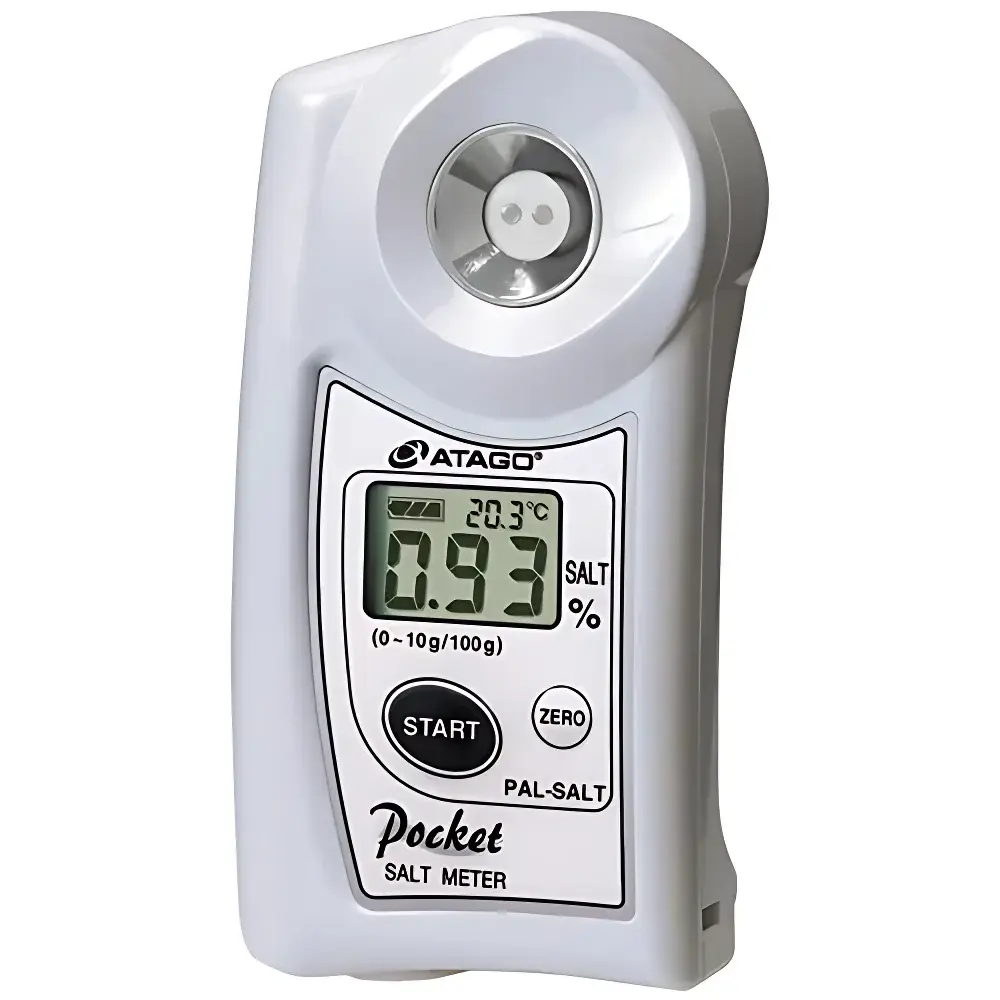
ATAGO PAL-SALT Conductivity-Based Salinometer
| Brand | ATAGO |
|---|---|
| Origin | Japan |
| Model | PAL-SALT |
| Measurement Range | 0.00–10.0% (w/w) NaCl |
| Resolution | 0.01% (0.00–2.99%), 0.1% (3.0–10.0%) |
| Accuracy | ±0.05% (0.00–0.99%), ±5% rel. (1.00–10.0%) |
| Temperature Compensation | 10–40°C (auto) |
| Power | 2× AAA alkaline batteries |
| IP Rating | IP65 |
| Dimensions | 55 × 31 × 109 mm |
| Weight | 100 g (instrument only) |
Overview
The ATAGO PAL-SALT is a handheld, conductivity-based salinometer engineered for rapid, field-deployable quantification of sodium chloride concentration in aqueous solutions. Unlike optical refractometric or titrimetric methods, the PAL-SALT employs electrical conductivity measurement—a principle grounded in the linear correlation between ionic strength and conductance in dilute NaCl solutions under controlled temperature conditions. The instrument incorporates automatic temperature compensation (ATC) across 10–40°C to correct for thermal drift in conductivity response, ensuring consistent output regardless of ambient or sample thermal variation. A defining feature is its integrated 10-fold dilution correction algorithm: users pre-dilute samples 1:10 (v/v), measure the diluted solution, and the device applies an embedded calibration curve—validated against reference standard solutions—to directly display the undiluted sample’s salt concentration (% w/w). This eliminates manual calculation, reduces operator error, and avoids reagent consumption associated with classical argentometric titration per ASTM D1141 or ISO 9562.
Key Features
- Conductivity-based measurement with built-in 10× dilution compensation logic for direct % w/w NaCl readout
- Automatic temperature compensation (10–40°C) using high-stability thermistor circuitry
- Dual-resolution display: 0.01% resolution below 3.00%, 0.1% above—optimized for both low-concentration process control and high-range brine verification
- Rugged, pocket-sized housing rated IP65 for dust ingress protection and resistance to water jets—suitable for factory floors, food processing lines, and outdoor field use
- Low-power design powered by two standard AAA alkaline batteries, supporting >10,000 measurements per set
- No consumables, no reagents, no calibration fluids required beyond routine verification with certified NaCl standards
Sample Compatibility & Compliance
The PAL-SALT is validated for homogeneous aqueous NaCl solutions, including brines, pickling liquors, soy sauce, fish sauce, dairy whey, and desalination feed streams. It is not intended for non-ionic solutes (e.g., sucrose), highly viscous media (>100 mPa·s), or suspensions containing particulates >5 µm that may coat electrodes. While not a GLP-compliant primary standard, the device meets functional requirements for in-process quality checks aligned with ISO 2173 (fruit and vegetable products), AOAC 973.40 (salt in meat), and FDA seafood HACCP guidelines. Its traceable measurement chain supports internal audit documentation when used with documented standard verification protocols.
Software & Data Management
The PAL-SALT operates as a standalone instrument with no onboard data logging, Bluetooth, or USB interface. All measurement data remain on-device only during active use and are not retained after power-off. For regulated environments requiring electronic records, users must manually transcribe results into LIMS or paper-based batch records. The absence of digital connectivity ensures compliance with facilities restricting wireless devices in explosive atmospheres (ATEX Zone 2) or electromagnetic-sensitive labs. Calibration verification is performed using NIST-traceable NaCl reference standards (e.g., 1.00%, 5.00%, and 8.00% w/w); no firmware updates or software licensing is required over the instrument’s service life.
Applications
- Food & beverage QC: Rapid verification of salt content in cured meats, fermented sauces, canned vegetables, and ready-to-eat meals
- Aquaculture & marine biology: Field monitoring of salinity in hatchery tanks, recirculating aquaculture systems (RAS), and estuarine sampling
- Pharmaceutical excipient control: On-line checking of saline solution concentrations during IV bag preparation or buffer formulation
- Industrial cleaning validation: Quantifying residual NaCl on metal surfaces post-rinse in automotive or aerospace manufacturing
- Academic teaching labs: Demonstrating conductivity–concentration relationships and dilution mathematics without hazardous reagents
FAQ
Does the PAL-SALT require calibration before each use?
No—routine calibration is not required. However, daily verification using at least one certified NaCl standard (e.g., 2.5% w/w) is recommended for critical applications.
Can it measure seawater directly?
No. Seawater contains multiple ions (Mg²⁺, Ca²⁺, K⁺, SO₄²⁻) that deviate from pure NaCl conductivity behavior. The PAL-SALT is calibrated exclusively for NaCl; use a dedicated seawater salinometer (e.g., based on CTD or refractive index) for marine applications.
What is the minimum sample volume needed?
Approximately 0.3 mL is sufficient to fully immerse the stainless-steel conductivity cell; excess volume is unnecessary and may cause spillage during handheld operation.
Is the device compliant with FDA 21 CFR Part 11?
No—it lacks electronic record generation, audit trail, or user authentication capabilities. It is classified as a Class I general-purpose measurement device under FDA guidance.
How often should the electrode be cleaned?
After each sample group, especially when measuring viscous or protein-rich solutions; wipe gently with lint-free tissue and rinse with deionized water—do not soak or ultrasonicate.




