
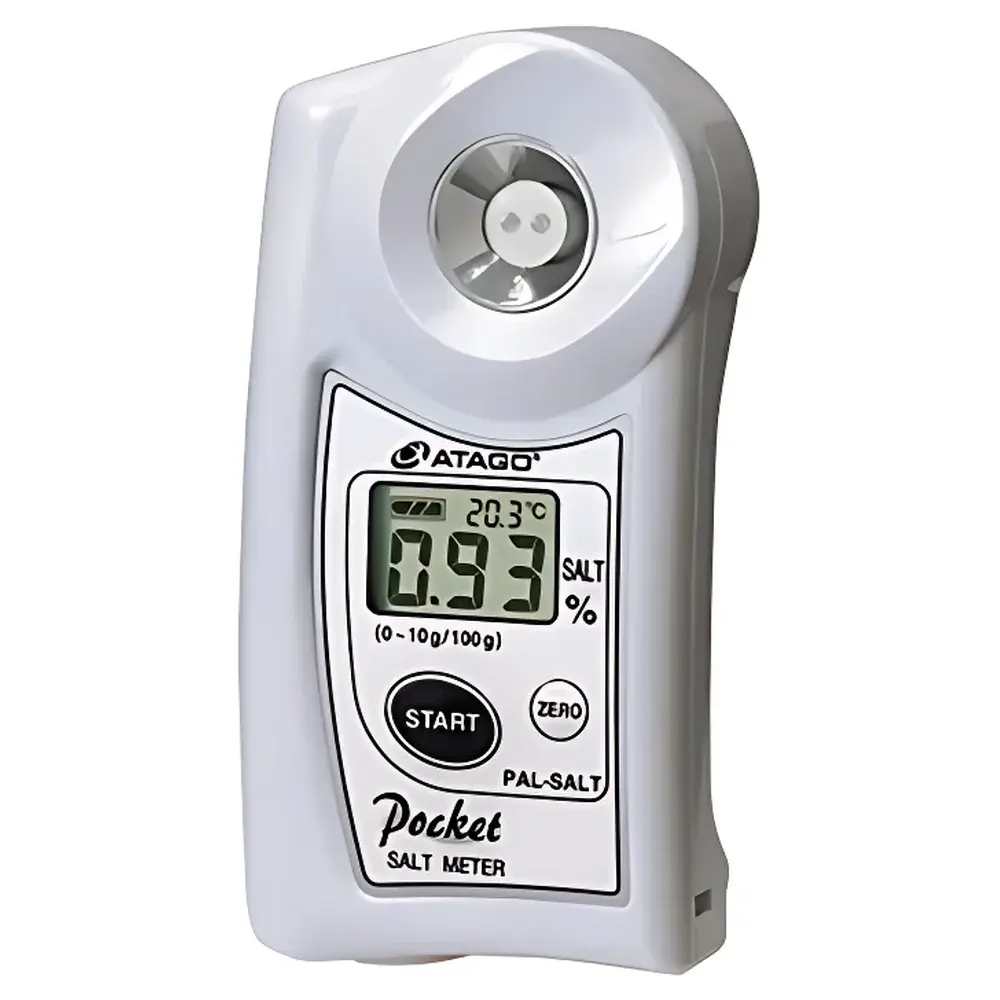
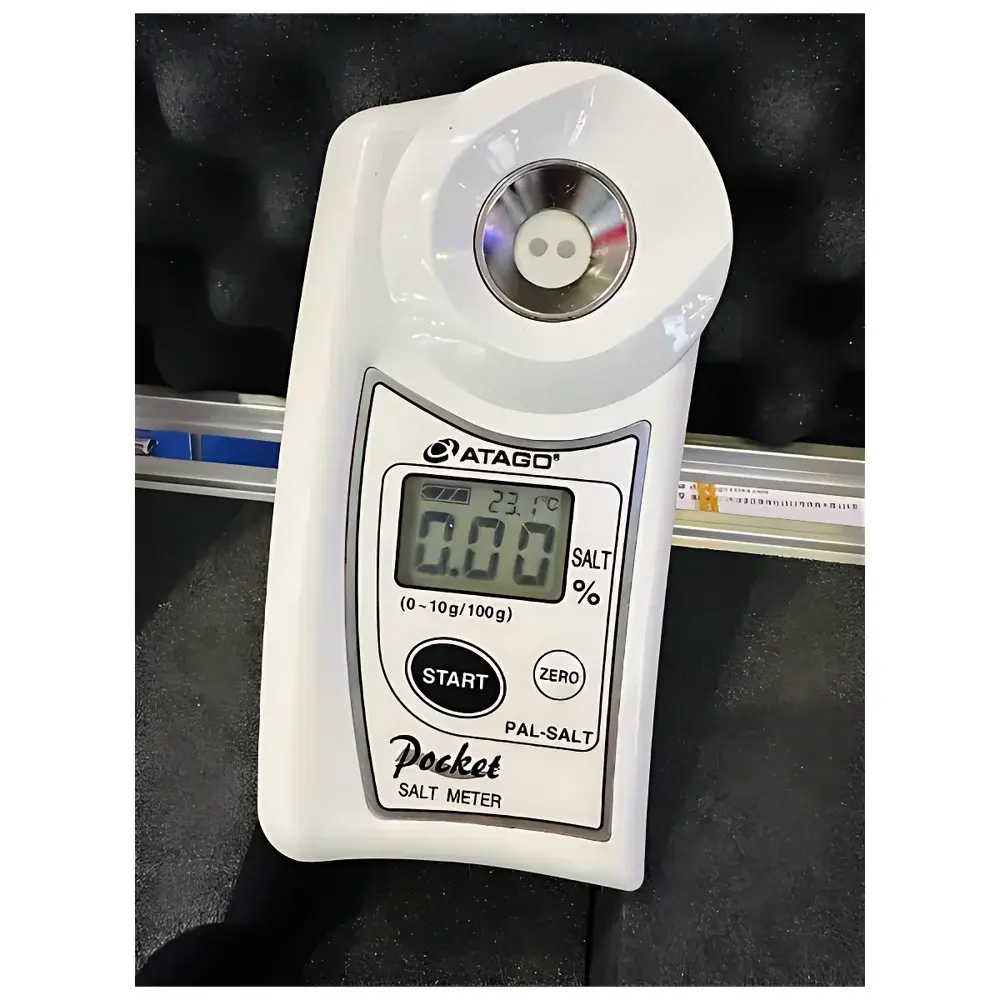
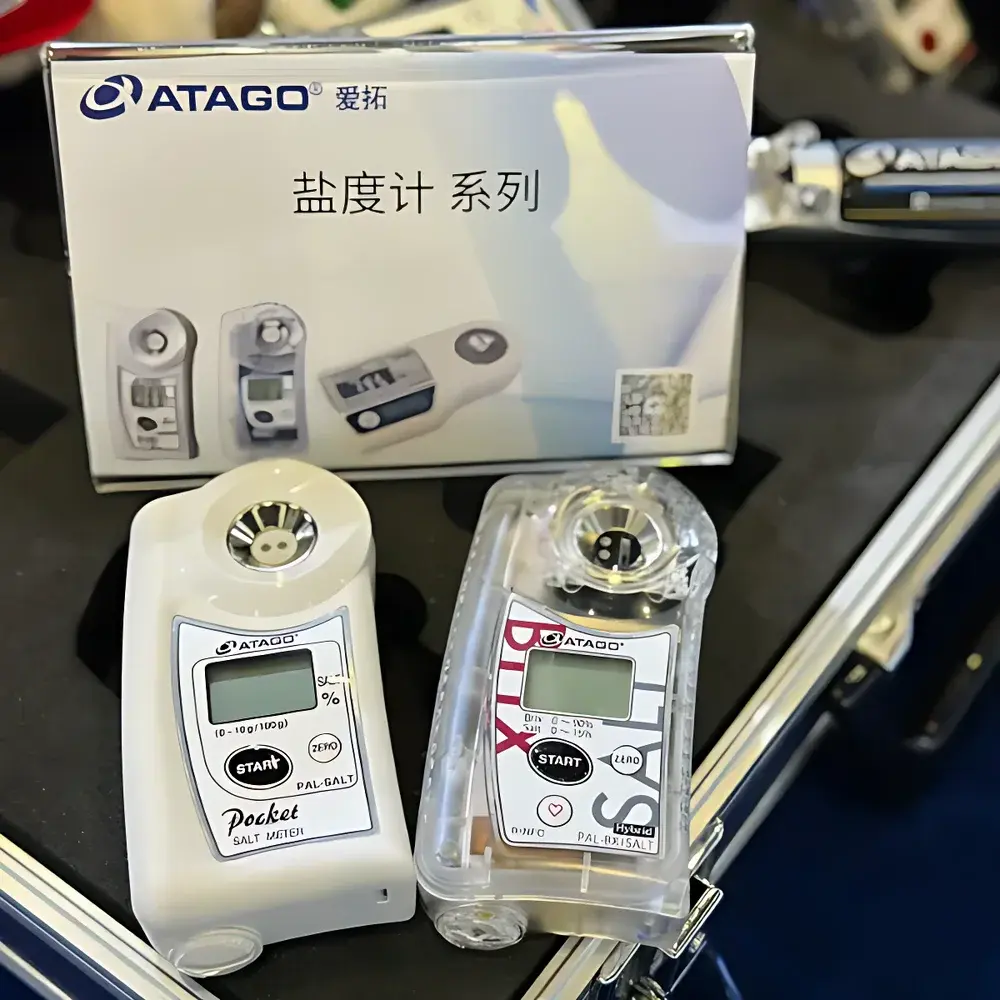
ATAGO PAL-SALT Digital Conductivity-Based Salinometer
| Brand | ATAGO |
|---|---|
| Origin | Japan |
| Model | PAL-SALT |
| Measurement Principle | Electrical Conductivity |
| Measurement Range | 0.00–10.0% (g/100g) |
| Accuracy | ±0.05% (0.00–0.99%), ±5% rel. (1.00–10.0%), ±1°C (ATC) |
| Resolution | 0.01% (0.00–2.99%), 0.1% (3.0–10.0%) |
| ATC Range | 5.0–100°C |
| Operating Ambient Temp | 10–40°C |
| IP Rating | IP65 |
| Power | 2× AAA alkaline batteries |
| Dimensions & Weight | 5.5 × 3.1 × 10.9 cm, 100 g (host only) |
Overview
The ATAGO PAL-SALT Digital Conductivity-Based Salinometer is a handheld, field-deployable instrument engineered for rapid, reagent-free determination of salt concentration in aqueous solutions—expressed as mass percentage (g/100g). Unlike titrimetric or refractometric methods, the PAL-SALT employs electrical conductivity measurement, leveraging the linear correlation between ionic strength and conductance in dilute sodium chloride solutions. The device incorporates an integrated Automatic Temperature Compensation (ATC) system calibrated to the standard temperature dependence of NaCl conductivity (per ISO 7888 and ASTM D1125), ensuring stable readings across 5.0–100°C sample temperatures. Its core design addresses laboratory and production-line needs where speed, portability, and regulatory traceability are critical—particularly in food processing, seafood quality control, brine formulation, and wastewater monitoring. The PAL-SALT does not measure total dissolved solids (TDS) or salinity in seawater units (psu); rather, it reports NaCl-equivalent % (w/w) based on conductivity calibration curves traceable to NIST-traceable reference standards.
Key Features
- Reagent-free operation: Eliminates consumables, hazardous chemicals, and disposal costs associated with argentometric titration (e.g., ASTM D511, ISO 9297).
- Dilution-corrected measurement algorithm: Compensates for mandatory 1:10 sample dilution—internally computing and displaying final % (w/w) without manual calculation (e.g., raw reading × 10).
- Offset correction function: Enables user-defined curve adjustment to align conductivity-derived results with reference titration data, supporting method equivalence validation per GLP/GMP requirements.
- IP65-rated enclosure: Dust-tight and protected against low-pressure water jets—suitable for humid production floors, fish markets, and outdoor sampling sites.
- High-resolution dual-range display: 0.01% resolution below 3.0%, switching automatically to 0.1% above—optimized for both low-salt sauces and high-salt pickling brines.
- Battery-operated portability: Powered by two standard AAA alkaline cells; average service life exceeds 10,000 measurements per set under typical use conditions.
Sample Compatibility & Compliance
The PAL-SALT is validated for homogeneous, non-viscous, low-fat aqueous samples containing predominantly NaCl—such as soy sauce, miso broth, vegetable brines, dairy whey, and desalination effluent. It is not suitable for high-viscosity fluids (>100 mPa·s), suspensions, emulsions, or samples with significant non-NaCl electrolytes (e.g., CaCl₂-rich de-icing solutions), which may introduce systematic bias due to differing ion mobility. Calibration is performed using certified NaCl standard solutions (0.5% and 5.0% w/w). The instrument complies with IEC 60529 (IP65), JIS Z 8401 (numerical rounding), and supports audit-ready documentation when used within a defined SOP framework aligned with ISO/IEC 17025 clause 7.7 (uncertainty of measurement).
Software & Data Management
The PAL-SALT operates as a standalone instrument with no embedded data logging or PC connectivity. All measurements are displayed in real time on a high-contrast LCD. While it lacks Bluetooth or USB interfaces, its deterministic measurement logic and built-in offset function enable consistent manual recording in paper-based or LIMS-integrated workflows. For regulated environments, users may document instrument ID, calibration date, operator ID, ambient temperature, and measured value per batch—supporting 21 CFR Part 11 compliance when paired with electronic notebooks that enforce electronic signatures and audit trails.
Applications
- Quality assurance in fermented food manufacturing (soy sauce, fish paste, kimchi brine)
- Routine salt verification in ready-to-eat meal production lines
- Process control during cheese brining and meat curing
- Field screening of aquaculture water salinity for species-specific thresholds
- Educational labs demonstrating conductivity–concentration relationships (chemistry, food science)
- Regulatory pre-screening prior to confirmatory titration per AOAC Official Method 971.25
FAQ
Does the PAL-SALT require calibration before each use?
No—daily verification with a single-point standard (e.g., 2.5% NaCl) is recommended; full two-point calibration is required after battery replacement or if drift exceeds ±0.1%.
Can it measure sea salt or mixed-salt solutions?
It reports NaCl-equivalent % only; accuracy degrades significantly in solutions containing >10% non-NaCl ions (e.g., K⁺, Mg²⁺, Ca²⁺), as conductivity response differs from pure NaCl standards.
What does the “Offset” function actually adjust?
It applies a multiplicative correction factor to the raw conductivity ratio, enabling alignment with lab-reference titration results—critical for method transfer validation and internal consistency audits.
Is ATC active during ambient temperature fluctuations?
Yes—the thermistor continuously monitors sample temperature at the electrode interface and applies real-time compensation using the standardized NaCl conductivity vs. temperature polynomial (ITS-90 referenced).
How is measurement uncertainty estimated for reporting?
Combined standard uncertainty includes contributions from resolution (±0.005%), repeatability (±0.02% RSD, n=6), ATC error (±0.3°C), and calibration standard uncertainty (±0.01%); typical expanded uncertainty (k=2) is ≤±0.12% for values <3.0%.





