
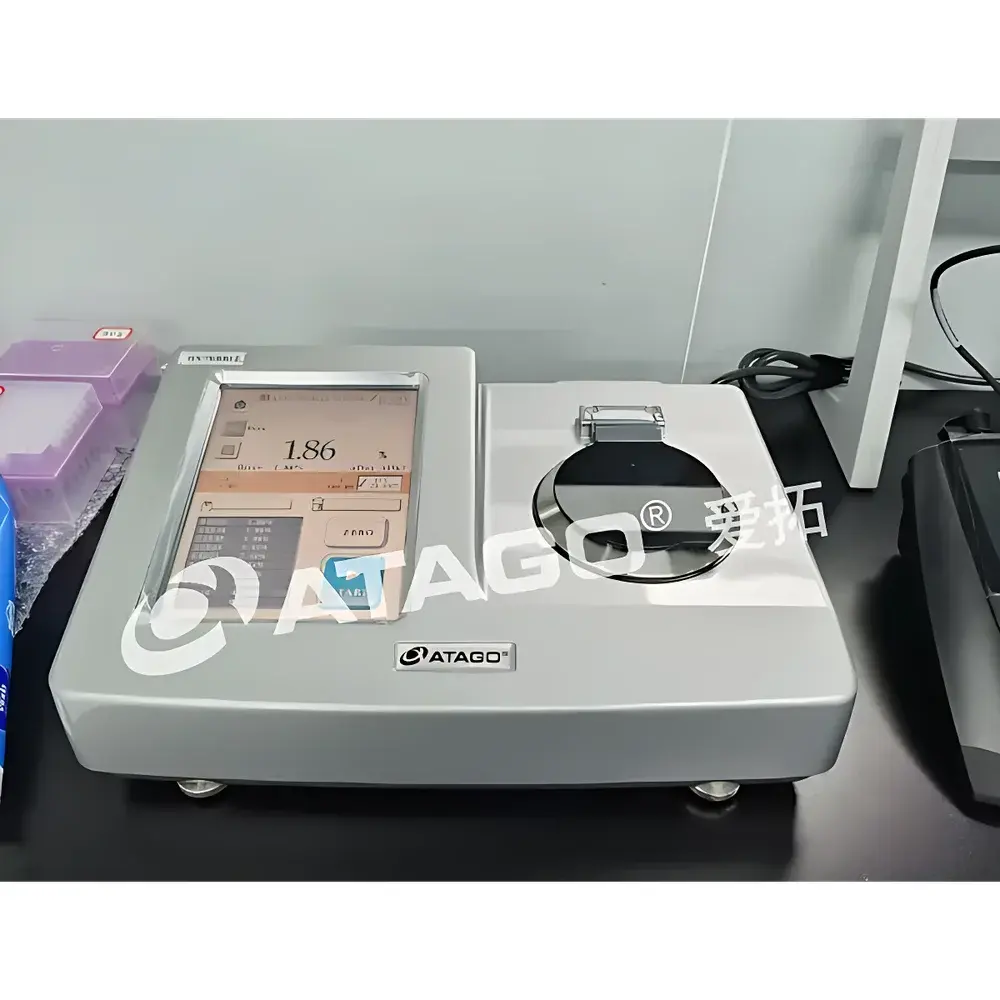
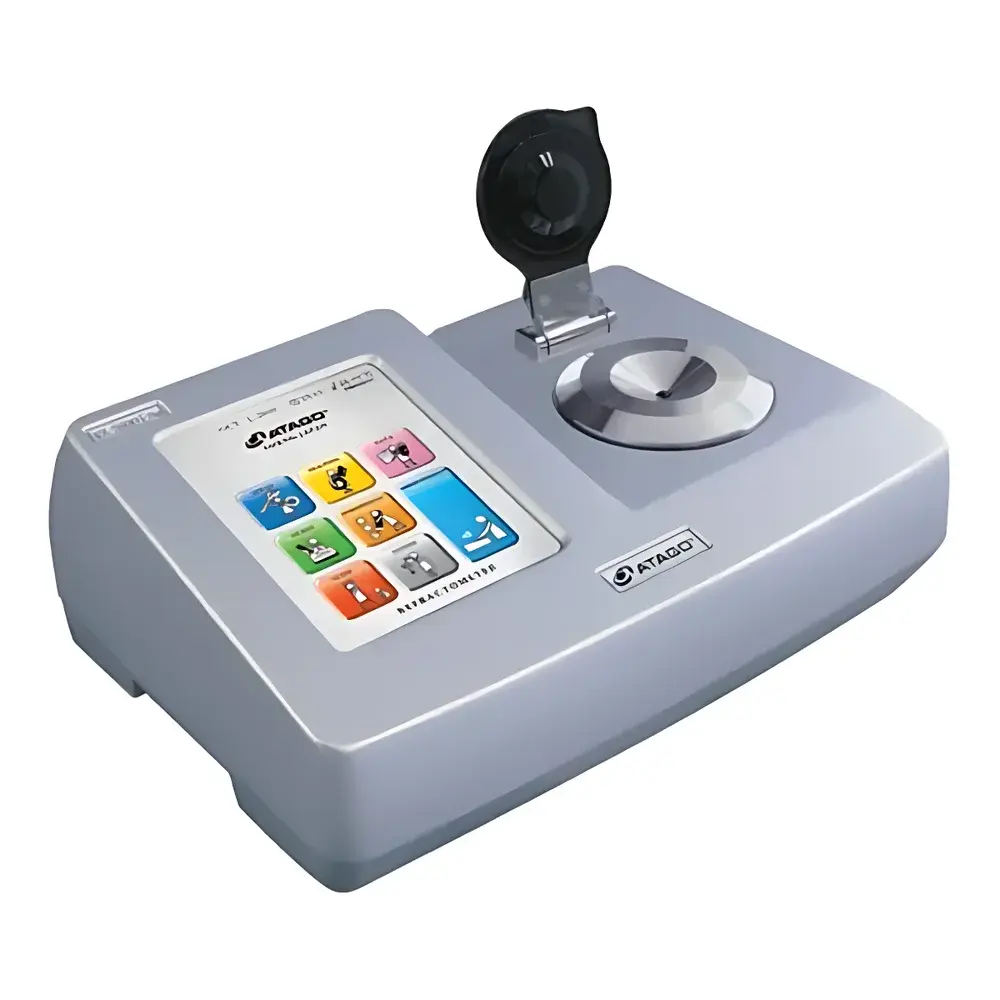
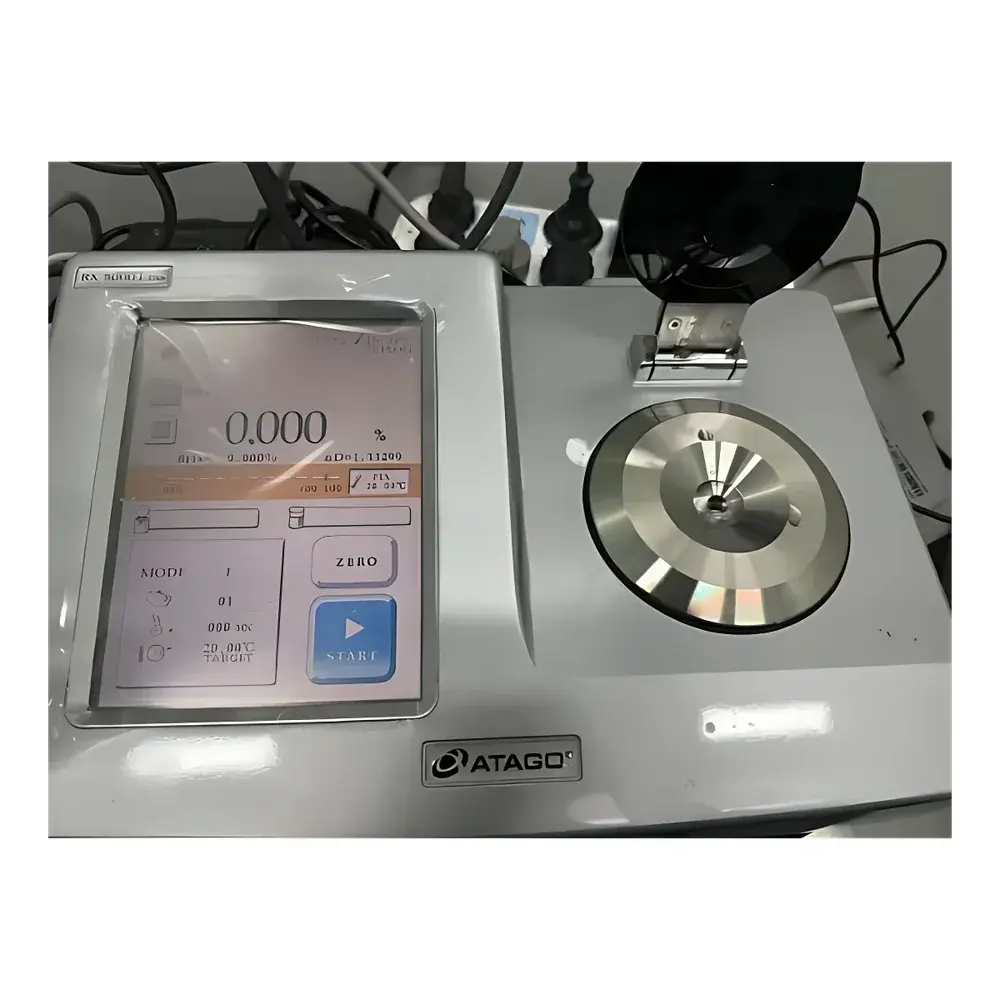
ATAGO RX-5000i-plus Benchtop Automatic Digital Refractometer for Food & Beverage Industry
| Brand | ATAGO |
|---|---|
| Origin | Japan |
| Instrument Type | Benchtop Refractometer |
| Temperature Control | Integrated Peltier System |
| Display | Full-color Touchscreen Interface |
| Measurement Range | Refractive Index (nD): 1.324200–1.580000 |
| Brix | 0.000–100.000% |
| Accuracy | ±0.000020 (nD), ±0.010% (Brix) |
| Resolution | 0.000001 (nD), 0.001% (Brix), 0.01°C (Temperature) |
| Temperature Range | 5–75°C (Auto-compensated, ΔT ≤ ±0.1°C stability) |
| Data Storage | 500 measurements with timestamp, user ID, and temperature log |
| Calibration | Dual-mode (Auto-self-check + manual standard calibration using distilled water or certified sucrose solution) |
| Compliance | Designed to support GLP/GMP workflows with audit-ready measurement records |
Overview
The ATAGO RX-5000i-plus is a high-precision, benchtop digital refractometer engineered specifically for quality control and R&D laboratories in the food and beverage industry. It operates on the principle of critical-angle refractometry: a collimated LED light beam passes through a sapphire prism in contact with the sample, and the resulting refraction angle is detected by a high-resolution linear CCD sensor. This optical configuration enables direct, non-destructive quantification of solute concentration—primarily expressed as Brix (%)—based on the sample’s refractive index (nD). Unlike conventional handheld or analog refractometers, the RX-5000i-plus integrates a thermoelectric (Peltier) temperature control system that actively regulates prism temperature within ±0.1°C across a 5–75°C operational range. This eliminates reliance on external water baths and ensures strict adherence to standardized measurement conditions required by ISO 2173, AOAC 932.12, and USP <788> for sugar content verification.
Key Features
- Integrated Peltier-based thermostatic control: Achieves target temperature in under 90 seconds and maintains thermal stability at ±0.1°C during measurement—critical for reproducible Brix values across viscous syrups, fruit concentrates, and dairy-based emulsions.
- Full-color capacitive touchscreen interface: Intuitive icon-driven navigation enables one-finger operation, minimizing training time and reducing operator-induced variability.
- High-resolution optical detection: 1.0 µm spatial resolution CCD array delivers nD resolution of 0.000001 and Brix resolution of 0.001%, supporting tight process tolerances in premium beverage formulation and fermentation monitoring.
- Multi-scale flexibility: Stores up to 100 user-defined calibration curves (e.g., for invert sugar, fructose-glucose blends, or proprietary formulations) alongside 24 factory-loaded scales compliant with international food standards.
- Automated workflow integration: Auto-initiates measurement upon temperature stabilization; supports programmable pass/fail thresholds and real-time deviation alerts for inline QC decision-making.
Sample Compatibility & Compliance
The RX-5000i-plus accommodates a broad spectrum of liquid and semi-liquid matrices common in food manufacturing—including clarified juices, wine musts, soft drink concentrates, dairy whey, honey, molasses, and plant-based milk alternatives. Its sapphire prism surface resists scratching and chemical degradation from organic acids, ethanol, and mild cleaning agents (e.g., 2% NaOH or 1% HNO3). All measurement data include embedded metadata: timestamp, operator ID, ambient temperature, sample temperature at acquisition, and calibration status. The instrument supports traceability requirements per FDA 21 CFR Part 11 when paired with ATAGO’s optional PC software (Refractometer Manager v4.2), which logs electronic signatures, audit trails, and version-controlled method files—enabling full compliance with GLP and GMP documentation protocols.
Software & Data Management
Data export is supported via USB 2.0 and RS-232 interfaces, enabling seamless transfer to LIMS or ERP systems. The included Refractometer Manager software provides advanced analysis tools: trend charting over time, statistical process control (SPC) charts (X-bar/R), batch comparison reports, and customizable PDF certificate generation. Each stored record contains full metrological context—no post-hoc reconstruction required. Internal memory retains the most recent 500 measurements with full traceability; older entries are automatically archived upon USB export without overwrite risk.
Applications
- Real-time Brix verification during juice concentration and evaporation processes
- Batch release testing of carbonated soft drinks and isotonic beverages per Codex Alimentarius standards
- Fermentation endpoint determination in beer, wine, and kombucha production
- Quality screening of raw materials (e.g., fruit pulp, agave syrup, maple sap)
- Stability assessment of emulsified dressings and functional beverage suspensions
- Validation of cleaning-in-place (CIP) rinse efficacy via residual sugar detection
FAQ
Does the RX-5000i-plus require external cooling or heating equipment?
No. Its built-in Peltier module provides both heating and cooling functions, eliminating dependency on circulating water baths or environmental chambers.
Can it measure samples with suspended solids or high viscosity?
Yes—provided the sample is homogeneous and free of air bubbles. For viscous products (e.g., honey, corn syrup), pre-warming to 40–50°C improves flow and surface wetting; the instrument’s auto-temperature compensation ensures accuracy regardless.
How often must the prism be calibrated?
Daily verification with distilled water (nD = 1.3330 at 20°C) is recommended before first use and after extended idle periods; formal recalibration with NIST-traceable sucrose standards is advised every 3–6 months depending on usage frequency.
Is the device compatible with laboratory network security policies?
Yes. It operates as a standalone instrument with no internet connectivity by default; data exchange occurs only via physically connected USB drives or isolated serial connections—fully aligned with ITAR- and HIPAA-aligned lab infrastructure requirements.
What regulatory standards does its measurement methodology satisfy?
The optical design and temperature control architecture comply with the performance criteria outlined in ISO 2173:2003 (fruit and vegetable products), AOAC Official Method 932.12 (sugar solutions), and ASTM D1218–19 (refractive index of hydrocarbons), making it suitable for auditable QC reporting in FDA-registered facilities.





