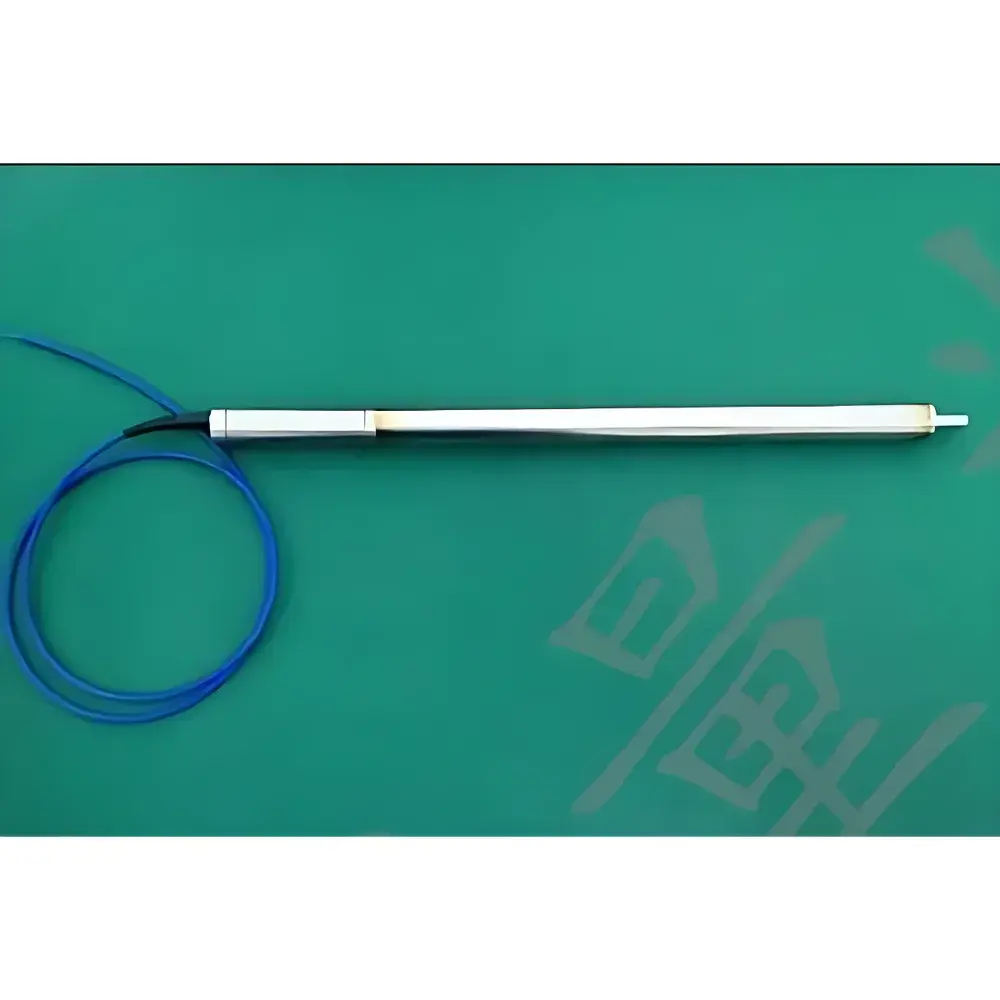
Auniontech Aut-S800 Fiber Bragg Grating Displacement Sensor
| Brand | Auniontech |
|---|---|
| Origin | Shanghai, China |
| Model | Aut-S800 |
| Displacement Range | 100 mm (customizable) |
| Displacement Accuracy | ±1% FS |
| Displacement Resolution | 0.1% FS |
| Temperature Range | −20 to +85 °C |
| Temperature Accuracy | ±1 °C |
| Temperature Resolution | 0.1 °C |
| Center Wavelength | 1528–1568 nm (±0.1 nm) |
| Dimensions | Φ25 × 360 mm |
| Fiber Connector | FC/APC |
| Housing Material | Stainless Steel |
| Dual FBG Design | Yes |
| Temperature Compensation | Built-in |
| Network Topology | Series-compatible for FBG sensor arrays |
Overview
The Auniontech Aut-S800 Fiber Bragg Grating (FBG) Displacement Sensor is an engineered solution for high-stability, long-term structural health monitoring (SHM) in civil infrastructure and geotechnical applications. Based on the principle of wavelength-encoded strain measurement via dual FBG interrogation, the Aut-S800 simultaneously resolves axial displacement and ambient temperature with inherent cross-sensitivity compensation. Unlike conventional resistive or LVDT-based sensors, this device leverages the intrinsic immunity of fiber-optic sensing to electromagnetic interference, corrosion, moisture, and high-voltage environments—making it suitable for deployment in harsh, inaccessible, or safety-critical locations such as post-tensioned concrete, submerged foundations, or seismic zones. Its dual-FBG architecture enables real-time decoupling of mechanical strain and thermal drift by referencing one grating as a dedicated temperature reference and the other as a strain-sensitive element, thereby delivering compensated displacement output without post-processing assumptions.
Key Features
- Dual-FBG architecture with integrated temperature compensation for simultaneous, independent measurement of displacement and temperature
- FC/APC fiber connectors enabling daisy-chain configuration of up to 30+ sensors on a single interrogation line—reducing cabling complexity and system cost
- Stainless steel hermetic packaging (Φ25 × 360 mm) rated for IP67 environmental protection and long-term stability under cyclic loading
- High-resolution optical interrogation: displacement resolution of 0.1% full scale (FS), temperature resolution of 0.1 °C
- Wide operational temperature range (−20 to +85 °C) with calibrated accuracy of ±1 °C and ±1% FS displacement error across the full 100 mm range
- Customizable displacement range (standard: 100 mm; available options: 25 mm, 50 mm, 200 mm, or extended per application requirements)
- Center wavelength tunability within the C-band (1528–1568 nm, ±0.1 nm tolerance) for compatibility with standard FBG interrogators supporting ITU-T grid alignment
Sample Compatibility & Compliance
The Aut-S800 is designed for direct embedding into concrete, anchoring onto steel reinforcement bars (rebar), surface-mounting on bridge girders, or installation within settlement plates in embankments and landslide-prone slopes. It complies with ASTM E2427-21 (Standard Practice for Structural Health Monitoring Using Fiber Optic Sensors) and aligns with ISO/IEC 17025 requirements for calibration traceability when used with NIST-traceable FBG interrogation systems. While not certified for nuclear-grade or SIL-2/3 applications out-of-the-box, its stainless steel housing and passive optical design support integration into IEC 61508-compliant monitoring subsystems when paired with appropriate safety-rated interrogators and data acquisition logic. All units undergo factory calibration against dead-weight and thermal chamber references, with individual calibration certificates provided per serial number.
Software & Data Management
The Aut-S800 operates transparently with industry-standard FBG interrogation platforms—including Micron Optics sm130, HBM FiberSensing FS22, and Luna ODiSI series—supporting both static and dynamic acquisition modes (up to 1 kHz sampling, depending on interrogator). Raw wavelength shift data (in pm) is converted to engineering units (mm, °C) using polynomial calibration coefficients embedded in sensor metadata. Time-series datasets are exportable in CSV, HDF5, or TDMS formats. When deployed in regulatory environments (e.g., dam safety monitoring under USACE EM 1110-2-1906), the system supports audit-ready data logging with timestamped, tamper-evident records compliant with FDA 21 CFR Part 11 (when implemented with validated software and electronic signature controls). Optional MATLAB® and Python SDKs enable custom algorithm development for anomaly detection, baseline drift correction, and multi-sensor fusion.
Applications
- Crack width and opening/closing dynamics in reinforced concrete structures during curing, loading, or thermal cycling
- Relative displacement monitoring between abutment and pier in highway bridges under live load and thermal expansion
- Horizontal and vertical deformation tracking in earth-fill dams, tailings facilities, and retaining walls
- Real-time feedback for active control systems in smart tunnel boring machines (TBMs) and shield jacking operations
- Long-baseline strain mapping in pre-stressed tendon ducts to verify effective force transfer and detect bond loss
- Geotechnical instrumentation for slope stability assessment, including deep-seated shear zone displacement via inclinometer coupling
FAQ
What is the maximum recommended cable length between the Aut-S800 and the FBG interrogator?
For optimal signal-to-noise ratio and minimal chromatic dispersion, we recommend ≤10 km total fiber path length (including patch cords and splices) when using standard single-mode G.652.D fiber at 1550 nm.
Can the Aut-S800 be embedded directly into fresh concrete?
Yes—its stainless steel housing and hermetic FC/APC interface are rated for direct embedment; however, proper conduit protection and strain relief at the exit point are required to prevent fiber damage during vibration and compaction.
Is factory recalibration available after field installation?
Recalibration is performed at the component level prior to shipment; post-installation verification is conducted via reference measurements (e.g., dial indicators or precision micrometers) rather than re-calibration, in accordance with ISO/IEC 17025 Clause 6.6.
Does the sensor support multiplexing with other FBG types (e.g., strain, tilt, or vibration sensors)?
Yes—the Aut-S800 is fully compatible with mixed FBG arrays, provided wavelength allocation avoids overlap (e.g., spacing ≥1.2 nm between adjacent gratings) and the interrogator supports the required dynamic range and resolution.
What documentation is supplied with each unit?
Each sensor ships with a unique calibration certificate (wavelength vs. displacement/temperature), mechanical installation drawing, fiber handling guidelines, and RoHS/REACH compliance statement.