
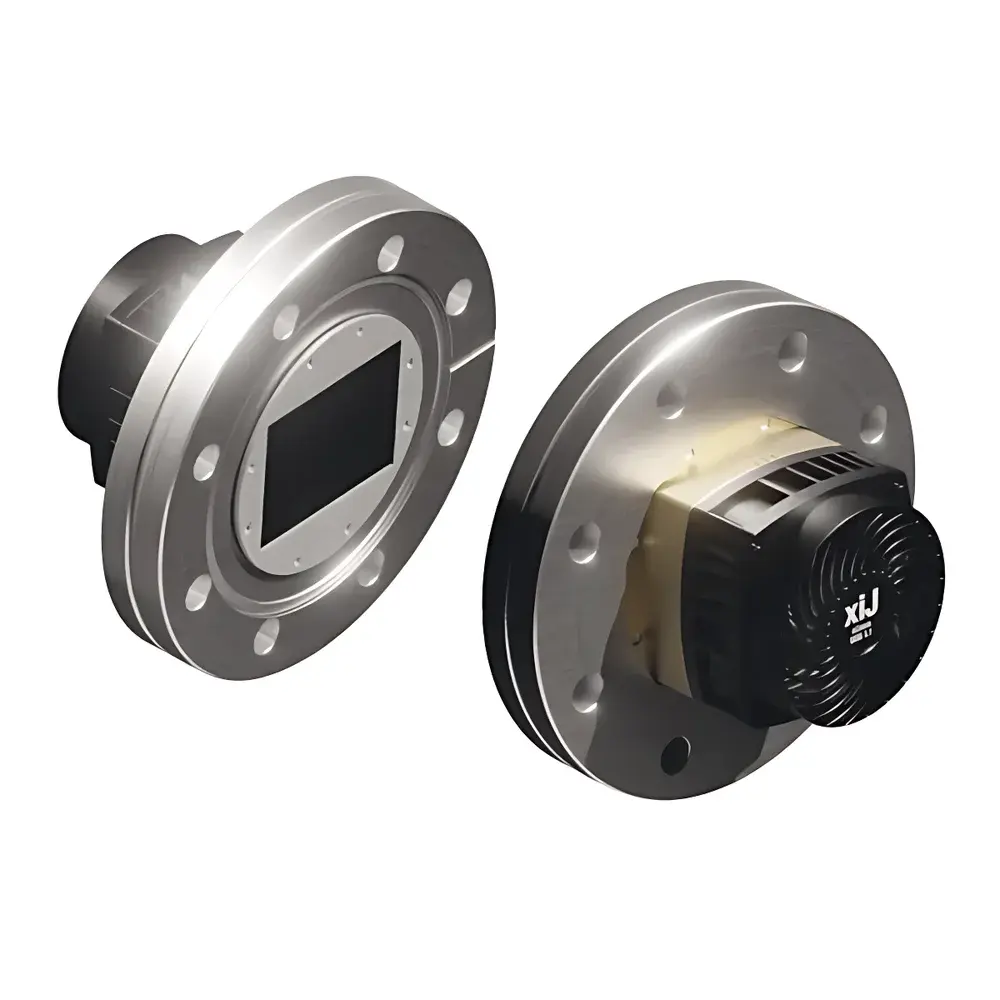
XIMEA MJ042MR-GP-P11-BSI-UV EUV & Soft X-Ray Scientific CMOS Camera
| Brand | XIMEA |
|---|---|
| Origin | Germany |
| Manufacturer Type | Authorized Distributor |
| Origin Category | Imported |
| Model | MJ042MR-GP-P11-BSI-UV |
| Spectral Range | 0.5–1000 nm (80–1000 eV) |
| Resolution | 2048 × 2048 (4.2 MP) |
| Pixel Size | 11 µm |
| Sensor | Gpixel GSENSE400 BSI Pulsar |
| Cooling | Peltier (down to −25 °C) |
| Frame Rate | 48 fps @ 12-bit, 24 fps @ 16-bit HDR |
| Dynamic Range | >95 dB (HDR) |
| Readout Noise | ≤2 e⁻ (typ.) |
| Full Well Capacity | ≥80,000 e⁻ |
| Dark Current | <12 e⁻/px/s @ 0 °C |
| Interface | USB 3.1 Gen 1 (Type-C) |
| Vacuum Compatibility | DN 63 CF flange (standard), optional DN 100 CF |
| Exposure Range | 19.8 µs – 2147 s |
| I/O | 1 GPI, 1 GPO (50 VDC isolation) |
| Power Consumption | 3.5–16 W |
Overview
The XIMEA MJ042MR-GP-P11-BSI-UV is a vacuum-compatible, back-illuminated scientific CMOS camera engineered for high-fidelity imaging in the extreme ultraviolet (EUV, 10–124 nm), vacuum ultraviolet (VUV, 100–200 nm), and soft X-ray (0.2–12 nm, corresponding to 0.1–5 keV photon energy) spectral regimes. Based on the Gpixel GSENSE400 BSI Pulsar sensor, it delivers quantum efficiency exceeding 90% across the EUV water window (2.3–4.4 nm, 280–540 eV) and maintains >70% QE at 13.5 nm — a critical wavelength for next-generation lithography metrology and coherent diffractive imaging. Unlike conventional front-illuminated CCD or CMOS detectors, its deep-depletion, thinned backside illumination architecture eliminates absorption losses from gate structures, enabling direct photoelectron collection from low-energy photons with minimal charge diffusion. The camera operates under high vacuum (≤10⁻⁶ mbar) with the sensor surface fully exposed — a requirement for efficient EUV/soft X-ray detection where ambient gas molecules would otherwise attenuate signal or induce ionization noise. Its design adheres to fundamental principles of photoelectron conversion physics: photon energy deposition in silicon generates electron-hole pairs proportional to incident flux, with collection efficiency governed by depletion depth, surface passivation quality, and thermal noise suppression.
Key Features
- Back-illuminated Gpixel GSENSE400 BSI Pulsar sensor with 2048 × 2048 active pixels (4.2 MP), 11 µm pitch, and 22.5 × 22.5 mm active area
- Peltier thermoelectric cooling capable of stabilizing sensor temperature to −25 °C, reducing dark current to <12 e⁻/px/s at 0 °C and enabling long-exposure coherence measurements
- USB 3.1 Gen 1 (Type-C) interface supporting sustained 48 fps at 12-bit output and 24 fps in 16-bit HDR mode with on-chip dual-gain readout
- Vacuum-integrated mechanical design featuring standard DN 63 CF flange (with optional DN 100 CF adaptation), indium-sealed cold stage, and hermetically sealed electronics housing
- Dynamic range >95 dB in HDR mode, full well capacity ≥80,000 e⁻, and readout noise ≤2 e⁻ (RMS) — optimized for single-photon counting regimes in low-flux synchrotron or laser-plasma sources
- Rolling shutter operation with programmable exposure control (19.8 µs – 2147 s), precise trigger synchronization (GPI/GPO), and hardware-based pixel binning support
Sample Compatibility & Compliance
The MJ042MR-GP-P11-BSI-UV is compatible with ultra-high vacuum (UHV) beamlines, tabletop high-harmonic generation (HHG) sources, laser-produced plasma (LPP) EUV emitters, and synchrotron bending magnet or undulator endstations. Its bare-silicon sensor withstands direct exposure to photons in the 80–1000 eV range without degradation when operated below 10⁻⁶ mbar. The camera meets ISO 14644-1 Class 5 cleanroom handling requirements during installation and conforms to CE electromagnetic compatibility (EMC) directives. For regulated environments, firmware supports audit-trail logging of acquisition parameters (exposure, gain, temperature, timestamp) in accordance with GLP-compliant workflows. While not certified to FDA 21 CFR Part 11 out-of-the-box, its deterministic API enables integration into validated systems requiring electronic record integrity.
Software & Data Management
XIMEA provides the xiSDK — a cross-platform C/C++, Python, MATLAB, and LabVIEW-compatible software development kit — with native support for time-stamped metadata embedding (EXIF-like headers), TIFF-64 and HDF5 export formats, and real-time histogram analysis. The SDK implements lossless compression (FPZIP for floating-point datasets) and supports multi-camera synchronization via hardware TTL triggers. For large-scale experiments (e.g., ptychographic reconstruction or tomographic stacks), the camera integrates with open-source frameworks including TomoPy, PtychoNN, and silx. Raw frame buffers are accessible via memory-mapped I/O, enabling zero-copy transfer to GPU-accelerated processing pipelines. All firmware updates are digitally signed and verified prior to installation.
Applications
- Coherent diffractive imaging (CDI) and ptychography in the water window (2.3–4.4 nm) for unstained biological specimen visualization (e.g., cellular organelles, virus capsids)
- X-ray absorption near-edge structure (XANES) and near-edge X-ray absorption fine structure (NEXAFS) spectroscopy at synchrotron beamlines
- Scanning transmission X-ray microscopy (STXM) and X-ray photoemission electron microscopy (X-PEEM) with sub-20 nm spatial resolution
- EUV lithography mask inspection and actinic aerial image metrology at 13.5 nm
- High-harmonic generation (HHG) pulse characterization, attosecond streaking, and time-resolved photoelectron spectroscopy
- Atmospheric science: remote sensing of trace gas absorption features in the VUV/EUV band (e.g., O₂, N₂, NO, CO)
- Plasma diagnostics: imaging of laser-driven plasma jets, pinch dynamics, and EUV emission anisotropy
FAQ
Is the sensor sensitive to visible light as well?
Yes — the GSENSE400 BSI Pulsar exhibits broad spectral response from 0.5 nm (soft X-ray) to 1000 nm (near-infrared), making it suitable for multimodal alignment and reference imaging using visible lasers or LEDs.
What vacuum level is required for stable operation?
Continuous operation requires ≤10⁻⁶ mbar; brief exposures (<1 min) are permissible down to 10⁻⁴ mbar, though residual gas ionization may increase background noise.
Can the camera be used with grazing-incidence optics?
Yes — its shallow 11 µm pixel depth and high QE at <1° incidence angles enable integration with zone plates, multilayer mirrors, and Kirkpatrick-Baez configurations.
Does the camera support external triggering with sub-microsecond jitter?
Yes — the GPI input accepts TTL/CMOS signals with <100 ns timing jitter relative to exposure start, validated using synchronized femtosecond laser pump-probe setups.
Is radiation damage a concern during prolonged EUV exposure?
No measurable degradation has been observed after >10⁹ photons/µm² at 13.5 nm under UHV conditions; accelerated lifetime testing shows no threshold displacement damage below 1 keV photon energy.
Related Products




