
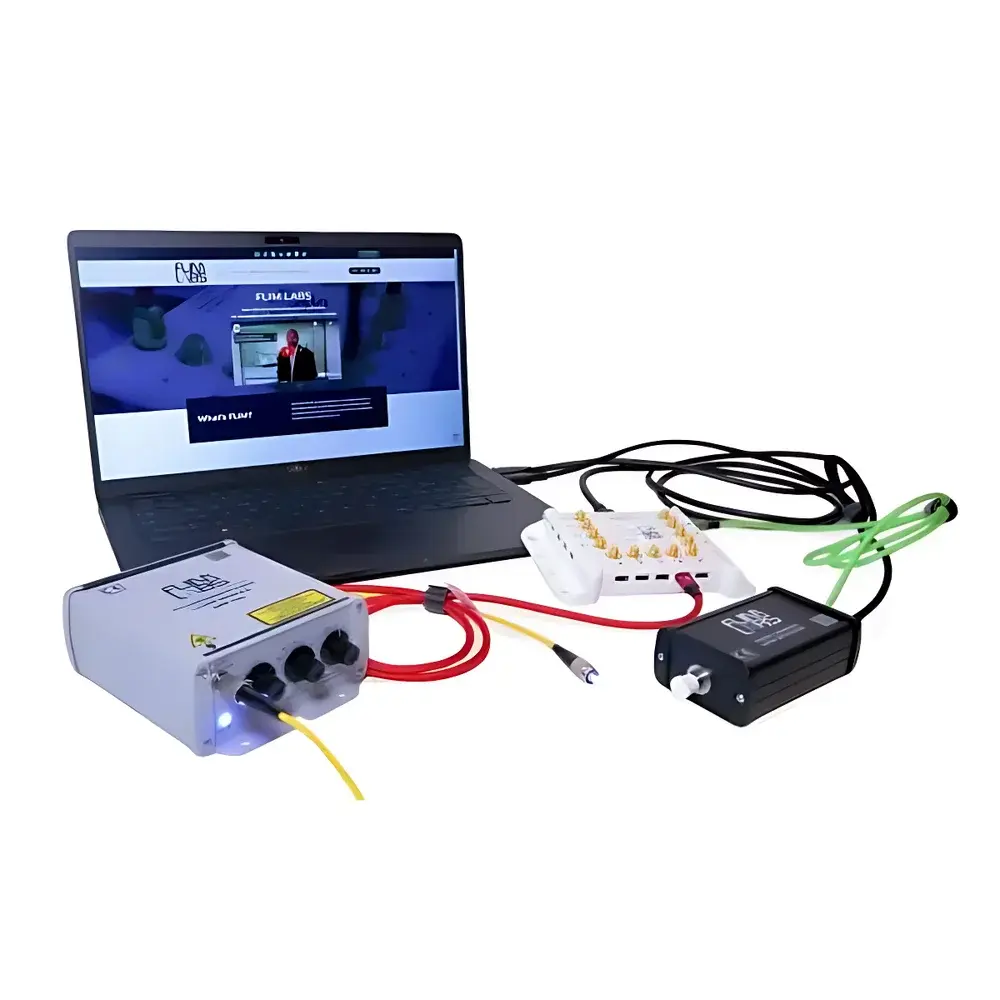
Auniontech FLIM Starter Kit for Time-Resolved Fluorescence Imaging
| Brand | Auniontech |
|---|---|
| Origin | Shanghai, China |
| Model | FLIM Starter Kit (Time-Correlated Single-Photon Counting System) |
| Minimum Resolvable Fluorescence Lifetime | 50 ps |
| Laser Wavelengths | 405, 445, 488, 520, 635, and 850 nm |
| Pulse Width (FWHM) | ≤50 ps |
| Detector | FC/PC-coupled SPAD with Dark Count Rate: 7 cps and Timing Jitter: <200 ps |
| SPAD Spectral Range | 370–900 nm (Peak Sensitivity at 450 nm) |
| FPGA-Based TCSPC Architecture | Up to 25 Parallel Fluorescence Input Channels |
| Interface | USB 3.0 SuperSpeed micro-B |
| Data Acquisition Card Dimensions | 101 × 139 × 28 mm |
| Weight | 120 g |
| Minimum Time Bin Width | 24 or 48 ps |
| Timing Precision (σ/� | 2): 300 ps |
| Dead Time | 1.5 ns |
| Minimum Pixel Dwell Time | 1 µs |
| Laser Module Dimensions | 135 × 110 × 50 mm |
| Detector Module Dimensions | 100 × 60 × 30 mm |
| Software Support | Windows, Linux |
| Data Export Formats | HDF5, SVG, MATLAB, Python-native |
| Cloud Storage Integration | Yes |
| API Languages | Rust, C, C++, C#, Python, Node.js, .NET |
Overview
The Auniontech FLIM Starter Kit is a fully integrated, turnkey time-correlated single-photon counting (TCSPC) platform engineered for entry-level and intermediate researchers seeking rigorous fluorescence lifetime imaging (FLIM) and time-resolved fluorescence spectroscopy capabilities. Built around the physical principle of photon arrival-time histogramming relative to excitation pulses, the system enables quantitative mapping of nanosecond-to-picosecond-scale fluorescence decay kinetics across biological specimens, thin-film materials, and optoelectronic devices. Its core architecture leverages ultrafast pulsed laser excitation synchronized with high-temporal-resolution SPAD detection and FPGA-accelerated timestamp processing—ensuring sub-50 ps lifetime resolution without requiring cryogenic cooling or optical table stabilization. Designed explicitly for laboratory environments where space, budget, and ease of deployment are constraints, this kit eliminates the need for custom integration of disparate components while preserving full experimental flexibility and scientific traceability.
Key Features
- Sub-50 ps minimum resolvable fluorescence lifetime—validated using standard reference dyes (e.g., Rhodamine B in ethanol, τ ≈ 4.1 ns) and IRF characterization under identical acquisition conditions
- Multi-wavelength pulsed laser source with six discrete diode options (405–850 nm), all fiber-coupled via FC/PC interface and gain-switched for stable, low-jitter pulse generation (FWHM ≤50 ps)
- TE-cooled SPAD detector with spectral responsivity spanning 370–900 nm and peak quantum efficiency at 450 nm—optimized for visible/NIR fluorophores including GFP, mCherry, NAD(P)H, and quantum dots
- Compact, USB-powered TCSPC data acquisition card featuring field-programmable gate array (FPGA) logic for real-time histogramming, with up to 25 parallel input channels supporting multi-color or multi-lifetime channel multiplexing
- Plug-and-play USB 3.0 SuperSpeed interface enabling deterministic latency (400 Mbps—compatible with standard desktop and laptop configurations running Windows or Linux
- Integrated thermal management across all modules (laser, detector, electronics) ensuring long-term timing stability and reproducibility over multi-hour acquisitions
Sample Compatibility & Compliance
The FLIM Starter Kit supports standard microscopy configurations—including widefield epifluorescence, confocal point-scanning, and macro-scale surface imaging—via flexible fiber-optic coupling. Samples ranging from live-cell monolayers and tissue sections to polymer films and perovskite photovoltaic layers have been successfully characterized using this platform. All hardware and firmware comply with IEC 61000-6-3 (EMC emission limits) and IEC 61000-6-2 (immunity requirements). The software environment supports audit-trail logging and user-access controls aligned with GLP-compliant workflows; optional configuration packages enable alignment with 21 CFR Part 11 electronic record/electronic signature requirements for regulated pharmaceutical or clinical research applications.
Software & Data Management
The bundled FLIM software provides a unified environment for instrument control, real-time histogram visualization, phasor plot generation, and multi-exponential decay fitting (Levenberg–Marquardt algorithm). It includes native support for phasor-based lifetime unmixing—enabling label-free discrimination of molecular species based on lifetime signatures alone. The software exposes a comprehensive, documented API in Rust, C, C++, C#, Python, Node.js, and .NET, allowing seamless integration into custom analysis pipelines or existing lab infrastructure (e.g., Micro-Manager, Python-based image analysis frameworks). All raw timestamp data and processed FLIM maps are stored in open HDF5 format, with metadata compliant with the OME-XML schema. SVG export ensures publication-ready vector graphics for phasor plots and lifetime overlays. Optional cloud synchronization enables centralized data archiving, version-controlled analysis scripts, and collaborative annotation across distributed teams.
Applications
- Quantitative metabolic imaging via NAD(P)H and FAD autofluorescence lifetime shifts in live cells and tissues
- Protein–protein interaction studies using Förster resonance energy transfer (FRET) with lifetime-based readout—eliminating intensity artifacts common in ratiometric methods
- Characterization of luminescent nanomaterials (e.g., upconversion nanoparticles, carbon dots) for sensing and theranostics
- Quality control of OLED and perovskite LED emissive layers through spatially resolved lifetime heterogeneity mapping
- Development and validation of novel fluorescent probes with environment-sensitive decay kinetics (e.g., pH, viscosity, ion concentration)
- Teaching and training in advanced optical metrology—supporting hands-on instruction in TCSPC principles, photon statistics, and time-domain spectroscopy
FAQ
What is the effective temporal resolution limit of this system under typical operating conditions?
The system achieves a minimum resolvable lifetime of 50 ps, limited primarily by the combined instrument response function (IRF) width—determined by laser pulse duration (~50 ps FWHM), detector jitter (<200 ps), and electronics timing precision (300 ps σ/√2). Actual resolution in biological samples may be further constrained by photon statistics and sample scattering.
Can the system be synchronized with external equipment such as galvo scanners or piezo stages?
Yes—the data acquisition card provides TTL-compatible trigger input/output ports for hardware synchronization with third-party scanning systems, shutter controllers, or environmental chambers.
Is calibration against certified lifetime standards included?
The kit ships with a reference cuvette containing Rhodamine B in ethanol (τ = 4.1 ns ± 0.05 ns at 22 °C), along with step-by-step calibration protocols and IRF measurement routines embedded in the software.
Does the software support batch processing of large FLIM datasets?
Yes—command-line mode and Python API bindings allow automated processing of hundreds of FLIM stacks using custom-defined pipelines, including background subtraction, pixel-wise biexponential fitting, and phasor clustering.
Are OEM integration options available for embedding this TCSPC engine into custom instrumentation?
Auniontech offers mechanical, electrical, and firmware integration support—including custom FPGA bitstream development, driver SDKs, and mechanical mounting adapters—for original equipment manufacturers building end-user instruments.




