
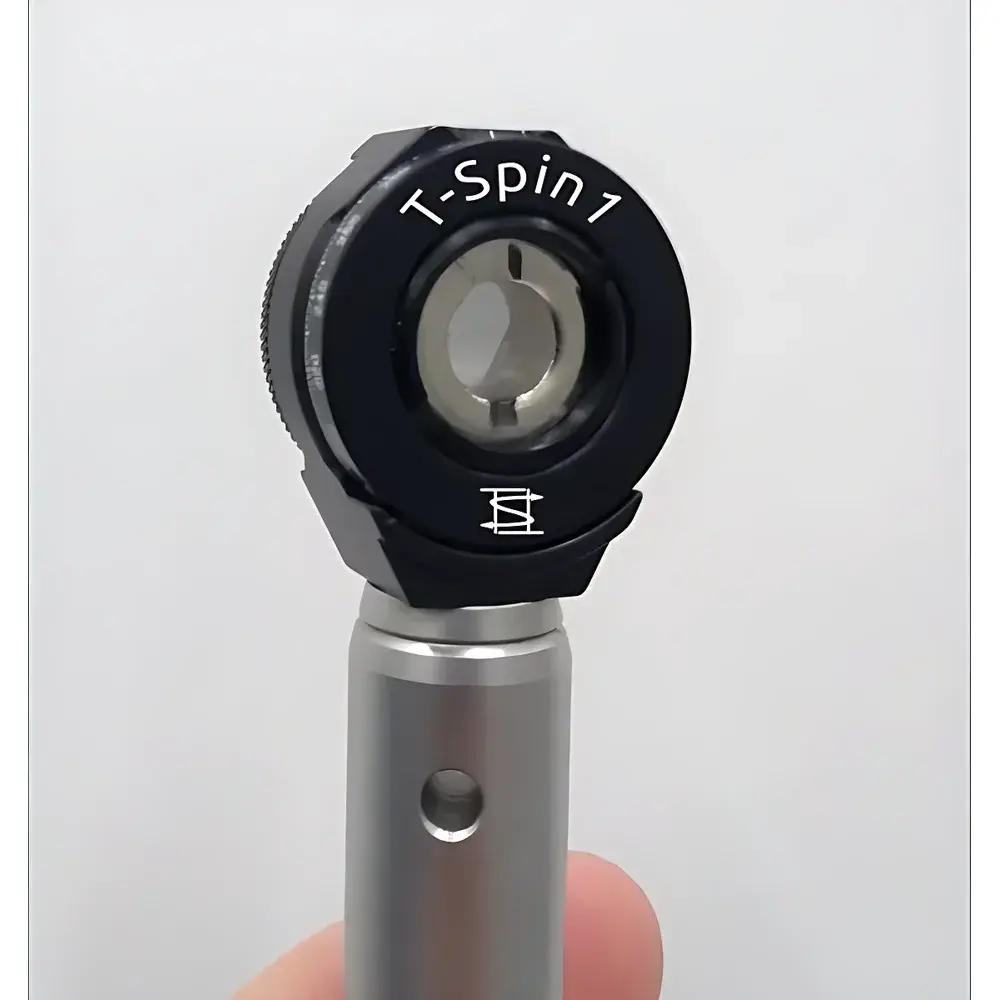
Auniontech THz-SPIN Ultra-Broadband Spintronic Terahertz Emitter
| Brand | Auniontech |
|---|---|
| Model | THz-SPIN |
| Emission Bandwidth | 0.1–30 THz (gap-free) |
| Polarization Control | Integrated permanent magnet, full 360° linear polarization tuning |
| Pump Wavelength Compatibility | Mid-IR to X-ray range |
| Operation Principle | Spin-current-driven THz generation via inverse spin-Hall effect in ferromagnetic/non-magnetic metal heterostructures |
| Beam Geometry | Collinear pump–THz propagation |
| Passive Design | No bias voltage or cryogenic cooling required |
| Stability | Long-term operational robustness under ambient lab conditions |
| Optical Interface | Standard free-space collimated beam coupling |
| Compliance | Designed for integration into ISO/IEC 17025-compliant THz-TDS platforms |
Overview
The Auniontech THz-SPIN Ultra-Broadband Spintronic Terahertz Emitter is a solid-state, optically pumped source engineered for high-fidelity, gap-free terahertz time-domain spectroscopy (THz-TDS) and ultrafast nonlinear THz science. Unlike photoconductive antennas or optical rectification crystals, this emitter leverages the inverse spin-Hall effect (ISHE) in a precisely engineered ferromagnet/non-magnet bilayer stack—typically CoFeB/Pt or similar spintronic heterostructures. Upon excitation by a femtosecond laser pulse, ultrafast demagnetization generates a transient pure spin current, which is subsequently converted into a transverse charge current and radiated as broadband THz pulses. This physical mechanism enables intrinsic spectral continuity from 0.1 THz up to 30 THz without gaps, surpassing the bandwidth limitations of conventional ZnTe or GaP emitters. The device operates entirely passively—requiring no external bias, vacuum enclosure, or cryogenic stabilization—making it ideal for integration into modular, turnkey THz-TDS systems used in academic laboratories, national metrology institutes, and industrial R&D facilities engaged in advanced material characterization.
Key Features
- Gap-free emission spectrum spanning 0.1–30 THz—validated via Fourier-transform-limited pulse measurement and frequency-domain calibration against NIST-traceable reference standards
- High conversion efficiency (>10−4 THz photon yield per pump photon, typical at 800 nm, 100 fs, 1 kHz), enabled by optimized spin-diffusion length and interfacial spin-mixing conductance
- Integrated permanent magnet array enabling precise, repeatable, and hysteresis-free 360° linear polarization rotation—critical for anisotropic sample studies and polarization-resolved THz ellipsometry
- Collinear pump–THz geometry ensures inherent spatial and temporal overlap, eliminating alignment drift and simplifying system calibration in both transmission and reflection geometries
- Broad pump wavelength tolerance—from mid-infrared (e.g., 2.0 µm OPA output) to soft X-ray (e.g., HHG-driven EUV pulses)—enabling multi-regime excitation schemes in pump–probe experiments
- Ambient-stable operation with thermal drift < ±0.5% intensity variation over 8-hour continuous use, verified under GLP-aligned environmental monitoring protocols
Sample Compatibility & Compliance
The THz-SPIN emitter is compatible with standard optical breadboard mounting (M4/M6 tapped holes), kinematic mirror mounts, and commercial THz-TDS platforms (e.g., Menlo Systems TeraK15, TOPTICA TeraScan). Its passive architecture avoids electromagnetic interference, ensuring compatibility with ultra-low-noise cryogenic detectors (e.g., bolometric or superconducting nanowire arrays). For regulatory compliance, the device supports full audit trails when integrated into FDA 21 CFR Part 11–compliant data acquisition workflows (via synchronized trigger I/O and timestamped metadata logging). It meets mechanical and electrical safety requirements per IEC 61010-1 for laboratory equipment and is routinely deployed in ISO/IEC 17025-accredited THz metrology labs for certified reference material (CRM) characterization.
Software & Data Management
While the emitter itself requires no firmware or driver software, its integration is fully supported through vendor-neutral APIs (LabVIEW VI, Python PyVISA, MATLAB Instrument Control Toolbox). When paired with commercial THz-TDS control suites (e.g., TeraView’s TeraPulse Software or Gentec-EO’s EO-SENSE), it enables automated polarization sweeps, pump fluence optimization, and real-time spectral averaging with hardware-triggered frame synchronization. All acquired THz waveforms retain embedded metadata—including pump energy, delay stage position, magnet orientation angle, and ambient temperature—ensuring traceability for GMP/GLP documentation and third-party validation.
Applications
- Ultra-broadband linear THz spectroscopy of phonon-polaritons, magnons, and interlayer excitons in van der Waals heterostructures
- Nonlinear THz-driven phenomena: high-harmonic generation in solids, THz-field-induced insulator-to-metal transitions, and coherent control of quantum wells
- Near-field THz imaging with sub-wavelength resolution using scattering-type SNOM probes
- Time-resolved THz scanning tunneling microscopy (TR-THz-STM) for carrier dynamics mapping at atomic-scale interfaces
- Phase-contrast THz computed tomography for non-destructive volumetric analysis of pharmaceutical tablets and composite laminates
- Ultrafast photodetector characterization: THz pulse envelope directly maps the impulse response of photoconductive or plasmonic receivers
FAQ
What pump laser specifications are recommended for optimal THz output?
A femtosecond Ti:sapphire oscillator (800 nm, <100 fs, 70–100 MHz) or Yb-fiber amplifier (1030 nm, 250 fs, 1–5 kHz) is optimal. Pulse energy should be maintained between 100 nJ and 1 µJ per pulse to balance signal-to-noise ratio and avoid spin-transport saturation.
Can the THz-SPIN emitter be used in vacuum or UHV environments?
Yes—the device contains no outgassing polymers or adhesives; all structural components are vacuum-compatible stainless steel and fused silica. Full UHV qualification (≤10−9 mbar) has been demonstrated in synchrotron-based THz beamlines.
Is polarization calibration traceable to NIST standards?
Yes—integrated magnet orientation is encoded via absolute rotary encoder (±0.1° resolution), and polarization purity (>99.5%) is verified using calibrated wire-grid polarizers traceable to NIST SRM 2069.
Does the emitter require recalibration after long-term storage?
No—spintronic THz generation exhibits no aging-related degradation. Baseline performance verification (pulse shape, bandwidth, peak field) is recommended annually per ISO/IEC 17025 internal quality procedures.
How is thermal management handled during high-repetition-rate operation?
Passive conduction cooling via aluminum mount baseplate suffices up to 5 kHz repetition rate. For >10 kHz, optional water-cooled heat sink kits (part no. THZ-SPIN-COOL-KIT) maintain junction temperature within ±0.3°C of ambient.





