Auniontech Handyscope Series PC-Based Oscilloscope Software
| Brand | Auniontech |
|---|---|
| Origin | Shanghai, China |
| Manufacturer Type | Authorized Distributor |
| Product Origin | Domestic (China) |
| Model | Handyscope Series |
| Pricing | Available Upon Request |
Overview
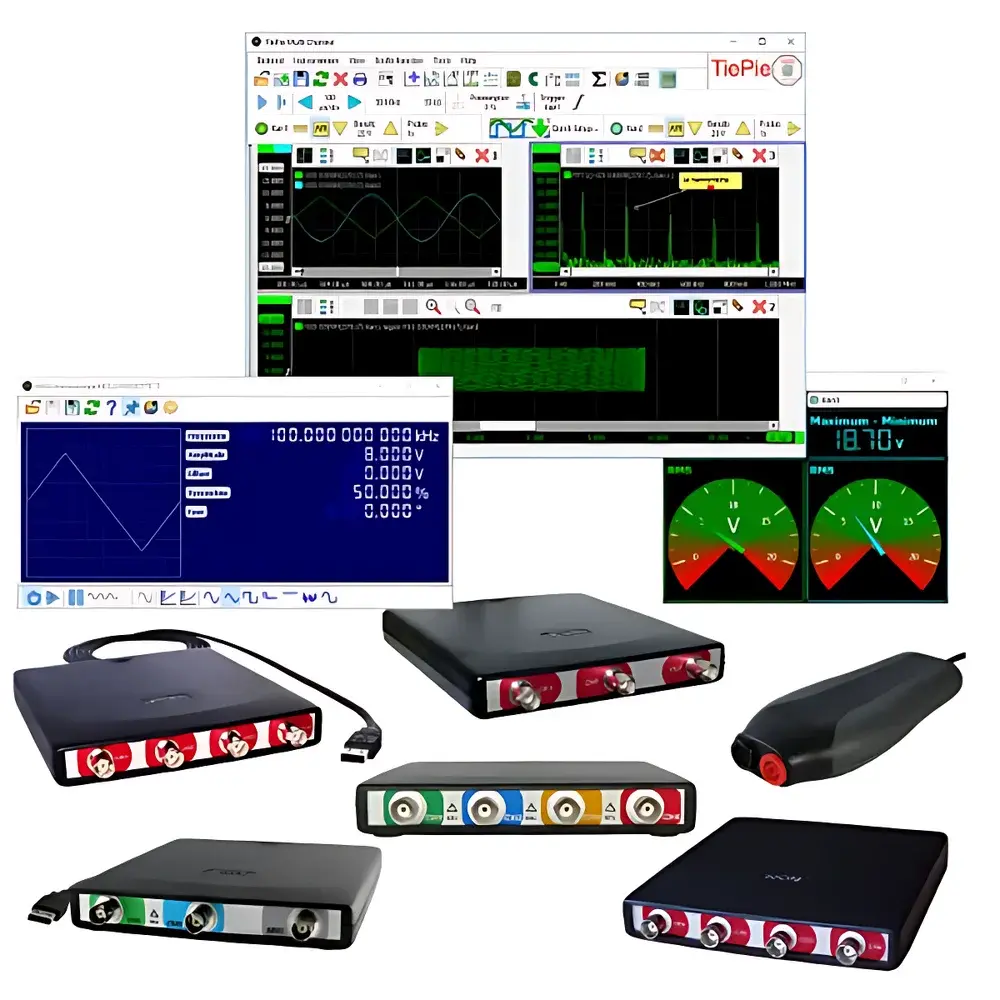
Auniontech Handyscope Series PC-Based Oscilloscope Software is a comprehensive, modular instrumentation platform designed to transform compatible USB and Wi-Fi–enabled Handyscope hardware into a multi-function test and measurement system. Unlike traditional embedded oscilloscopes, this software-centric architecture leverages the computational power and display capabilities of modern Windows PCs to deliver synchronized, high-fidelity acquisition and analysis across multiple domains—including time-domain waveform visualization, frequency-domain spectral analysis, long-duration data logging, real-time parameter measurement, arbitrary waveform generation, and protocol-level bus decoding. The software operates on a unified acquisition engine compliant with standard SCPI command sets and supports deterministic timing synchronization across distributed instruments via Ethernet or USB 2.0/3.0 interfaces. Its core architecture is engineered for laboratory-grade repeatability and engineering validation workflows—particularly in R&D labs, electronics education environments, and production test benches where flexibility, traceability, and cross-domain signal correlation are essential.
Key Features
- Multi-Instrument Fusion: Seamlessly combine up to four Handyscope units via dedicated synchronization cables to create a single logical instrument with up to 16 synchronized analog input channels—maintaining sub-nanosecond inter-channel skew and phase coherence.
- Unified Acquisition Engine: All instrument modes (oscilloscope, spectrum analyzer, data logger, multimeter, AWG, protocol analyzer) share a common timebase and trigger architecture, enabling correlated measurements across domains without manual timestamp alignment.
- Real-Time Network Transparency: Native Ethernet/Wi-Fi support enables remote control and full-feature access over LAN, WLAN, or WAN—without requiring port forwarding, static IP assignment, or network configuration expertise. Discovered instruments appear automatically in the “Available Devices” dialog.
- Extensible Math Processing Framework: Over 20 built-in mathematical operations—including integration, differentiation, FFT-based convolution, logarithmic scaling, and custom expression evaluation—are implemented as reusable I/O processing blocks. Blocks can be chained in directed graphs for advanced signal conditioning and feature extraction.
- Application-Oriented Quick Setup Library: Hierarchically organized tree structure of preconfigured measurement templates—grouped by application (e.g., power electronics, sensor characterization, serial bus debugging)—includes wiring diagrams, probe compensation guidance, reference waveforms, and context-aware help text.
- Full-Resolution Scalability: Unlimited vertical/horizontal zoom with full undo/redo history; all acquired samples remain accessible during navigation—even after deep zoom into multi-gigasample captures.
Sample Compatibility & Compliance
The software is validated for use with Auniontech Handyscope HS3, HS4, and HS5 series USB/Wi-Fi oscilloscopes (8–16-bit resolution, 10 MS/s–100 MS/s sampling rates). It supports IEEE 1149.1 (JTAG), ISO 11898-1 (CAN), SAE J1939, I²C, SPI, and UART/RS-232 physical layer protocols—enabling bit-level decoding, frame reconstruction, and error detection per respective specification annexes. While not certified to formal regulatory standards (e.g., IEC 61000-4-x, EN 61326), the software adheres to GLP-aligned practices: all measurement sessions generate timestamped, immutable audit logs containing instrument ID, firmware version, acquisition parameters, and user metadata—supporting internal traceability requirements under ISO/IEC 17025 and FDA 21 CFR Part 11 when deployed with appropriate IT governance controls.
Software & Data Management
Built on a .NET 6 runtime with native Win32 driver integration, the software provides native support for CSV, HDF5, MATLAB (.mat), and TDMS file formats for export. All captured datasets retain full metadata—including channel calibration coefficients, trigger conditions, and math block configurations—ensuring reproducibility across analysis environments. The GUI features a fully localized interface supporting English, Simplified Chinese, German, and Japanese. Role-based user profiles allow restriction of configuration changes, export permissions, and device access—facilitating shared lab deployment. Automatic firmware update checks and integrated driver signing verification ensure operational continuity and security compliance.
Applications
- Power integrity analysis (ripple, transient response, switching noise)
- Embedded system debug (I²C/SPI register reads, CAN message timing validation)
- Acoustic and vibration sensor characterization (FFT-based resonance detection)
- Educational signal processing labs (convolution, filtering, modulation/demodulation)
- Automotive ECU stimulus testing (replay of calibrated crank/cam sensor waveforms)
- Long-term environmental monitoring (temperature, humidity, pressure trends over hours/days)
- RF front-end validation (harmonic distortion analysis, AM/FM demodulation metrics)
FAQ
Is the software compatible with Linux or macOS?
No. The software is exclusively supported on Windows 10/11 (64-bit) due to low-level USB/Ethernet driver dependencies and .NET runtime requirements.
Can I automate measurements using external scripts?
Yes. The software exposes a COM automation interface and SCPI-over-TCP/IP command set—enabling integration with Python (pyvisa), LabVIEW, MATLAB, and custom C# applications.
Does the software support hardware-accelerated FFT?
Yes. When running on systems with Intel AVX-512 or AMD Zen 4 CPUs, the spectrum analyzer module automatically offloads FFT computation to vector instruction units—reducing latency by up to 40% for real-time 1 M-point transforms.
What is the maximum record length supported?
Record length is constrained only by available system RAM and storage bandwidth—not by software licensing. Users routinely acquire and analyze 2+ billion sample buffers on workstations with ≥32 GB RAM.
Are calibration certificates provided with the software?
The software itself is not calibrated; however, each Handyscope hardware unit ships with NIST-traceable calibration documentation. Software-generated measurements inherit the uncertainty budget of the connected instrument’s analog front-end and clock source.