
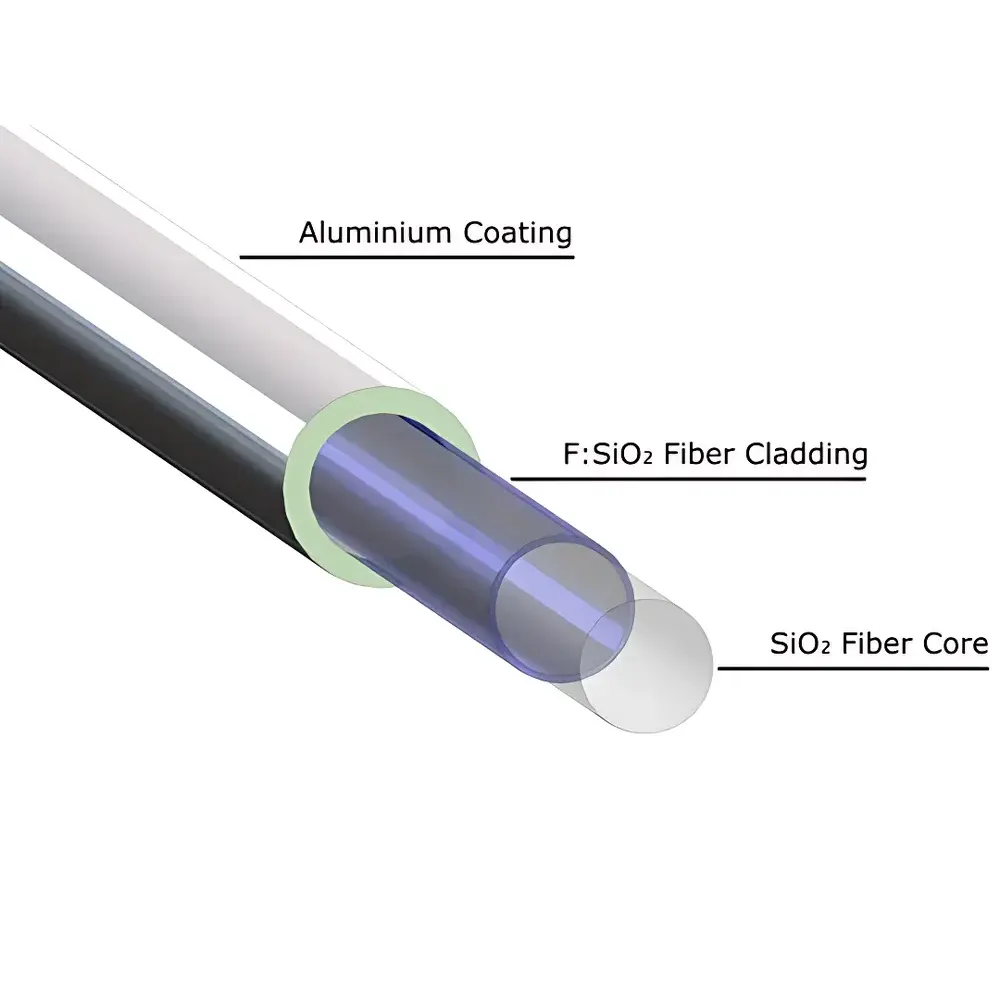
Auniontech Metal-Coated Optical Fiber
| Brand | Auniontech |
|---|---|
| Coating Material | Aluminum or Copper Alloy |
| Core Diameter | 9–600 µm |
| Cladding Diameter | 125–660 µm |
| Coating Thickness | 140–825 µm |
| Numerical Aperture | 0.13–0.22 |
| Operating Temperature Range | −270 °C to +600 °C |
| Environmental Resistance | 100% RH, High Vacuum, Sterilizable (Steam, EtO, Gamma) |
| Spectral Range | 220–2400 nm |
| Fiber Type | Step-Index Multimode, Graded-Index Multimode, Single-Mode |
| Compliance | Suitable for ISO/IEC 61300, MIL-STD-883, ASTM F2477 (optical fiber durability), USP <85> (for medical sterilization validation) |
Overview
Metal-coated optical fibers are engineered for mission-critical photonic applications where conventional polymer- or acrylate-coated fibers fail—particularly under extreme thermal, mechanical, vacuum, or chemically aggressive conditions. Unlike standard silica fibers, these fibers feature a hermetically sealed metallic cladding (aluminum or copper alloy) directly applied over the glass cladding, eliminating outgassing, moisture ingress, and thermal delamination. The metal layer serves both as a robust mechanical barrier and an efficient thermal conductor, enabling stable light transmission across cryogenic (−270 °C) to ultra-high-temperature (up to +600 °C) environments. This architecture supports reliable operation in high-vacuum chambers (≤10−9 mbar), sterilization autoclaves, reactive gas atmospheres, and high-power laser delivery systems where beam stability and long-term reliability are non-negotiable.
Key Features
- Hermetic metal encapsulation: Aluminum or copper alloy coating provides zero-permeability barrier against H2O vapor, O2, and hydrocarbons—critical for vacuum-compatible optical feedthroughs and space-grade instrumentation.
- Extended thermal resilience: Aluminum-coated variants sustain continuous operation up to +400 °C; copper-alloy versions extend to +600 °C with minimal attenuation drift (<0.05 dB/m change per 100 °C rise in controlled testing).
- Vacuum compatibility: Meets outgassing requirements per ASTM E595: TML ≤ 0.5%, CVCM ≤ 0.1%, ensuring no contaminant deposition on adjacent optics or sensors.
- Sterilization-ready design: Fully compatible with steam autoclaving (134 °C, 3 bar), ethylene oxide (EtO) exposure, and gamma irradiation (≥25 kGy)—validated per ISO 11137 and USP .
- Weldable termination: Metallic surface enables direct laser welding or resistance bonding to stainless steel housings, ceramic ferrules, or metalized connectors—eliminating epoxy-based interfaces prone to thermal fatigue.
- Enhanced thermal dissipation: Copper-alloy coating exhibits thermal conductivity >300 W/m·K, enabling efficient heat extraction from high-power laser coupling points (e.g., 1–10 kW CW fiber lasers).
Sample Compatibility & Compliance
This fiber family includes step-index multimode (9–600 µm core), graded-index multimode (50 µm), and single-mode (9 µm) configurations—all manufactured from high-OH or low-OH synthetic fused silica preforms. Standard aluminum-coated variants operate from deep UV (220 nm) through NIR (2400 nm); copper-alloy versions maintain comparable transmission above 350 nm but exhibit higher absorption below 400 nm due to native Cu oxide formation. All fibers comply with IEC 60793-2-10 (multimode) and IEC 60793-2-50 (single-mode) dimensional tolerances. Mechanical proof testing is performed at ≥100 kpsi (0.7 GPa), exceeding Telcordia GR-20-CORE requirements. Batch traceability includes spectral attenuation curves (190–2500 nm), tensile strength histograms, and vacuum bakeout logs.
Software & Data Management
While inherently passive, these fibers integrate seamlessly into calibrated photonic measurement systems governed by ISO/IEC 17025-compliant workflows. When deployed in distributed sensing arrays (e.g., FBG or Raman-based temperature monitoring), they support full audit trails per FDA 21 CFR Part 11 when paired with validated DAQ platforms (e.g., Micron Optics sm125, Luna ODiSI). Raw spectral data generated during qualification testing—including wavelength-dependent loss, numerical aperture verification, and thermal cycling hysteresis—are archived in vendor-provided .csv/.xlsx formats with embedded metadata (batch ID, draw date, coating thickness XRF scan report, and environmental test logs).
Applications
- High-temperature industrial process monitoring (e.g., molten metal bath thermometry, turbine blade surface temperature mapping)
- Downhole optical sensing in oil & gas wells (200 °C+, H2S-rich environments)
- Spacecraft avionics interconnects and satellite payload telemetry links
- Medical laser delivery for ablation, coagulation, and photodynamic therapy—where repeated sterilization cycles demand material integrity
- Ultra-high-vacuum beamlines in synchrotron facilities and fusion research (e.g., ITER diagnostics)
- Combustion diagnostics in jet engines and scramjets using UV-absorption spectroscopy
- Deep-UV lithography illumination systems requiring low-fluorescence, low-outgassing waveguides
FAQ
Can metal-coated fibers be connectorized using standard FC/PC or SMA fittings?
Yes—custom metal-ferrule assemblies (e.g., stainless steel or Invar) are available with precision bore alignment and laser-welded terminations. Polymer-based connectors are not recommended.
What is the typical attenuation coefficient at 1550 nm for 200/220 µm Al-coated fiber?
Measured median value is 12–15 dB/km at 1550 nm (including coating-induced microbend contribution), consistent with ITU-T G.651.1 specifications for multimode telecom fiber.
Is hydrogen darkening a concern in high-radiation environments?
No—metal encapsulation prevents H2 diffusion into the core. Radiation-induced attenuation (RIA) at 1 MGy(Si) is <0.5 dB/m at 850 nm, per IEEE 383-2019 qualification protocols.
How does the metal coating affect polarization-maintaining performance?
Standard variants are non-PM. For PM applications, elliptical-core or PANDA-style designs with metal cladding are available upon request—maintaining extinction ratio >20 dB over −40 to +200 °C.
Do you provide spectral transmission data for custom lengths?
Yes—full-range (190–2500 nm) spectrophotometric scans are included with every order of ≥10 m length, referenced to NIST-traceable standards.






