
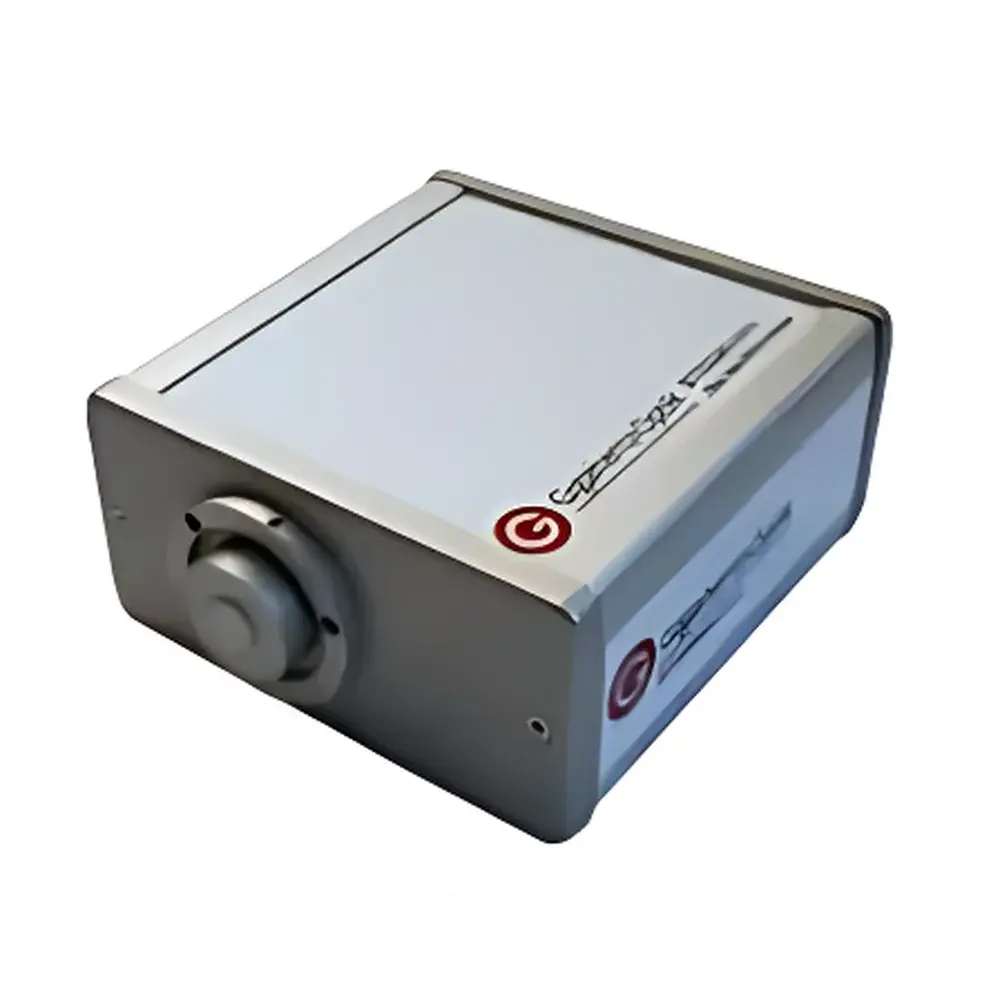
Gigahertz-Optik BTS256-LED BiTec Spectroradiometer for LED Luminous Flux and Color Measurement
| Brand | Gigahertz-Optik |
|---|---|
| Origin | Germany |
| Model | BTS256-LED |
| Spectral Range | 360–830 nm |
| Spectral Bandwidth | 5 nm |
| Wavelength Accuracy | ±1 nm |
| Wavelength Repeatability | ±0.0001 (Standard A Source), ±0.0002 (LED) |
| Detector Type | BiTec sensor (Si photodiode + CMOS diode array spectrometer) |
| Integration Sphere Diameter | 50 mm with diffuse coating |
| Measurement Port | Tapered conical port |
| Interface | USB 2.0 |
| Calibration | DAkkS-accredited ISO/IEC 17025 laboratory (DK-15047-01-00), traceable to PTB standards |
| Software | S-BTS256 (included), supports spectral mismatch correction (f₁′ ≤ 1.5% after correction) |
Overview
The Gigahertz-Optik BTS256-LED is a compact, high-precision BiTec spectroradiometer engineered for absolute measurement of luminous flux, spectral power distribution (SPD), chromaticity coordinates (x, y), correlated color temperature (CCT), and color rendering index (CRI, including R₁–R₁₅ and Rₐ) of individual visible and near-infrared (VIS-NIR) LEDs. Its core architecture integrates two complementary optical detection principles within a single instrument: a V(λ)-matched silicon photodiode optimized for high dynamic range, linearity, and temporal response; and a calibrated CMOS-based diode array spectrometer delivering high-resolution spectral data across 360–830 nm at 1 nm data resolution. The BiTec principle enables real-time mutual correction—spectral data from the array calibrates the photodiode’s spectral responsivity, while the photodiode provides absolute radiometric scaling for the spectrometer—thereby eliminating systematic errors arising from spectral mismatch (f₁′ ≤ 1.5% post-correction). This dual-detector architecture is particularly critical for accurate characterization of narrowband and phosphor-converted LEDs under pulsed (e.g., PWM-driven) or thermally variable operating conditions.
Key Features
- Compact aluminum housing with integrated 50 mm integrating sphere featuring Lambertian-coated interior and tapered conical measurement port—enabling direct board-level LED mounting and thermal-effect-inclusive measurement.
- BiTec dual-sensor system: V(λ)-filtered Si photodiode + CMOS diode array spectrometer—ensuring simultaneous high-speed photometric and spectrometric acquisition with intrinsic cross-calibration.
- Remote-controlled mechanical shutter for precise dark-current compensation and software-actuated auxiliary lamp for self-absorption correction (in-sphere calibration without external reference sources).
- USB 2.0 interface with included S-BTS256 software for full remote operation, automated measurement sequences, real-time data visualization, and compliance-ready reporting.
- DAkkS-accredited ISO/IEC 17025 calibration (certificate DK-15047-01-00) covering both spectral responsivity and spectral irradiance, traceable to Physikalisch-Technische Bundesanstalt (PTB) standards.
- Two independent calibration modes: one optimized for 2π Lambertian emission (e.g., diffused LEDs), another for directional sources—supporting accurate flux measurement across diverse LED packages and beam profiles.
Sample Compatibility & Compliance
The BTS256-LED is designed for single-LED testing in R&D, incoming inspection, and inline QC environments. It accommodates surface-mount (SMD), through-hole, and COB-type LEDs mounted directly onto test PCBs inserted via the conical port. Its 50 mm sphere supports maximum input flux up to 70,000 lm, with noise-equivalent flux of 0.05 mlm—making it suitable for low-flux micro-LEDs and high-power automotive or horticultural emitters. All measurements comply with CIE S 025/E:2015, IES LM-79-19, and EN 13032-4 for LED photometric testing. The instrument’s firmware and S-BTS256 software support audit trails, user access control, and electronic signatures—facilitating alignment with GLP, GMP, and FDA 21 CFR Part 11 requirements where documentation integrity is mandated.
Software & Data Management
S-BTS256 provides a validated, Windows-based platform for configuration, acquisition, analysis, and export. It computes CIE 1931 xy, CIE 1976 u’v’, CCT (1700–17000 K), Duv, CRI (Ra, R₁–R₁₅), TM-30 metrics (Rf, Rg), and spectral integrals (e.g., PAR, PUR). Raw spectral data (CSV, TXT) and formatted reports (PDF, Excel) are exportable. Spectral mismatch correction is applied automatically using measured SPD and CIE V(λ) function—reducing f₁′ error from ≤6% (uncorrected) to ≤1.5%. Batch measurement scripts, pass/fail thresholds, and statistical process control (SPC) charts support high-throughput production validation.
Applications
- LED binning and grading in manufacturing—verifying compliance with JEDEC JESD78 and IEC 62717 tolerances for flux, CCT, and Δu’v’.
- Thermal derating studies—measuring flux and chromaticity drift under controlled junction temperature via integrated thermal pads or external thermal chambers.
- R&D of phosphor-converted white LEDs, UV-pumped RGB systems, and NIR emitters (700–830 nm) for sensing and biomedical applications.
- Automotive lighting validation per UNECE R149 and SAE J1383, including pulse-width-modulated (PWM) dimming performance assessment.
- Calibration lab transfer standards—leveraging DAkkS-traceable certification for inter-laboratory comparison and reference instrument qualification.
FAQ
What is the BiTec measurement principle, and how does it improve accuracy?
BiTec combines a linear, high-speed Si photodiode with a CMOS spectrometer in one optical path. The photodiode provides absolute radiometric scaling; the spectrometer delivers wavelength-resolved data. Their signals are cross-referenced in real time to correct for spectral responsivity deviations—especially critical for LEDs with non-Lambertian emission or complex SPDs.
Can the BTS256-LED measure pulsed or PWM-driven LEDs?
Yes. Its microsecond-scale integration time (5.2–30,000 ms) and synchronized shutter enable time-resolved acquisition of modulated signals. The BiTec architecture ensures accurate averaging over multiple PWM cycles without aliasing.
Is the calibration valid for both standard A-source and LED-specific measurements?
Yes. The instrument undergoes dual-mode calibration: one using a DAkkS-certified reference lamp for broad-spectrum sources, and another using narrowband LED standards—ensuring traceability and uncertainty budgets appropriate for each source type.
Does the system support automated production-line integration?
Yes. S-BTS256 offers COM/ActiveX interfaces and command-line control (SCPI-like syntax), enabling integration into LabVIEW, Python, or PLC-based test stations with full metadata logging and pass/fail flagging.
How is stray light minimized in the optical design?
The BTS256-LED achieves effectively zero stray light (<0.001% relative) through a combination of optimized grating design, multi-stage internal baffling, and detector shielding—validated per CIE Publication 177:2006.
Related Products






