
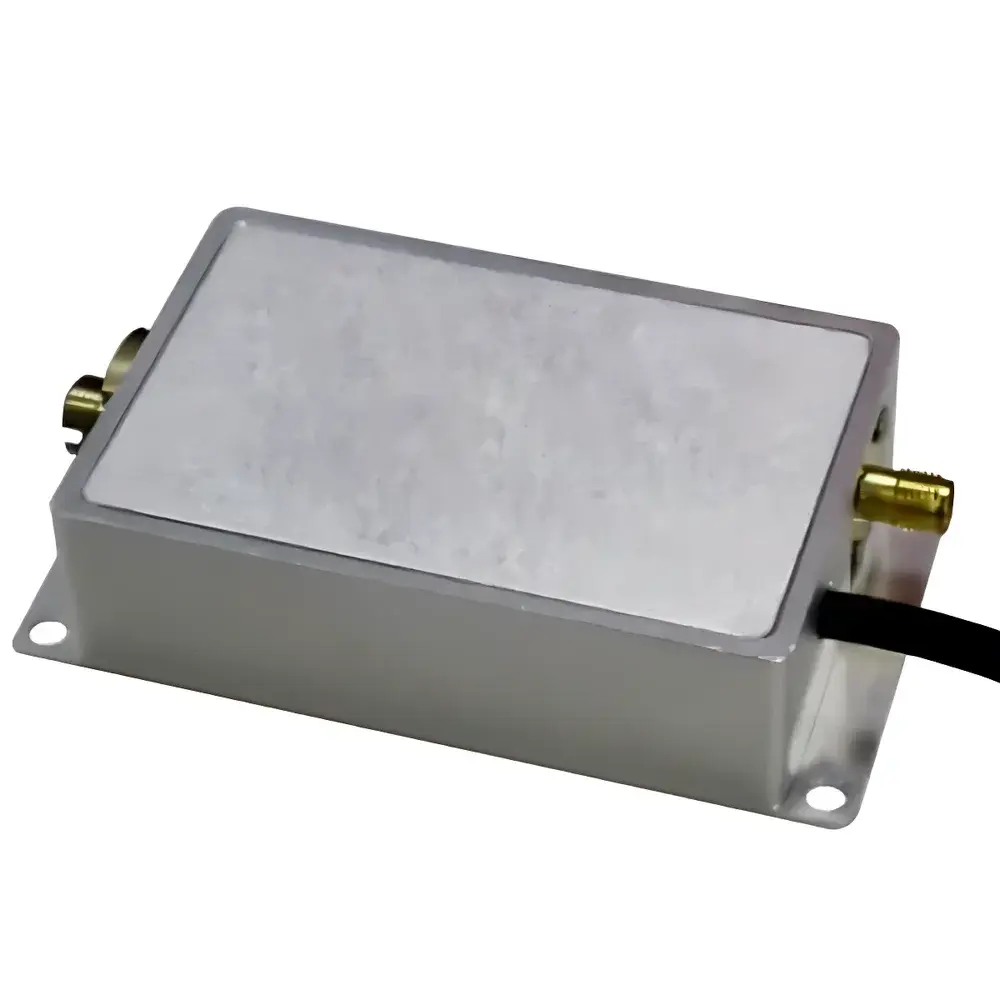
Auniontech InGaAs APD Photodetector 800–1700 nm
| Brand | Auniontech |
|---|---|
| Origin | Shanghai, China |
| Model | InGaAs APD Photodetector |
| Wavelength Range | 800–1700 nm |
| Bandwidth | DC to 250 MHz |
| Responsivity (λ = 1310 nm, Vr = 0 V) | 0.85 mA/mW |
| Responsivity (λ = 1550 nm, Vr = 0 V) | 0.9 mA/mW |
| Transimpedance Gain | 22 kV/A |
| Output Impedance | 50 Ω |
| Optical Input | FC/APC |
| Electrical Output | SMA |
| Supply Voltage | +9 to +12 V (single supply) |
| Operating Current | <100 mA |
| Operating Temperature | −40 to +85 °C |
| Storage Temperature | −50 to +100 °C |
| Detector Active Diameter | 75 µm |
| Housing | Hermetically Sealed All-Metal Enclosure with EMI Shielding |
Overview
The Auniontech InGaAs APD Photodetector (800–1700 nm) is a high-sensitivity, wide-bandwidth photoreceiver engineered for precision optical signal detection in demanding scientific and industrial environments. Based on an InGaAs avalanche photodiode (APD) architecture, it operates across the near-infrared (NIR) and short-wave infrared (SWIR) spectral bands—specifically optimized for telecom wavelengths (1310 nm and 1550 nm), as well as broader applications from 800 nm to 1700 nm. Its internal transimpedance amplifier delivers a stable 22 kV/A gain, enabling reliable detection of low-power continuous-wave (CW) and nanosecond-scale pulsed optical signals. The detector’s DC-coupled, 250 MHz bandwidth supports time-resolved measurements including heterodyne beat-note analysis, ultrafast pulse characterization, and coherent optical sensing. Designed with a hermetically sealed all-metal housing, it provides superior electromagnetic interference (EMI) shielding and thermal stability—critical for integration into laser interferometry, quantum optics setups, or field-deployable optical communication systems.
Key Features
- InGaAs APD sensor with 75 µm active diameter, offering high quantum efficiency across 800–1700 nm
- DC to 250 MHz analog bandwidth, supporting both CW and pulsed laser detection with sub-nanosecond temporal resolution
- Low-noise transimpedance amplifier with fixed 22 kV/A gain and 50 Ω output impedance for direct compatibility with oscilloscopes and RF spectrum analyzers
- FC/APC optical input interface ensures low back-reflection coupling for high-fidelity signal integrity in interferometric and coherent applications
- SMA electrical output connector enables standardized 50 Ω impedance matching and minimal signal distortion up to 250 MHz
- Single-supply operation (9–12 V DC), consuming <100 mA; suitable for integration into compact, low-power instrumentation platforms
- Robust all-metal enclosure with EMI/RFI shielding, rated for operation from −40 °C to +85 °C and storage up to +100 °C
Sample Compatibility & Compliance
This photodetector is compatible with standard single-mode and multimode fiber sources emitting within the 800–1700 nm range, including distributed feedback (DFB) lasers, tunable external cavity lasers (ECLs), superluminescent diodes (SLDs), and mode-locked fiber lasers. It meets mechanical and electrical interface requirements aligned with IEC 61315 (optical fiber components) and IEEE 802.3 standards for optical receiver sensitivity in datacom applications. While not certified to specific regulatory frameworks (e.g., FDA, CE, or RoHS) out-of-the-box, its design adheres to GLP-aligned documentation practices for traceable calibration and performance validation. Users deploying this detector in regulated environments (e.g., medical laser safety monitoring or aerospace optical telemetry) are advised to perform system-level qualification per ISO/IEC 17025 or relevant application-specific standards.
Software & Data Management
The detector operates as a standalone analog front-end and does not include embedded firmware or onboard digitization. It is fully compatible with third-party data acquisition systems—including National Instruments PXI platforms, Keysight Infiniium oscilloscopes, and MATLAB-based real-time acquisition toolboxes—enabling synchronized time-domain and frequency-domain analysis. When integrated into automated test benches, the device supports audit-ready workflows when paired with software enforcing 21 CFR Part 11-compliant electronic signatures and data integrity controls (e.g., LabVIEW with DIAdem or Python-based acquisition scripts with HDF5 logging). Calibration certificates—including wavelength-dependent responsivity curves and bandwidth roll-off characterization—are provided upon request and traceable to NIST-calibrated reference detectors.
Applications
- Heterodyne detection of beat frequencies between two closely spaced NIR lasers for precision spectroscopy and optical frequency metrology
- Time-of-flight (ToF) and intensity-modulated continuous-wave (IM-CW) LiDAR receivers in autonomous vehicle and underwater optical communication systems
- Quantum key distribution (QKD) receiver modules requiring high gain-bandwidth product and low dark current
- Non-destructive testing (NDT) using laser ultrasonics or photothermal imaging, where broadband NIR excitation and detection are essential
- Ultrafast laser pulse diagnostics—including autocorrelation, FROG, and SPIDER pre-amplification stages—leveraging its sub-ns rise time
- Industrial process monitoring in semiconductor wafer inspection and thin-film thickness measurement via reflectometry
FAQ
Is this detector suitable for free-space optical alignment?
Yes—when coupled with appropriate collimating optics and FC-to-free-space adapters, it can be used for beam profiling, alignment verification, and power stabilization loops.
Can the bandwidth be extended beyond 250 MHz?
Custom variants with enhanced bandwidth (up to 1 GHz) are available upon request; these require modified amplifier topology and may affect noise floor and gain flatness.
Does the detector include temperature compensation?
No built-in thermoelectric cooler (TEC) or compensation circuitry is integrated; however, the APD’s dark current drift is minimized through optimized biasing and metal-can thermal mass, ensuring stable operation over the full −40 to +85 °C range.
What is the maximum optical input power before saturation?
Saturation occurs at approximately −10 dBm (0.1 mW) for the 22 kV/A gain setting; users requiring higher dynamic range should consider optional attenuators or lower-gain configurations.
Is calibration data provided with each unit?
Each detector ships with a factory-measured responsivity curve (800–1700 nm), bandwidth response plot (DC–250 MHz), and dark current specification sheet; NIST-traceable calibration is available as an add-on service.






