
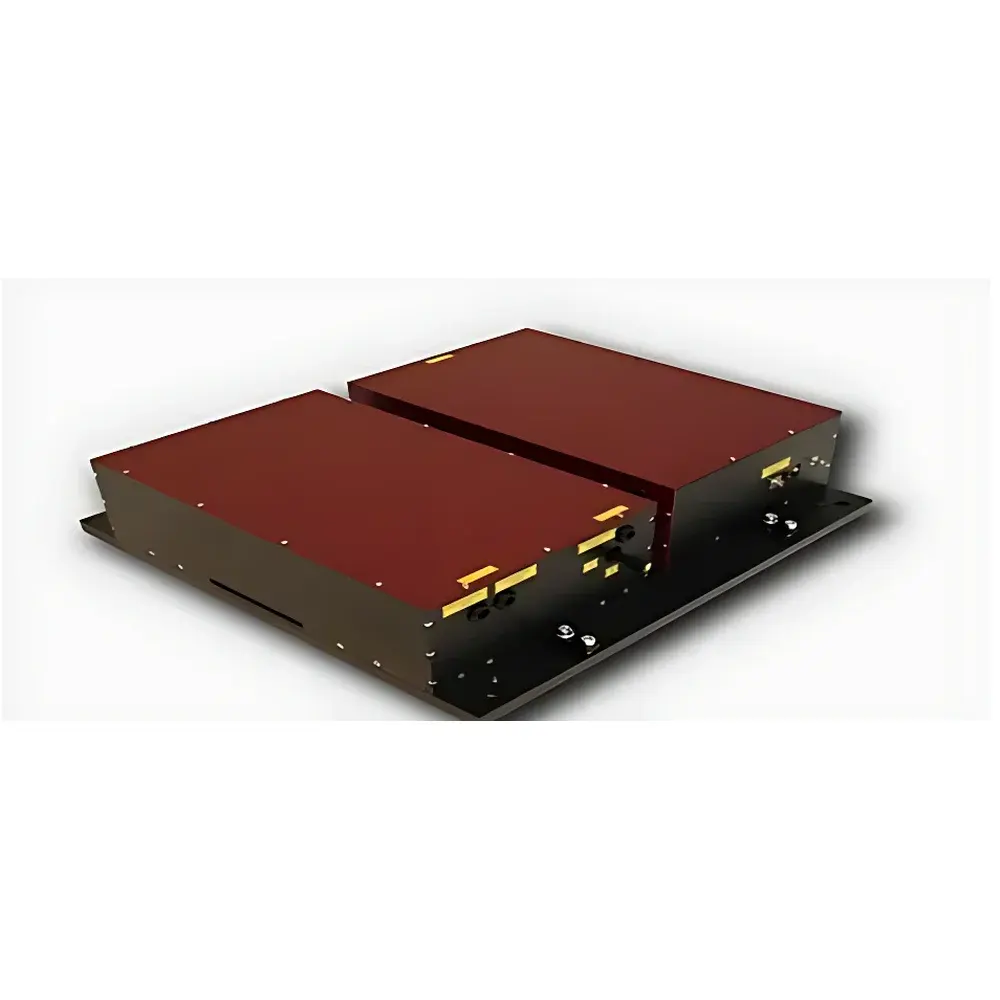
Avesta EFOA-SH-UB Multi-Wavelength Femtosecond Fiber Laser System
| Origin | Russia |
|---|---|
| Manufacturer Type | Distributor |
| Origin Category | Imported |
| Model | EFOA-SH-UB |
| Price | USD 1,450 (est.) |
| Core Components | Yb-doped mode-locked fiber oscillator, SHG crystal module, supercontinuum generation module |
Overview
The Avesta EFOA-SH-UB is a turnkey multi-wavelength femtosecond fiber laser system engineered for advanced ultrafast optical research. Based on a robust, all-fiber Yb-doped mode-locked oscillator operating at 1560 nm, the system integrates three synchronized output channels via nonlinear frequency conversion: fundamental (1560 nm), second harmonic (780 nm), and broadband supercontinuum (1100–2000 nm). All outputs are temporally overlapped with sub-150 fs pulse duration and share a common 70 MHz repetition rate, enabling precise pump-probe synchronization and multi-color excitation without external timing electronics. Unlike bulk Ti:sapphire or Cr:forsterite lasers, the EFOA-SH-UB eliminates reliance on high-power green pump lasers—reducing thermal load, alignment sensitivity, and long-term maintenance overhead—while delivering comparable temporal resolution and spectral flexibility in a compact, air-cooled architecture.
Key Features
- Triple-wavelength output from a single platform: 1560 nm (fundamental), 780 nm (SHG), and 1100–2000 nm (supercontinuum)
- Pulse duration <150 fs across all channels, with fixed 70 ± 5 MHz repetition rate
- High amplitude stability: RMS power fluctuation <1% over 24 hours (measured at 780 nm output)
- Integrated fiber-coupled service port (1560 nm, FC/APC, ~1 mW) and TTL-compatible HF sync output (SMA)
- Compact modular design: laser head (430 × 455 × 120 mm), control unit (353 × 260 × 155 mm), and SHG unit (200 × 160 × 60 mm)
- Linear polarization maintained across outputs: horizontal at 1560 nm, vertical at 780 nm
- Mode-lock status indicator via dual-output interface (3.5 V / 0 V TTL + front-panel LED)
Sample Compatibility & Compliance
The EFOA-SH-UB is designed for integration into regulated and non-regulated laboratory environments. Its all-fiber construction ensures mechanical and thermal stability suitable for long-duration experiments requiring reproducible pulse characteristics. While not certified to IEC 61000-6-3 (EMC) or FDA 21 CFR Part 11 out-of-the-box, the system supports traceable calibration protocols and can be configured with optional audit-trail logging software for GLP/GMP-aligned workflows. Output wavelengths comply with ISO 11146-1:2019 (laser beam parameters) and align with common spectral windows used in ultrafast spectroscopy (e.g., ASTM E275-22 for UV-Vis-NIR reference standards). The 780 nm and 1560 nm outputs meet Class 4 laser safety requirements per IEC 60825-1:2014; full compliance documentation is provided upon request.
Software & Data Management
The system operates via a dedicated Windows-based control application supporting real-time monitoring of mode-lock status, output power (via integrated photodiodes), and temperature stabilization feedback. All operational states—including channel selection, shutter control, and sync output enable/disable—are programmable via ASCII command set over USB virtual COM port, enabling seamless integration with LabVIEW, Python (PySerial), or MATLAB automation frameworks. Data logs (timestamped power readings, lock status transitions, thermal sensor outputs) are exported in CSV format with configurable sampling intervals (1 Hz to 1 kHz). Optional firmware upgrade paths support future integration with time-stamped metadata tagging aligned with FAIR data principles.
Applications
- Multi-photon microscopy: Simultaneous excitation at 780 nm (two-photon) and 1560 nm (three-photon) enables depth-resolved imaging in scattering tissues with reduced photodamage
- Pump-probe spectroscopy: Cross-channel delay tuning (via motorized stages or optical delay lines) facilitates carrier dynamics studies in semiconductors, perovskites, and 2D materials
- Optical parametric amplification (OPA) seeding: Broadband SC output serves as tunable seed source for white-light continuum generation in NOPA systems
- Frequency comb metrology: 70 MHz repetition rate and low phase noise enable direct f–2f interferometry when combined with octave-spanning SC and Er:fiber-based fCEO detection
- Ultrafast material processing: High peak intensity at 780 nm enables precision ablation of transparent dielectrics and thin-film patterning without thermal diffusion
FAQ
Is the EFOA-SH-UB compatible with vacuum chamber integration?
Yes—the laser head and control units are convection-cooled and contain no moving parts or outgassing components; optional CF-flanged fiber feedthroughs are available.
Can the supercontinuum bandwidth be spectrally filtered in real time?
The SC output is delivered via free-space collimated beam; standard configurations include a manual bandpass filter wheel; motorized filter changers and AOTFs can be integrated upon request.
What is the typical warm-up time to achieve specified power stability?
Less than 30 minutes from cold start at 22 ± 5 °C ambient; full specification stability (<1% RMS) is achieved within 2 hours.
Does the system support external cavity dispersion compensation?
Yes—each output port includes a pair of adjustable grating compressors (optional); group delay dispersion (GDD) tuning range: ±50,000 fs² at 780 nm.
Are OEM integration kits available for custom enclosures or OEM instrument embedding?
Yes—Avesta provides mechanical drawings, electrical interface schematics, and API documentation under NDA for embedded system development.




