
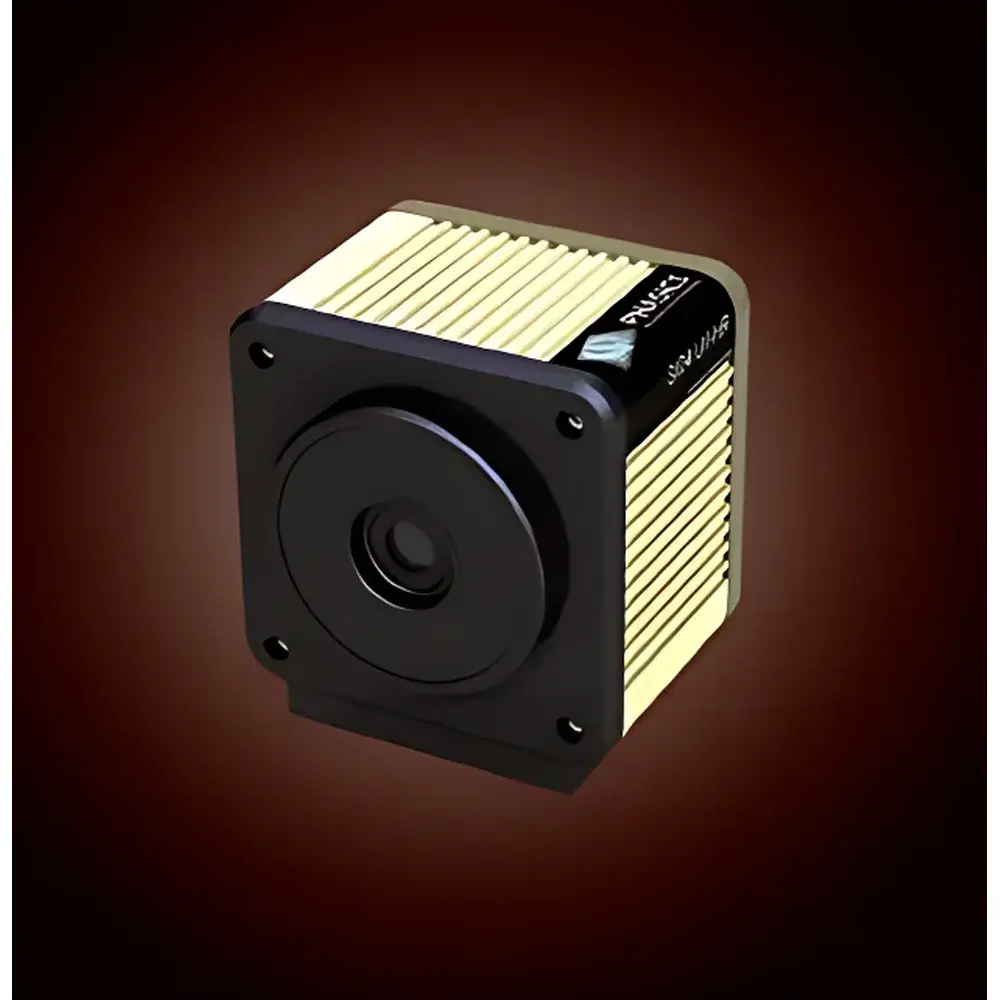
Phasics SID4 UV-HR and SID4-UV High-Resolution Wavefront Sensors
| Brand | Phasics |
|---|---|
| Origin | Germany |
| Manufacturer Type | Authorized Distributor |
| Origin Category | Imported |
| Model | SID4 UV-HR, SID4-UV |
| Price Range | USD 42,000–70,000 (FOB) |
| Operating Principle | Push-broom scanning |
| Imaging Mode | 3D phase-resolved imaging |
| Deployment | Ground-based and airborne platforms |
| Spectral Range | 190–400 nm |
| Spectral Resolution | 0.025 nm |
| Spatial Sampling | 250 × 250 points |
| Total Field of View (TFOV) | 5° |
| Instantaneous Field of View (IFOV) | 29.6 µrad |
| Frame Rate | 30 fps |
| Phase Accuracy | 20 nm RMS (SID4-UV), 10 nm RMS (SID4 UV-HR) |
| Sensitivity | 2 nm RMS @ 250 nm, 2 µJ/cm² (SID4-UV) |
| Dynamic Range | >200 µm |
| Aperture Size | 8.0 × 8.0 mm² (SID4 UV-HR), 7.4 × 7.4 mm² (SID4-UV) |
| Dimensions | 95 × 105 × 84 mm (SID4 UV-HR), 53 × 63 × 83 mm (SID4-UV) |
| Weight | 900 g (SID4 UV-HR), 450 g (SID4-UV) |
Overview
The Phasics SID4 UV-HR and SID4-UV are high-precision, Shack–Hartmann-based wavefront sensors engineered for quantitative phase measurement in the deep ultraviolet (DUV) to near-UV spectral range (190–400 nm). Unlike conventional interferometric or shearing-based systems, these sensors employ a proprietary micro-lens array coupled with a scientific-grade back-illuminated CCD/CMOS detector optimized for UV quantum efficiency and low read noise. The push-broom scanning architecture enables full-field, single-shot wavefront reconstruction without mechanical scanning—critical for dynamic beam characterization in ultrafast laser diagnostics, synchrotron beamlines, and EUV lithography R&D. Each sensor delivers diffraction-limited spatial sampling at 250 × 250 measurement points across its active aperture, supporting real-time Zernike mode decomposition, aberration mapping, and Strehl ratio computation per frame.
Key Features
- UV-optimized optical design: Anti-reflection coated fused silica micro-lens array and UV-enhanced silicon sensor deliver >65% quantum efficiency at 254 nm and >40% at 193 nm.
- True achromatic operation: No wavelength-dependent calibration required across 190–400 nm; validated per ISO 10110-5 for wavefront error stability under spectral shift.
- High dynamic range & sensitivity: >200 µm peak-to-valley (PV) wavefront deviation tolerance with sub-nanometer RMS sensitivity (0.5 nm RMS for SID4 UV-HR at 250 nm, 2 µJ/cm² illumination).
- Ruggedized OEM-ready packaging: Aluminum alloy housing rated IP52, thermal drift <0.05 λ/°C over 15–35°C ambient, compatible with vacuum flange mounting (CF35 optional).
- Real-time processing engine: Onboard FPGA-accelerated centroiding and Zernike fitting at up to 30 fps (full resolution), with USB 3.2 Gen 1 interface and deterministic latency <1.2 ms.
Sample Compatibility & Compliance
The SID4 UV-HR and SID4-UV support collimated and convergent beams with divergence angles up to ±15 mrad. They are routinely deployed in Class 100 cleanrooms for excimer laser metrology (ArF, KrF), EUV source characterization, and UV optical testing of aspheric mirrors and diffractive optics. Both models comply with IEC 61000-6-3 (EMC emissions), ISO 10110-5 (surface irregularity measurement), and ASTM E2844-18 (wavefront sensor performance verification). Data acquisition workflows meet GLP/GMP audit requirements via optional timestamped HDF5 output with embedded metadata (wavelength, exposure time, temperature, lenslet pitch), traceable to NIST-traceable UV radiometric standards.
Software & Data Management
Bundled Phasics WFS Studio v5.2 provides turnkey control, visualization, and analysis—including live MTF/PSF synthesis, aberration budgeting, and ISO 21247-compliant wavefront error reporting. Raw phase maps are exported in IEEE 754 double-precision floating-point format (.bin or .tiff) with georeferenced pixel metadata. For regulated environments, optional FDA 21 CFR Part 11 compliance package includes electronic signatures, role-based access control, audit trail logging (user action, timestamp, parameter change), and encrypted data storage. API support includes Python (pyPhasics), MATLAB, LabVIEW (NI-VISA), and C/C++ SDKs with thread-safe multithreaded callbacks.
Applications
- Laser beam quality assessment: M², BPP, and far-field intensity reconstruction for industrial UV lasers (e.g., Coherent AVIA, Trumpf TruMicro).
- Adaptive optics closed-loop control: Real-time deformable mirror correction in astronomical UV spectrographs and space-based solar observatories.
- Optical component certification: Surface figure error mapping of UV-transmissive materials (CaF₂, MgF₂, fused silica) per ISO 10110-5 and MIL-PRF-13830B scratch-dig standards.
- Plasma diagnostics: Time-resolved wavefront distortion monitoring in laser-induced breakdown spectroscopy (LIBS) and tokamak edge plasma imaging.
- Biophotonics: Quantitative phase contrast microscopy of unstained cellular structures using UV-illuminated digital holography setups.
FAQ
What is the minimum measurable wavefront gradient for SID4 UV-HR under low-light conditions?
The system achieves <0.5 µrad/pixel centroid uncertainty at 2 µJ/cm² irradiance (250 nm), enabling reliable detection of gradients down to 0.002 waves/mm.
Can the sensor operate in vacuum environments?
Yes—optional CF35 vacuum-compatible housing (with KF25 feedthrough for USB and power) supports pressures down to 10⁻⁶ mbar; thermal management validated for 24-hour bake-out at 80°C.
Is spectral calibration traceable to national standards?
Each unit ships with a NIST-traceable UV spectral responsivity certificate (200–400 nm, ±0.3 nm bandwidth reference), measured using a calibrated deuterium lamp and monochromator.
How does the push-broom architecture differ from traditional Shack–Hartmann implementations?
Unlike static arrays requiring beam dithering or scanning, the push-broom design uses synchronized linear motion + frame triggering to reconstruct extended fields without motion blur—ideal for airborne hyperspectral wavefront mapping.
Does the software support batch processing of time-series wavefront data?
Yes—WFS Studio includes scriptable batch mode (Python/Jython) for automated Zernike trend analysis, drift compensation, and statistical process control (SPC) chart generation compliant with ISO 22514-7.





