
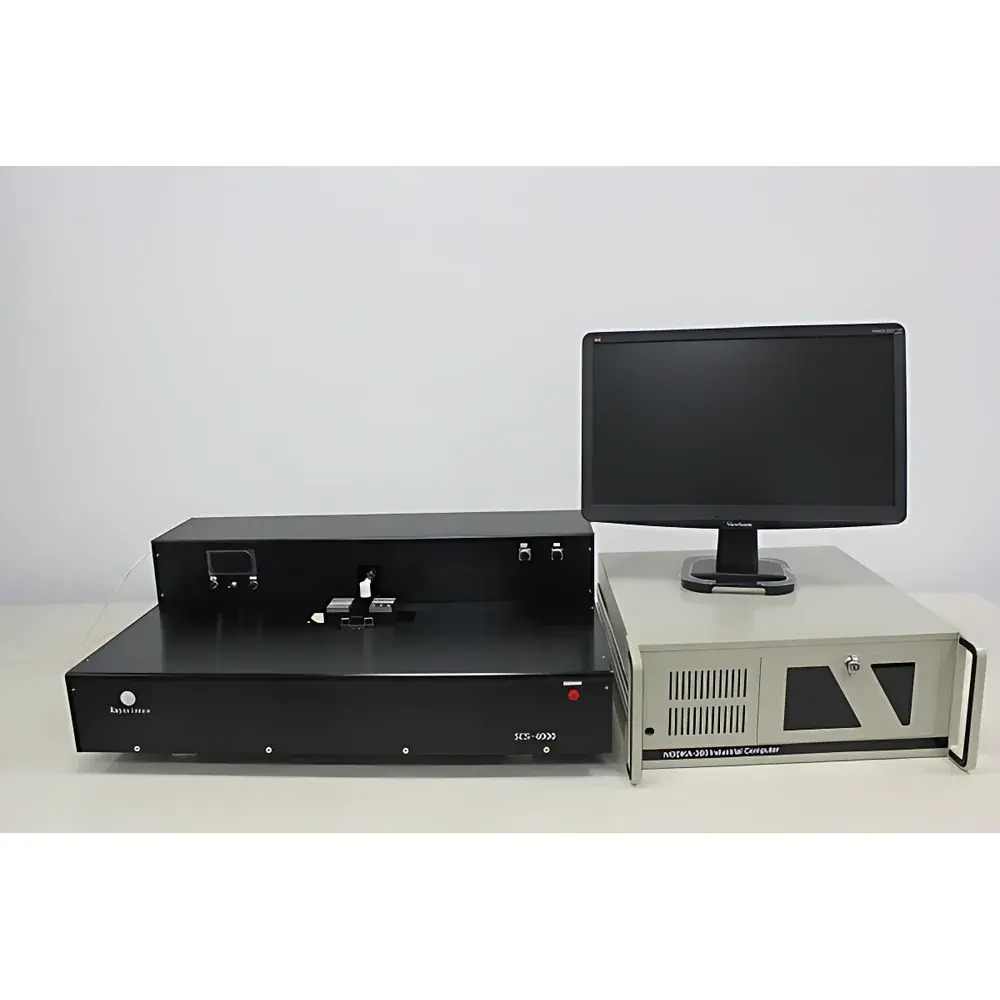
Oelabs SCS-4000-B Large-Core Multimode Fiber Fusion Tapering System
| Brand | Oelabs |
|---|---|
| Origin | Shanghai, China |
| Model | SCS-4000-B |
| Core/Cladding Diameters Supported | 105/125 µm, 200/220 µm, 400/440 µm, 600/660 µm |
| Numerical Aperture Compatibility | 0.11, 0.22, 0.37, 0.48 |
| Taper Configuration Options | 1×2, 1×3, 1×7, (N+1)×1, N×M (N = 2–7) |
| Heating Source | Hydrogen-Oxygen Flame |
| Control Architecture | PC-based Sequential Timing Control |
| Power Handling Capacity | Watt-level (dependent on fiber core geometry and coating integrity) |
| Customization Capability | Post-delivery process adaptation and secondary development support |
Overview
The Oelabs SCS-4000-B Large-Core Multimode Fiber Fusion Tapering System is a precision-engineered platform designed for the reproducible fabrication of high-power, low-loss multimode fiber combiners and beam splitters. It operates on the principle of controlled thermal drawing—using a stabilized hydrogen-oxygen micro-flame to locally heat paired or bundled large-core optical fibers while applying synchronized axial tension. This induces adiabatic tapering and evanescent field coupling between adjacent cores, enabling power redistribution across output ports with minimal modal distortion. The system is specifically optimized for industrial and research-grade manufacturing of N×M fused fiber devices where core diameters exceed 100 µm—addressing critical needs in high-brightness laser delivery, fiber laser pumping, and coherent beam combining applications.
Key Features
- Fully automated PC-controlled timing sequence for flame positioning, translation speed, gas flow modulation, and draw tension—ensuring inter-run repeatability within ±0.8% in coupling ratio and ≤±1.2% in insertion loss across identical taper profiles.
- Dual-axis motorized stage with sub-micron resolution (0.1 µm step size) for precise flame-to-fiber alignment and longitudinal pull control during taper formation.
- Integrated mass-flow controllers for independent regulation of H₂ and O₂ supply, calibrated to maintain stoichiometric combustion across variable flow rates (5–50 mL/min per channel), minimizing carbon deposition and thermal instability.
- Modular fiber fixture design accommodating cladding diameters from 125 µm to 660 µm, with adjustable V-groove holders and vacuum-assisted clamping to prevent slippage during high-tension draws.
- Real-time optical monitoring interface supporting external CCD or CMOS camera integration for in-situ visualization of taper waist evolution and molten zone geometry.
- Compliance-ready architecture with configurable audit trails, user access levels, and timestamped parameter logging—facilitating adherence to internal GLP protocols and pre-validation documentation for ISO/IEC 17025-compliant laboratories.
Sample Compatibility & Compliance
The SCS-4000-B supports standard silica-based multimode fibers with core/cladding dimensions including but not limited to 105/125 µm, 200/220 µm, 400/440 µm, and 600/660 µm. It accommodates numerical apertures ranging from 0.11 to 0.48, enabling compatibility with both low-NA specialty delivery fibers and high-NA pump combiner feedstocks. All mechanical interfaces conform to ISO 9001-certified manufacturing tolerances, and the system’s flame control subsystem meets EN 61000-6-3 electromagnetic emission standards. While not intrinsically certified for Class I laser environments, it is routinely deployed in conjunction with Class IV laser systems under ANSI Z136.1-compliant facility protocols.
Software & Data Management
The proprietary TaperControl™ software suite provides deterministic sequence programming via drag-and-drop timeline editing, allowing users to define multi-phase taper cycles—including pre-heating dwell, ramp-up draw, constant-velocity waist formation, and post-taper annealing. All executed recipes are stored with SHA-256 checksums; parameter sets include flame temperature estimation (derived from O₂/H₂ ratio and thermocouple feedback), real-time draw force (via load cell), and optical throughput monitoring (when coupled with external photodiodes). Export formats include CSV, HDF5, and XML—structured to align with LIMS integration requirements and FDA 21 CFR Part 11-compliant electronic record retention frameworks when configured with digital signature modules.
Applications
- Development and pilot-scale production of (N+1)×1 pump combiners for Yb-doped fiber lasers operating at 915 nm and 976 nm wavelengths.
- Fabrication of 1×7 and 1×3 beam splitters for spectral beam combining architectures requiring uniform power division across ≥3 kW aggregate input.
- Research into mode-field adaptation between dissimilar large-core fibers (e.g., 200/220 µm to 400/440 µm) for reduced splice loss in high-power free-space coupling interfaces.
- Process qualification of novel polymer-clad or low-OH silica fibers where thermal stability and surface wetting behavior under H₂/O₂ flame differ significantly from standard telecom-grade materials.
- Secondary development support for custom taper profiles—including asymmetric coupling ratios, wavelength-selective tapers, and multi-stage cascaded structures—under collaborative NDA-bound engineering engagements.
FAQ
What fiber types are compatible with the SCS-4000-B beyond standard fused silica?
The system has been validated with pure-silica core / fluorine-doped cladding fibers, as well as certain radiation-hardened and low-OH variants—provided their softening temperature falls within 1,600–2,000 °C and surface chemistry permits stable flame interaction.
Can the system produce tapered couplers with non-uniform splitting ratios (e.g., 90:10)?
Yes—by adjusting the relative draw velocity between input arms and introducing controlled asymmetry in flame dwell time, users can achieve customized power distribution profiles across output ports.
Is remote operation supported for integration into cleanroom or shielded laser labs?
All control signals are transmitted via optically isolated USB-C and Ethernet interfaces; optional fiber-optic I/O extension kits enable full functionality at distances exceeding 30 meters without signal degradation.
Does Oelabs provide calibration documentation traceable to national metrology institutes?
Upon request, factory calibration reports—including stage position verification using HeNe interferometry and gas flowmeter NIST-traceable certification—are supplied with each unit shipment.
How is thermal drift managed during extended tapering sequences (>15 minutes)?
The baseplate incorporates a passive copper-aluminum thermal buffer layer, and ambient air temperature is continuously monitored via four distributed PT100 sensors; software automatically compensates draw parameters if ambient deviation exceeds ±0.5 °C over 5-minute windows.




