
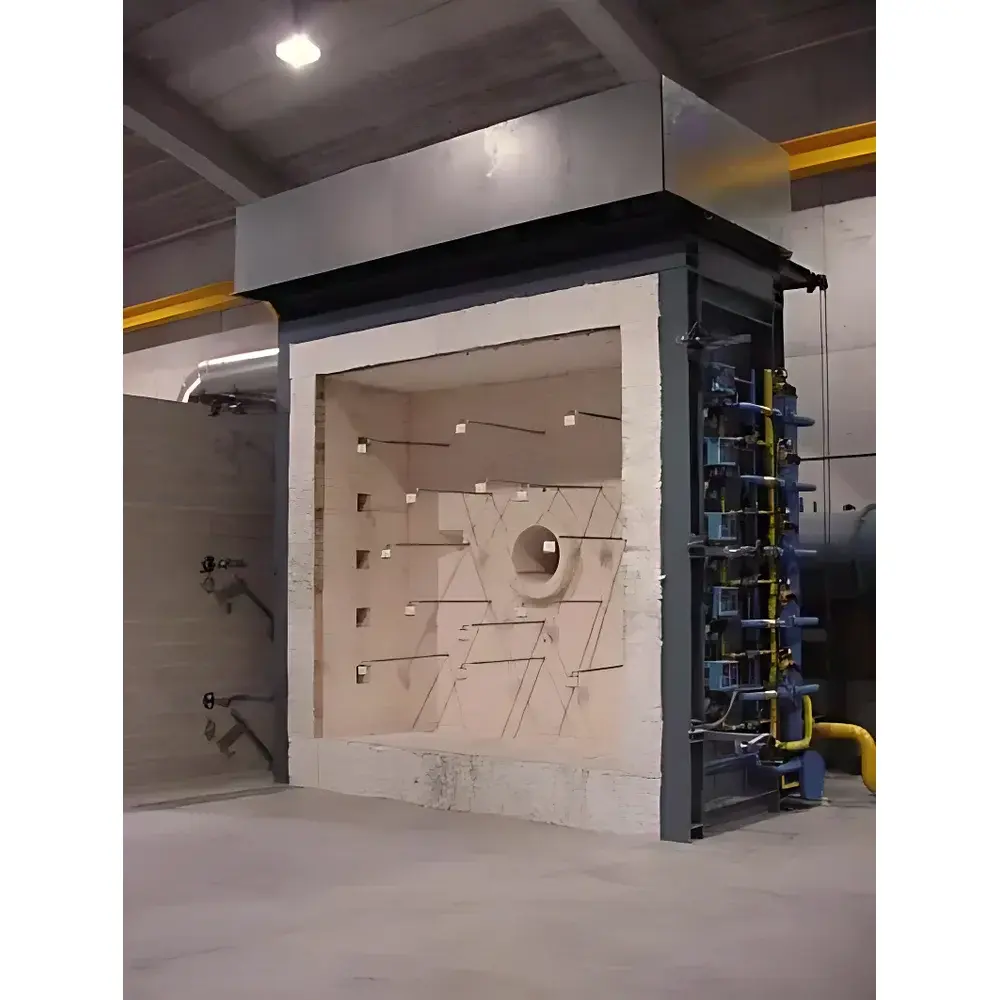
BCFR-1 Vertical Furnace for Fire Resistance Testing of Building Elements
| Origin | United Kingdom |
|---|---|
| Manufacturer Type | Authorized Distributor |
| Origin Category | Imported |
| Model | BCFR-1 |
| Pricing | Upon Request |
Overview
The BCFR-1 Vertical Furnace is a fully compliant, full-scale fire resistance test facility engineered for evaluating the structural integrity, thermal insulation, and load-bearing performance of building elements—including walls, partitions, floors, doors, and façade systems—under standardized fire exposure conditions. It operates in strict accordance with EN 1363-1 and EN 1363-2 (hydrocarbon and standard time–temperature curves), ISO 834-1, and supplementary national protocols adopted by internationally accredited fire testing laboratories such as Warrington Fire (UK), Bodycote (UK), Chiltern International (UK), OTIS (France), Vetrotech (Switzerland), AGC Flatglass (Belgium), PSB (Singapore), LGAI (Spain), SINTEF (Norway), and Far East Fire Testing Centre (China). The furnace employs controlled gas-fired combustion to replicate realistic fire scenarios, maintaining precise temperature profiles up to 1250 °C over durations ranging from 30 minutes to 240 minutes. Its modular steel frame, refractory-lined combustion chamber, and integrated pressure-regulated flue system ensure stable, repeatable, and auditable test environments suitable for regulatory certification and third-party accreditation under ISO/IEC 17025.
Key Features
- Modular three-section transport design (support structure, motorized dampers, combustion assembly) enabling disassembly, road transport, and on-site reassembly within standard industrial facilities.
- Refractory lining composed of 1400 °C-rated insulating firebrick, high-density 42% alumina bricks in critical zones, and bio-degradable ceramic fiber linings in flue ducts—engineered for thermal stability during 6-hour sustained tests.
- 12 independently controllable gas burners arranged across three vertical zones (4 burners per zone), each equipped with UV flame detection, spark ignition, dual-stage solenoid/throttling valves, and air/gas ratio control.
- Three water-cooled stainless-steel motorized dampers with position feedback and interlocked safety logic—integrated into real-time pressure regulation of the combustion chamber.
- Four air-cooled observation ports with heat-resistant quartz glass; optional camera iris integration for remote visual monitoring without thermal degradation.
- Comprehensive sensor infrastructure: nine rear-wall thermocouples (K/N/R-type compliant), four wall-mounted pressure taps with T-fittings, and provision for oxygen analyser (optional).
- IP65-rated control cabinet housing microprocessor-based logic, 24 VDC industrial I/O, ESD-protected relays, and RS485 communication backbone.
Sample Compatibility & Compliance
The BCFR-1 accommodates non-loadbearing and loadbearing building elements up to 3 m × 3 m internal dimensions via a dedicated vertical restraining frame weighing approximately 5 tonnes (excluding specimen). The frame features wedge-and-roller anchoring, ceramic-seal grooves, and replaceable high-density refractory cladding—designed for mechanical durability, thermal resilience, and rapid post-test inspection. All test configurations comply with EN 1364-1 (non-loadbearing elements), EN 1365-1 (loadbearing walls), EN 1634-1 (fire doors), and ASTM E119 where applicable. The furnace’s measurement architecture supports GLP/GMP-aligned data traceability, including audit trails for sensor calibration, test parameter changes, and manual override events—fully compatible with FDA 21 CFR Part 11 requirements when configured with electronic signature functionality.
Software & Data Management
The dual-channel data acquisition system provides 240 synchronized analog input channels—covering thermocouples (K/N/R), pressure transducers, displacement sensors, strain gauges, load cells, and gas analyzers—with 21-bit resolution, 0.005% FS accuracy, and programmable sampling rates from 1 ms to 3 s. Cold-junction compensation is applied per channel with ±0.1 °C absolute accuracy. All inputs are optically isolated (3000 V DC) and filtered for EMI/ESD suppression common in high-temperature combustion environments. Data is acquired and displayed in real time on a Windows-based control PC (≥2 GB RAM, ≥300 GB HDD, RS485 optical isolation interface), with simultaneous logging to a redundant backup workstation. The system supports networked access for remote observation and integrates with laboratory information management systems (LIMS) via standard CSV/Excel export. Manual operation remains fully independent of the computer system, with hardwired safety interlocks, audible alarms, and fail-safe burner shutdown logic.
Applications
The BCFR-1 serves as a primary test platform for fire resistance classification of construction products intended for CE marking (EU Construction Products Regulation No. 305/2011), UKCA marking, and international market access. Typical applications include: evaluation of fire-rated glazing assemblies and curtain wall systems; validation of intumescent coatings on structural steel; assessment of fire barrier penetration seals; qualification of prefabricated concrete or timber-framed wall panels; and development testing of novel passive fire protection materials. Its reproducible hydrocarbon and standard fire curves support both routine compliance verification and advanced research into fire dynamics, heat transfer modeling, and material pyrolysis behavior under controlled boundary conditions.
FAQ
What fire standards does the BCFR-1 support?
It fully complies with EN 1363-1, EN 1363-2, ISO 834-1, EN 1364-1, EN 1365-1, EN 1634-1, and related national annexes used by accredited laboratories worldwide.
Is the furnace supplied with installation and commissioning support?
Yes—factory pre-commissioning, on-site mechanical/electrical integration, refractory lining verification, burner tuning, and final performance validation against reference thermocouple arrays are included.
Can the system be upgraded for future regulatory changes?
The modular hardware architecture, RS485 expandable measurement network, and software-configurable I/O allow seamless integration of additional sensors, updated control algorithms, or revised curve definitions without hardware replacement.
What utility requirements must be met on-site?
Natural gas supply: ~260 m³/h at ≥21 mbar; LPG: ~130 m³/h; cooling water: 15 mm domestic copper line per damper; electrical supply: 200–240 VAC, 40–70 Hz, 7 VA per module.
Does the system meet ISO/IEC 17025 documentation requirements?
Yes—the control system logs all calibration events, sensor drift corrections, test parameter deviations, and operator interventions with timestamps and user IDs, supporting full audit readiness.



