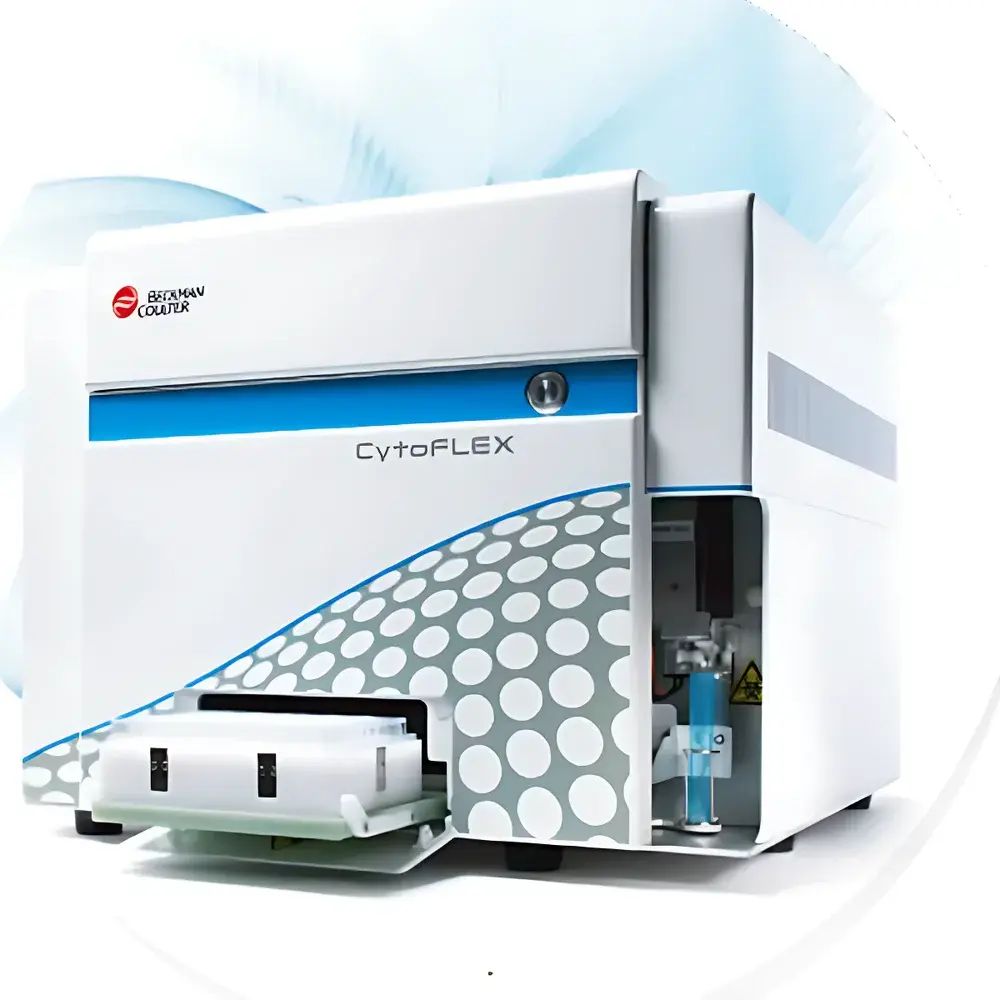
Beckman Coulter CytoFLEX / CytoFLEX S / CytoFLEX LX Flow Cytometer
| Brand | Beckman Coulter |
|---|---|
| Origin | USA |
| Instrument Type | Analytical Flow Cytometer |
| Configuration Options | Up to 3 Lasers / 13 Colors (CytoFLEX) |
| Fluorescence Sensitivity | FITC < 30 MESF, PE < 10 MESF |
| Small Particle Detection Limit | ≥80 nm (via VSSC) |
| Optical Architecture | Wavelength-Division Multiplexing (WDM) Detection |
| Regulatory Compliance | FDA 21 CFR Part 11–Ready |
| Software Interface | Dual-language (English/Chinese), Graphical User Interface (GUI) |
| Sorting Capability | Optional Sort Module Available |
| Intended Use | Research-Only |
Overview
The Beckman Coulter CytoFLEX series represents a modular, high-sensitivity analytical flow cytometer platform engineered for rigorous life science research applications. Built upon a solid-state laser excitation architecture and integrated wavelength-division multiplexing (WDM) optical detection, the system minimizes photon loss across the spectral range while maximizing signal fidelity. Unlike traditional filter-based systems, WDM enables simultaneous collection of multiple fluorescence emissions with precise spectral deconvolution—critical for high-parameter panel design and rare-event detection. The platform supports three configuration tiers: the base CytoFLEX (up to 3 lasers, 13 parameters), the enhanced CytoFLEX S (up to 4 lasers standard, expandable to 6 lasers), and the high-end CytoFLEX LX (6 lasers, 21-color capability), all sharing a common fluidics core, digital signal processing engine, and software framework. Its compact benchtop footprint and low maintenance requirements make it suitable for core facilities, academic laboratories, and translational research units requiring reproducible, quantitative single-cell phenotyping and functional profiling.
Key Features
- Ultra-high fluorescence sensitivity: <30 MESF for FITC and <10 MESF for PE—enabling robust detection of dim markers and low-expression antigens in primary human samples.
- Submicron particle resolution: Validated detection of nanoparticles and extracellular vesicles down to 80 nm using violet-side scatter (VSSC), supported by calibrated reference standards and optimized hydrodynamic focusing.
- Modular laser architecture: Field-upgradable laser modules (405 nm, 488 nm, 561 nm, 638 nm, 735 nm, and optional 355 nm UV) allow flexible panel expansion without hardware replacement.
- Digital signal processing: 24-bit dynamic range per parameter ensures linear quantification across five orders of magnitude without gain adjustment during acquisition.
- FDA 21 CFR Part 11–compliant software suite with electronic signatures, audit trails, and role-based user permissions—fully traceable for GLP/GCP-aligned studies.
- Integrated quality control: On-board daily QC with CST (Cytometer Setup & Tracking) beads and automated compensation matrix generation reduce inter-operator variability.
Sample Compatibility & Compliance
The CytoFLEX platform accommodates a broad range of sample types—including peripheral blood mononuclear cells (PBMCs), whole blood lysed or fixed samples, dissociated tissues, cultured cell lines, and purified exosome preparations—without requiring specialized nozzles or sheath fluid formulations. All configurations operate with standard isotonic sheath fluid (e.g., PBS-based) and support both tube-based and plate-based (96-/384-well) acquisition modes via optional autosamplers. Regulatory alignment includes full documentation support for ISO 13485–aligned quality systems, adherence to CLSI EP17-A2 guidelines for sensitivity verification, and compatibility with USP recommendations for flow cytometry method validation. The instrument’s firmware and software are validated per ICH GCP Annex 11 and support 21 CFR Part 11-compliant workflows including secure data archiving, change control logs, and electronic record retention for ≥25 years.
Software & Data Management
CytoFLEX instruments run on CytExpert™ software—a dual-language (English/Chinese), touch-optimized GUI designed for intuitive experimental setup, real-time visualization, and offline analysis. The software features built-in compensation algorithms (spillover compensation matrix auto-generation), hierarchical gating tools, dimensionality reduction (tSNE, UMAP), and batch analysis templates compliant with MIFlowCyt reporting standards. Raw FCS 3.1/3.2 files are natively generated and exportable to third-party platforms including FlowJo™, FCS Express™, and R/Bioconductor environments. Data integrity is preserved through cryptographic hashing of acquisition files, timestamped audit trails for every gating or parameter modification, and encrypted local storage options. For enterprise deployment, CytExpert integrates with LIMS via HL7/FHIR APIs and supports centralized license management across multi-instrument sites.
Applications
- Immunophenotyping of complex hematopoietic lineages and tumor-infiltrating lymphocytes (TILs) using ≥18-color panels.
- Functional assays including intracellular cytokine staining (ICS), phospho-flow, calcium flux, and mitochondrial membrane potential assessment.
- Extracellular vesicle (EV) characterization—size distribution, surface marker profiling (CD63, CD81, CD9), and cargo co-localization studies.
- Stem cell differentiation monitoring via multi-stage marker expression kinetics.
- Viral transduction efficiency quantification and CRISPR-edited cell population enrichment tracking.
- Preclinical immunotoxicity screening in rodent and non-human primate models.
FAQ
Is the CytoFLEX platform compatible with sorting applications?
Yes—while the base CytoFLEX and CytoFLEX S are analytical-only systems, the CytoFLEX LX supports optional integration of a high-speed, purity-optimized sort module capable of 4-way sorting at up to 20,000 events/sec with >99% purity for single-cell deposition into plates or tubes.
What regulatory documentation is provided for GxP environments?
Beckman Coulter supplies a complete validation package including IQ/OQ protocols, software validation summary reports, and 21 CFR Part 11 implementation guides—all available under NDA upon request.
Can compensation be performed automatically during acquisition?
Yes—CytExpert supports real-time spillover compensation using single-stained controls, with automatic matrix calculation and application prior to data saving.
Does the system support bead-based absolute counting?
Yes—integrated CountBright™ and AccuCount™ absolute counting beads are fully supported, with concentration calculations embedded directly in the acquisition interface and report generation.
How is optical alignment maintained over time?
The system employs passive thermal stabilization and factory-calibrated alignment fixtures; routine verification is performed using CST beads, with automated alignment diagnostics accessible via service mode.