
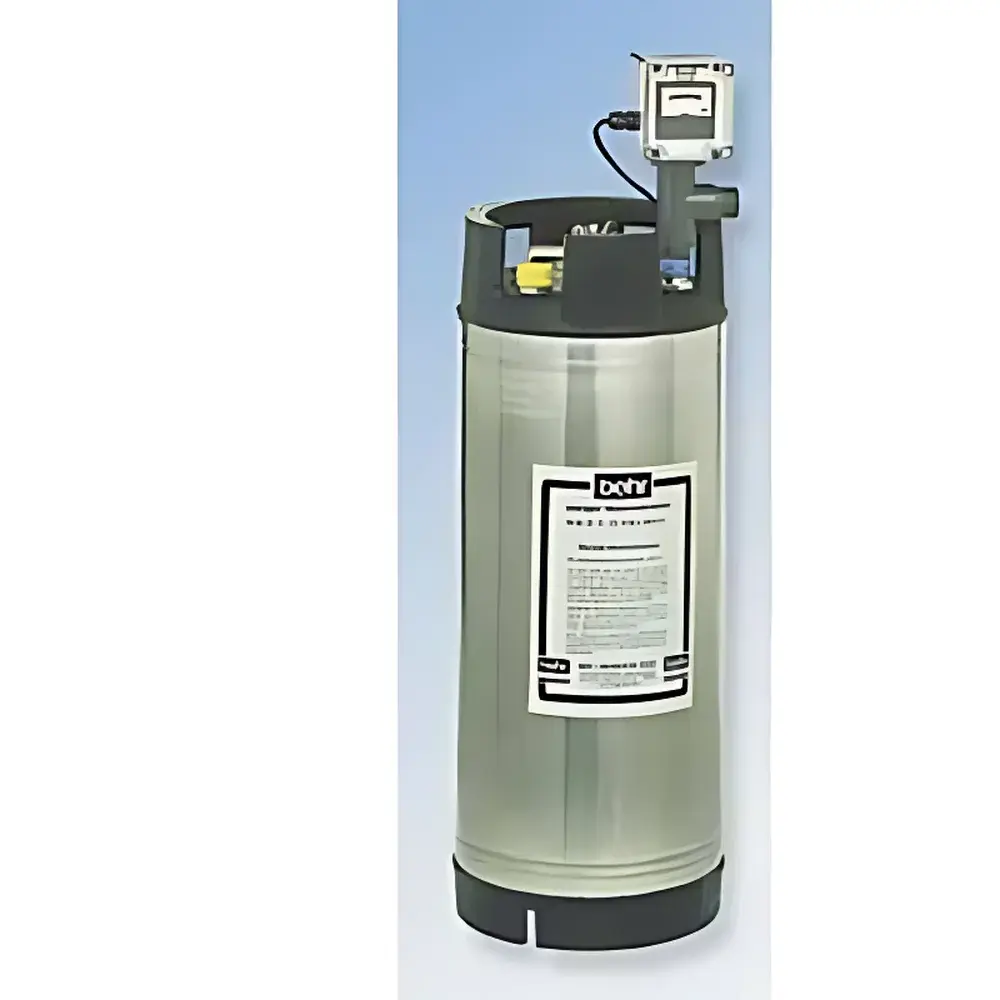
Behr E28/E40d Stainless Steel Mixed-Bed Ion Exchange Cartridge System
| Origin | Germany |
|---|---|
| Manufacturer Type | Authorized Distributor |
| Origin Category | Imported |
| Model | Behr E28/E40d |
| Output Water Grade | Type I Ultra-Pure Water |
| Resistivity | 18.2 MΩ·cm |
| Heavy Metals & Soluble Silica | <0.1 ppb |
| Total Organic Carbon (TOC) | <3 ppb |
| Microbial Count / Endotoxins | <0.001 EU/mL |
| Particles (>0.1 µm) | <1 particle/mL |
| Max. Operating Pressure | 10 bar (E28d/E40d), 8 bar (E40dA) |
| Exchange Capacity (at 10 °dH) | 2,800 L (E28), 4,000 L (E40d) |
| Max. Flow Rate | 500 L/h (E28), 700 L/h (E40d) |
| Housing Diameter | 24 cm |
| Overall Height | 74 cm (E28), 84 cm (E40d) |
| Cartridge Height | 60 cm (E28), 70 cm (E40d) |
| Conductivity Alarm Threshold | 20 µS/cm |
| Material | ASTM A276 Type 316L (V4A) stainless steel |
| Integrated Conductivity Monitoring | Yes |
| Optional Features | Solenoid Valve + Limit Switch (Model “A”), Spare Cartridge Kit (Model “Z”) |
Overview
The Behr E28/E40d Stainless Steel Mixed-Bed Ion Exchange Cartridge System is a high-integrity, pressure-rated post-treatment module engineered for the final polishing stage of ultra-pure water (UPW) generation systems. Designed and manufactured in Germany to DIN and ISO 9001-certified production standards, this system employs a fixed-bed configuration of strongly acidic cation and strongly basic anion exchange resins in stoichiometric balance—ensuring complete deionization of feedwater following reverse osmosis (RO) or electrodeionization (EDI) pretreatment. Its V4A (ASTM A276 Type 316L) stainless steel housing withstands continuous operating pressures up to 10 bar, eliminating the need for external pressure-reduction valves and enabling direct integration into municipal or industrial feedwater networks with variable pressure profiles. The system operates on the principle of counter-current ion exchange kinetics, where uniform radial flow distribution—achieved via the proprietary behropur® nozzle manifold—maximizes resin utilization efficiency, minimizes channeling, and extends service life while maintaining consistent 18.2 MΩ·cm resistivity output.
Key Features
- V4A (316L) stainless steel construction with sulfurized elastomeric collars at top and base for mechanical shock absorption and vibration damping
- Integrated conductivity sensor with factory-calibrated measurement circuitry; supports both local analog readout and remote 4–20 mA signal transmission
- Automatic cut-off function triggered at user-configurable conductivity threshold (default: 20 µS/cm), compatible with external PLC or central UPW monitoring systems
- behropur® radial distributor nozzle ensures homogeneous hydraulic loading across the entire cross-sectional area of the mixed-bed cartridge—critical for reproducible ion exchange capacity and low TOC leaching
- Ergonomic recessed top handle for safe manual handling during cartridge replacement or maintenance cycles
- No external pressure regulation required: stable performance across fluctuating inlet pressures (1–10 bar)
- Modular design supports three configurations: standard monitoring (E28d/E40d), solenoid-valve–actuated auto-shutdown (E28dA/E40dA), and spare cartridge kits (E28dZ/E40dZ)
Sample Compatibility & Compliance
The E28/E40d system is validated for use with RO-permeate or EDI product water meeting ASTM D1193-20 Type II specifications (conductivity ≤ 1 µS/cm, TOC ≤ 50 ppb). It complies with key regulatory frameworks governing laboratory water quality, including ISO 3696:1987 (Grade 1), CLSI EP28-A3c, and USP Purified Water and Water for Injection monographs. All wetted surfaces are electropolished to Ra ≤ 0.4 µm and passivated per ASTM A967, ensuring minimal metallic leaching and endotoxin-free operation. The integrated conductivity monitor meets IEC 61000-4-3 immunity requirements for electromagnetic compatibility in shared laboratory environments.
Software & Data Management
While the E28/E40d operates as a standalone hardware module without embedded firmware, its analog conductivity output (0–20 µS/cm range, ±2% full-scale accuracy) is fully compatible with third-party SCADA platforms, LIMS interfaces, and centralized UPW management systems compliant with FDA 21 CFR Part 11. When deployed with optional solenoid valve (Model “A”), the system supports audit-trail–capable event logging—including timestamped conductivity excursions, valve actuation cycles, and cumulative volume tracking—enabling GLP/GMP-aligned documentation for pharmaceutical QC laboratories and accredited testing facilities.
Applications
- Final polishing stage in multi-stage ultra-pure water systems for analytical chemistry (HPLC, IC, ICP-MS), molecular biology (PCR, cell culture media preparation), and semiconductor wafer cleaning
- Deionization of RO permeate in centralized lab water networks serving glassware washing stations, autoclave feed, and general lab utility points
- Backup polishing unit for critical applications requiring redundant ion removal capability (e.g., reference standard preparation, calibration solution synthesis)
- Mobile or modular UPW skids for pilot-scale process validation and GMP-compliant manufacturing support
FAQ
What feedwater quality is required for optimal E28/E40d performance?
RO permeate with conductivity ≤ 1 µS/cm and TOC ≤ 30 ppb is recommended. Higher feed conductivity or organic load will reduce cartridge service life and risk premature breakthrough.
Can the E28/E40d be installed vertically only, or is horizontal orientation supported?
The system is certified for vertical installation only, as specified in DIN EN 13445. Horizontal mounting invalidates pressure rating certification and compromises flow distribution integrity.
Is regeneration of the mixed-bed cartridge possible onsite?
No. Behr supplies pre-packed, factory-balanced cartridges sealed under nitrogen. Regeneration is not supported due to resin segregation risks and lack of in-situ acid/base delivery infrastructure.
How frequently must the conductivity sensor be calibrated?
Annual calibration against NIST-traceable KCl standards (e.g., 1413 µS/cm at 25°C) is recommended. Calibration intervals may be extended under documented IQ/OQ protocols per ISO/IEC 17025.
Does the E40dA variant meet SIL-2 functional safety requirements?
No. While the solenoid valve and limit switch provide fail-safe shutdown, formal SIL-2 certification requires system-level hazard analysis and third-party verification beyond the scope of this component-level device.
Related Products



