
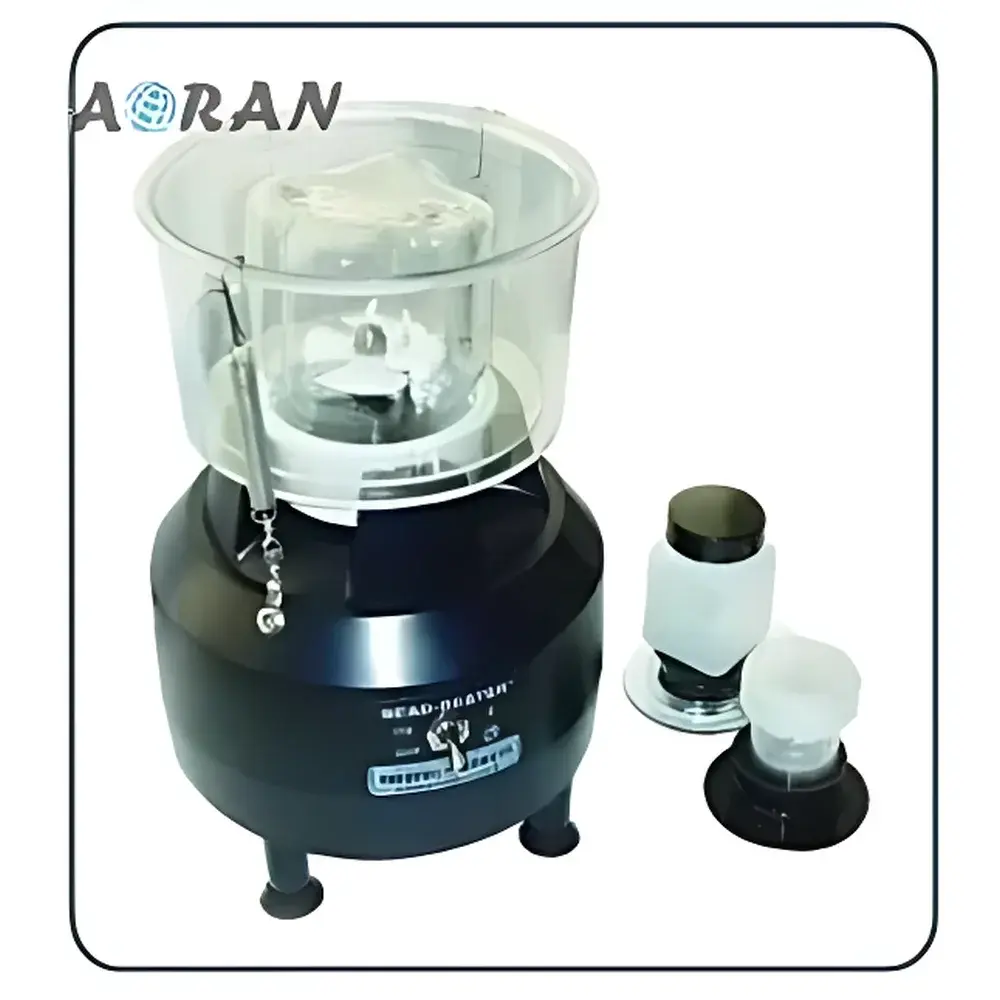
Biospec BeadBeater Bead Mill Homogenizer
| Brand | Biospec |
|---|---|
| Origin | USA |
| Model | BeadBeater |
| Instrument Type | Bead Mill Homogenizer |
| Dimensions (W×D×H) | 200 × 300 × 200 mm |
| Sample Volume Range | 0.5–300 mL |
Overview
The Biospec BeadBeater Bead Mill Homogenizer is a high-energy, mechanical lysis system engineered for rapid and reproducible disruption of biological samples through controlled bead-beating action. Operating on the principle of horizontal reciprocating motion, the instrument accelerates grinding beads inside sealed sample containers—generating intense shear, impact, and collision forces that efficiently rupture cell walls and membranes without thermal denaturation or chemical artifacts. Unlike rotor-stator or ultrasonic homogenizers, the BeadBeater delivers consistent mechanical energy input independent of sample viscosity or particulate load, making it especially suitable for challenging matrices such as Gram-positive bacteria, fungal spores, plant tissues, and fibrous animal organs. Its robust architecture ensures minimal carryover and contamination risk, supporting workflows requiring high integrity of nucleic acids, proteins, organelles, and metabolites.
Key Features
- High-efficiency mechanical lysis via stainless-steel or ceramic grinding beads in sealed tubes—eliminates foaming, organic solvents, and enzymatic inhibitors.
- Configurable sample capacity: accommodates volumes from 0.5 mL (microtubes) up to 350 mL (large-capacity chamber), with optional adapters for 1.5 mL, 7 mL, and 96-well deep-well plates.
- Temperature control compatibility: integrated ice-water bath sleeve enables active cooling during operation to preserve thermolabile biomolecules.
- Digital timing and speed control across multiple models: programmable cycle duration (0–300 s) and adjustable oscillation frequencies (2000–4800 rpm depending on configuration).
- Modular platform design: supports parallel processing—from single-tube lysis (BeadBeater) to high-throughput formats (Mini-BeadBeater-24 and Mini-BeadBeater-96).
- Low-noise engineering and reinforced housing enhance laboratory ergonomics and long-term operational stability.
Sample Compatibility & Compliance
The BeadBeater series demonstrates broad compatibility with diverse biological specimens, including but not limited to bacterial cultures (including Bacillus, Mycobacterium), yeast and filamentous fungi, mammalian and plant tissues, soil microbiomes, and environmental biofilms. Its closed-tube operation minimizes aerosol generation and cross-contamination, aligning with biosafety Level 2 (BSL-2) containment requirements. All models comply with IEC 61000-6-2 (EMC immunity) and IEC 61000-6-4 (EMC emission) standards. When used with certified consumables—including autoclavable stainless-steel or acid-washed glass beads—the system supports GLP- and GMP-aligned workflows. Data integrity features (e.g., audit-trail-capable digital controllers on newer units) facilitate compliance with FDA 21 CFR Part 11 where electronic records are required.
Software & Data Management
While the base BeadBeater operates via standalone digital controls, higher-tier variants (e.g., Mini-BeadBeater-24 and -96) integrate microprocessor-based interfaces enabling parameter logging, cycle repetition, and user-defined protocol storage. Optional USB connectivity allows export of run logs—including timestamp, speed, duration, and error codes—for integration into LIMS or ELN platforms. All firmware adheres to ISO/IEC 17025 traceability guidelines for instrument calibration and performance verification. Routine maintenance logs and bead wear assessments can be documented per ISO 15189 quality management requirements for clinical laboratories.
Applications
- Genomic DNA and total RNA extraction from recalcitrant samples prior to qPCR, RNA-seq, or metagenomic sequencing.
- Preparation of subcellular fractions (e.g., mitochondria, nuclei) with preserved structural integrity for functional assays.
- Rapid lysis of biofilm-embedded pathogens for antimicrobial susceptibility testing.
- Homogenization of plant root or leaf tissue for metabolite profiling and pesticide residue analysis.
- Disruption of spore-forming organisms (Clostridium, Aspergillus) in environmental monitoring and food safety testing.
- High-throughput sample prep for biobanking, clinical trial cohorts, and population-scale omics studies.
FAQ
What types of grinding beads are compatible with the BeadBeater system?
Standard options include acid-washed glass (0.1, 0.5, 1.0 mm), stainless steel, and zirconia ceramic beads—each selected based on sample hardness and downstream analytical requirements.
Can the BeadBeater be used for protein extraction without denaturation?
Yes—when operated with pre-chilled tubes and appropriate bead size selection, the system maintains native conformation of soluble and membrane-associated proteins for co-immunoprecipitation or activity assays.
Is the instrument validated for regulatory submissions (e.g., FDA, EMA)?
While the BeadBeater itself is not an IVD device, its use in sample preparation is widely cited in peer-reviewed protocols supporting regulatory filings; validation must be performed at the user site per ICH Q5A and USP <1043> guidance.
How often should grinding beads be replaced?
Beads are reusable but require visual inspection and cleaning (e.g., 70% ethanol soak + centrifugation) between uses; replacement is recommended after ≥50 cycles or upon visible pitting or fragmentation.
Does the system support 21 CFR Part 11 compliance?
Digital controller units with password-protected settings, electronic signature capability, and immutable audit trails meet core Part 11 criteria when deployed within a validated IT infrastructure.
Related Products



