
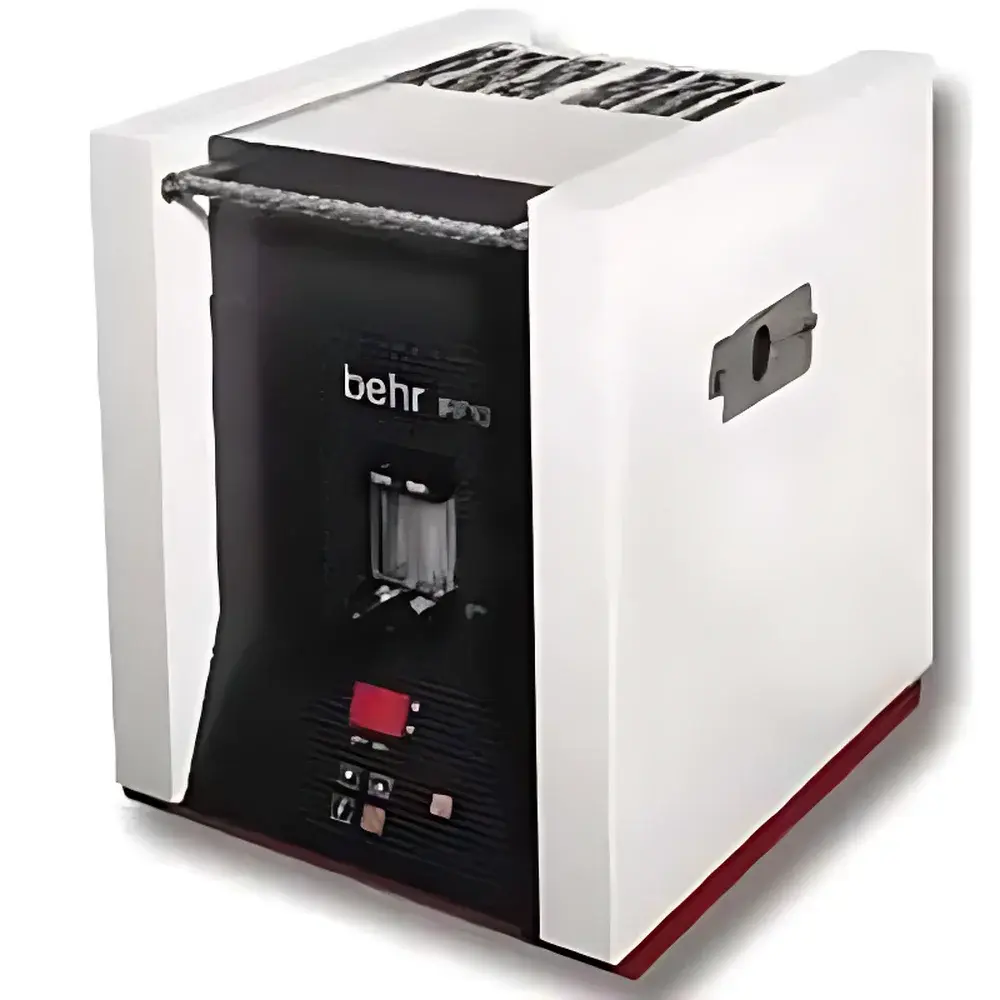
Behr IRF10 Programmable Infrared Tube Furnace
| Origin | Germany |
|---|---|
| Manufacturer Type | Authorized Distributor |
| Origin Category | Imported |
| Model | Behr IRF10 |
| Price Range | USD 1,400 – 7,200 |
| Instrument Type | Box-Type Furnace |
| Maximum Temperature | 1150 °C |
| Temperature Control Accuracy | ±3 °C |
| Rated Power | 1.5 kW |
| Heating Rate (to 1000 °C) | ≤10 s |
| Heating Method | Elliptical Reflector Infrared Radiation with Gold-Coated Interior |
| Internal Chamber Dimensions | 350 × 325 × 410 mm |
| Quartz Tube Outer Diameter Options | 18–20 mm, 22–24 mm, 26–28 mm |
| Infrared Heating Zone Length | 200 mm |
| Communication Interface | RS-232 (D-Sub 9-pin female) |
| Cooling Method | Passive Heat-Pipe-Assisted Rapid Quenching |
| Gas Inlets | Dual Mass Flow Controlled (O₂ + inert gas) |
| Thermocouple | Type K (NiCr–Ni), Mounted on Outer Wall of Quartz Combustion Tube |
Overview
The Behr IRF10 Programmable Infrared Tube Furnace is a precision-engineered thermal analysis platform designed for controlled high-temperature sample treatment under inert or oxidative atmospheres. Unlike conventional resistive muffle furnaces, the IRF10 employs focused infrared radiation generated by a tungsten-halogen emitter positioned at one focal point of an elliptical gold-coated reflector. This optical geometry directs radiant energy with high spatial concentration onto the second focal line—coincident with the central axis of the quartz combustion tube—enabling rapid, uniform, and contactless heating of samples. The furnace achieves operational temperatures up to 1150 °C with exceptional thermal responsiveness: ramp rates from ambient to 1000 °C in ≤10 seconds are reproducible across repeated cycles. Its architecture supports thermogravimetric workflows, selective volatilization, oxidative/reductive digestion, pyrolysis, and controlled desorption—all while maintaining sample position integrity throughout multi-stage temperature programs.
Key Features
- Elliptical infrared focusing system with electroformed gold-coated reflector for >92% radiant efficiency and minimal thermal lag
- Programmable thermal profiles: up to 5 independent ramps and 5 hold segments per cycle; repeatable sequence execution with <±0.5 °C inter-cycle deviation
- Passive heat-pipe-assisted cooling: achieves 1150 °C → 100 °C in <90 seconds without external coolant or forced air
- Modular quartz tube system: interchangeable tubes (OD 18–28 mm) compatible with quartz, ceramic, or inert crucible carriers
- Dual-gas mass flow control: independent regulation of O₂ and inert gases (e.g., N₂, Ar) via calibrated rotameters; inlet ports configured for downstream scrubber or online IR/IC coupling
- Integrated Type K thermocouple mounted directly on the outer surface of the quartz tube—ensuring accurate, real-time temperature feedback referenced to sample zone
- Front-accessible cylindrical lid: slides rearward to permit direct visual inspection and manual sample loading without chamber disassembly
- RS-232 serial interface (D-Sub 9-pin female) compliant with standard SCPI command sets for integration into LIMS or custom LabVIEW/Python automation frameworks
Sample Compatibility & Compliance
The IRF10 accommodates solid, powdered, or pelletized samples ranging from 10 mg to 1 g—dependent on thermal mass and emissivity—within quartz, alumina, or silicon carbide sample boats. Its open-tube geometry enables seamless coupling to off-gas analysis systems: evolved gases may be directed via heated transfer lines to ion chromatography (IC), coulometric titration cells, or FTIR spectrometers operating in real time. The furnace meets mechanical and electrical safety requirements per IEC 61010-1:2010 and carries CE marking for laboratory use in EU member states. Its programmable logic and audit-trail-capable communication interface support compliance with GLP and GMP environments when paired with validated software controls adhering to FDA 21 CFR Part 11 data integrity principles.
Software & Data Management
The IRF10 operates natively via front-panel keypad and LCD display, but full remote operation is enabled through its RS-232 interface. Standard ASCII-based command protocol allows bidirectional communication: users can upload temperature programs, query real-time thermocouple readings, log timestamped temperature vs. time datasets, and trigger start/stop/pause commands. When integrated with third-party acquisition software (e.g., MATLAB, LabVIEW, or custom Python scripts using PySerial), the furnace supports automated batch processing, inter-instrument synchronization (e.g., with TGA or GC-MS), and CSV-formatted data export. All program parameters—including ramp rates, dwell times, gas flow setpoints, and error logs—are stored non-volatily in EEPROM and survive power interruption.
Applications
- Controlled oxidative digestion of organic matrices (e.g., polymers, biomass, pharmaceutical excipients) prior to elemental analysis by ICP-OES or AAS
- Thermal desorption of volatile organic compounds (VOCs) from adsorbent tubes with subsequent cold trap–GC/MS analysis
- High-resolution thermogravimetric profiling of catalysts, battery cathode materials, or nanocomposites under dynamic gas switching
- Selective fractionation of multicomponent organic mixtures via programmed low-slope heating (e.g., 0.5–2 °C/min) in inert atmosphere
- Rapid ashing of filter papers or biological tissues for sulfate, chloride, or fluoride determination by ion chromatography
- In situ decomposition studies of metal-organic frameworks (MOFs) or perovskite precursors under controlled O₂ partial pressure
FAQ
What is the maximum recommended continuous operating temperature?
The IRF10 is rated for continuous operation up to 1150 °C; prolonged exposure above this limit may degrade quartz tube integrity and reflector coating performance.
Can the furnace be used under vacuum conditions?
No—the IRF10 is not vacuum-rated; it is designed exclusively for atmospheric-pressure operation with controlled gas purging.
Is calibration traceable to national standards?
Yes; optional factory calibration certificate (NIST-traceable) is available upon request, including verification at three points (300 °C, 700 °C, 1000 °C) with uncertainty ≤±1.2 °C.
How is temperature uniformity characterized along the heating zone?
At 1000 °C, axial uniformity across the 200 mm infrared zone is ±5 °C; radial variation within the quartz tube is <±2 °C under steady-state conditions.
Are replacement quartz tubes supplied with dimensional certification?
Yes—each quartz tube lot undergoes OD tolerance verification (±0.1 mm) and hydroxyl content testing; certificates of conformance accompany shipment.



