
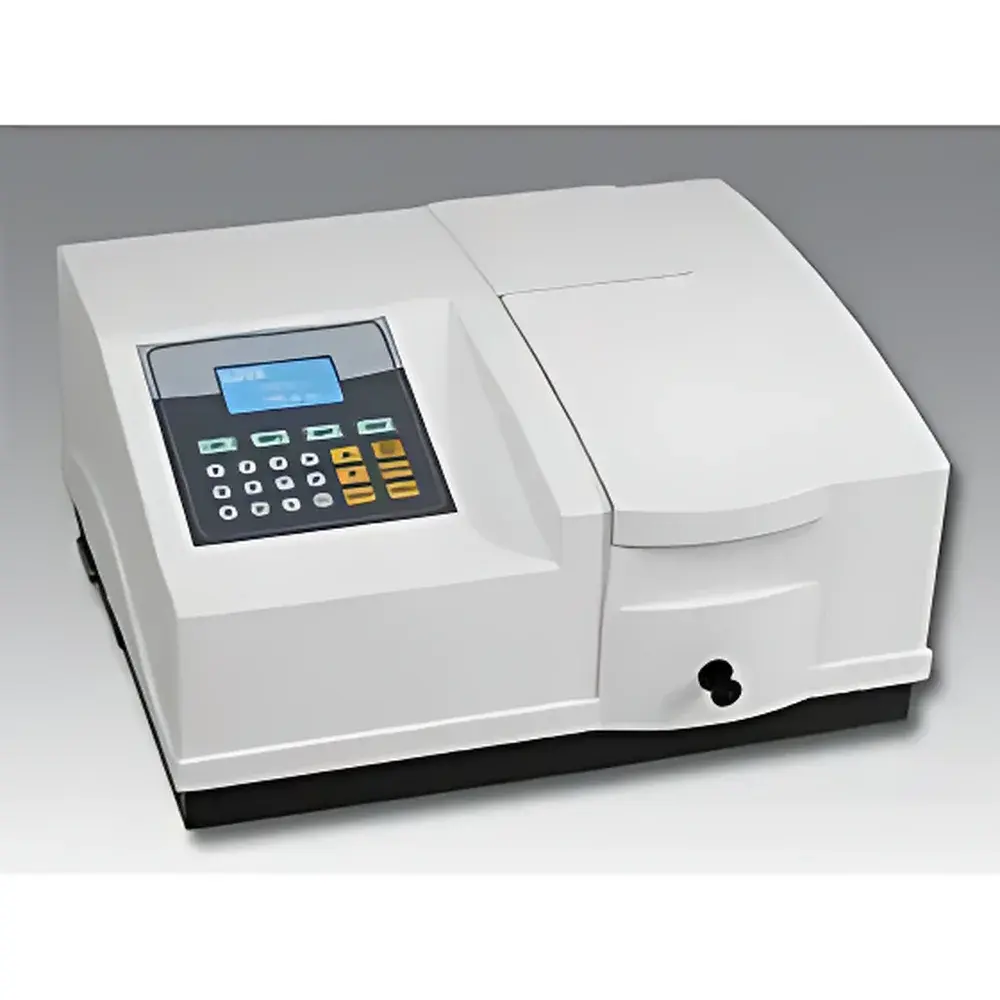
Beifen Sanpu 723PC UV-Visible Spectrophotometer
| Brand | Beifen Sanpu |
|---|---|
| Origin | Beijing, China |
| Manufacturer Type | Direct Manufacturer |
| Model | 723PC |
| Wavelength Range | 325–1100 nm (0.1 nm step resolution) |
| Spectral Bandwidth | 2 nm |
| Wavelength Accuracy | ±1.0 nm (auto-calibrated at startup) |
| Stray Light | ≤0.2% T at 360 nm |
| Detector | Photomultiplier Tube (PMT) |
| Optical Configuration | Dual-Wavelength Mode |
| Automation Level | Automatic Wavelength Selection |
| Photometric Range | Transmittance –1.0–200.0% T |
| Photometric Accuracy | ±0.5% T |
| Photometric Repeatability | ±0.2% T |
| Baseline Drift | ±0.002 A/h |
| Baseline Linearity | ±0.004 A |
| Display | 128×64 LCD |
| Dimensions | 455 × 430 × 220 mm |
| Interface | USB port for data export and PC connectivity |
| Software | UV-Solution 2.0 workstation software |
Overview
The Beifen Sanpu 723PC UV-Visible Spectrophotometer is a benchtop double-beam scanning instrument engineered for precise quantitative analysis in the visible and near-ultraviolet spectral region (325–1100 nm). It operates on the principle of Beer–Lambert law-based absorbance measurement, utilizing a high-sensitivity photomultiplier tube (PMT) detector and a fixed 2 nm spectral bandwidth to ensure consistent resolution across the operational range. Designed for routine laboratory applications where reliability, repeatability, and regulatory traceability are essential, the 723PC supports dual-wavelength comparative measurements—enabling background correction, differential analysis, and simultaneous monitoring of two analytes or reference/sample pairs. Its auto-calibration sequence at power-on ensures wavelength accuracy within ±1.0 nm without external intervention, while built-in dark-current compensation and baseline stabilization algorithms minimize drift to ±0.002 A/h—critical for extended kinetic assays or multi-hour calibration workflows.
Key Features
- Dual-wavelength measurement mode for real-time reference subtraction and ratio-based quantitation
- High-resolution wavelength scanning with 0.1 nm step increment and selectable scan intervals (0.1–5 nm)
- Photomultiplier tube (PMT) detector offering superior signal-to-noise ratio compared to silicon photodiodes in low-light conditions
- Automated wavelength positioning with onboard memory for up to 200 test records and 50 stored calibration curves
- Comprehensive curve-fitting engine supporting first-, second-, and third-order polynomial regression for standard curve generation
- Integrated system clock for time-stamped data logging, compliant with GLP documentation requirements
- USB interface enabling direct data transfer to Windows-based systems running UV-Solution 2.0 software
- Onboard 128×64 graphical LCD display with intuitive menu navigation and real-time spectrum preview
Sample Compatibility & Compliance
The 723PC accommodates standard 10 mm pathlength cuvettes (glass, quartz, or plastic), supporting liquid-phase transmission measurements for aqueous, organic, and mildly corrosive solutions. It meets core performance benchmarks referenced in ISO 6425:2022 (spectrophotometer performance verification) and aligns with ASTM E275–22 guidelines for spectrophotometric instrumentation validation. While not certified for FDA 21 CFR Part 11 out-of-the-box, its UV-Solution 2.0 software architecture supports audit-trail-enabling configurations—including user access logs, parameter change history, and electronic signature readiness—when deployed within validated GxP environments under site-specific qualification protocols. The instrument’s ≤0.2% T stray light specification at 360 nm satisfies USP requirements for UV-Vis method suitability in pharmaceutical excipient and active ingredient analysis.
Software & Data Management
UV-Solution 2.0 is a Windows-native application designed exclusively for the 723PC platform. It provides full control over instrument parameters and advanced post-acquisition processing. Key modules include Quantitative Analysis (with up to 20-point calibration standards and multi-order curve fitting), Kinetic Scanning (programmable duration up to 168 hours with sampling intervals from 0.5 s to 60 s), Wavelength Scanning (with overlay of up to eight spectra, smoothing filters, derivative calculation up to 4th order, and automatic peak/valley detection), and Multi-Wavelength Testing (configurable up to 15 discrete wavelengths per run). All data—including raw absorbance values, processed spectra, and metadata—are exportable in ASCII (.txt) and bitmap (.bmp) formats for integration into LIMS, statistical packages (e.g., JMP, Minitab), or regulatory submission dossiers. Internal memory retains 10,000 kinetic data points per session.
Applications
This spectrophotometer serves as a foundational tool in teaching laboratories for undergraduate spectroscopy instruction, including Beer’s law verification, molar absorptivity determination, and equilibrium constant calculations. In industrial QC settings, it performs routine assays for dye concentration in textile effluents (ISO 105-X12), nitrate/nitrite levels in drinking water (EPA Method 353.2), protein quantification via Bradford or Lowry assays, and enzymatic activity monitoring (e.g., NADH oxidation at 340 nm). Environmental labs use it for chlorophyll-a extraction analysis (APHA 10200H), while food testing facilities apply it to assess carotenoid content in oils and anthocyanin stability in beverages. Its dual-wavelength capability is especially valuable for turbidity-corrected measurements in unfiltered biological samples.
FAQ
Does the 723PC support GLP-compliant data archiving?
Yes—when used with UV-Solution 2.0 and configured with enabled audit trail logging, user authentication, and electronic signatures, the system can meet GLP documentation standards for non-clinical laboratory studies.
Can I perform kinetic assays lasting more than 24 hours?
Yes—the instrument supports kinetic runs up to 168 hours (7 days) with configurable sampling intervals ranging from 0.5 seconds to 60 seconds.
Is quartz cuvette compatibility verified across the full 325–1100 nm range?
Quartz cells are required for measurements below 350 nm; optical transmission above 350 nm is validated for both quartz and high-quality optical glass cuvettes.
What validation documentation is provided with the instrument?
Each unit ships with a factory calibration report (wavelength and photometric accuracy), a Certificate of Conformance, and a traceable serial-numbered logbook for user-initiated performance verification per ISO/IEC 17025 internal audit requirements.
Is remote operation possible via Ethernet or Wi-Fi?
No—the 723PC communicates exclusively via USB 2.0; network connectivity requires an external USB-to-Ethernet adapter and custom middleware integration.
Related Products





