
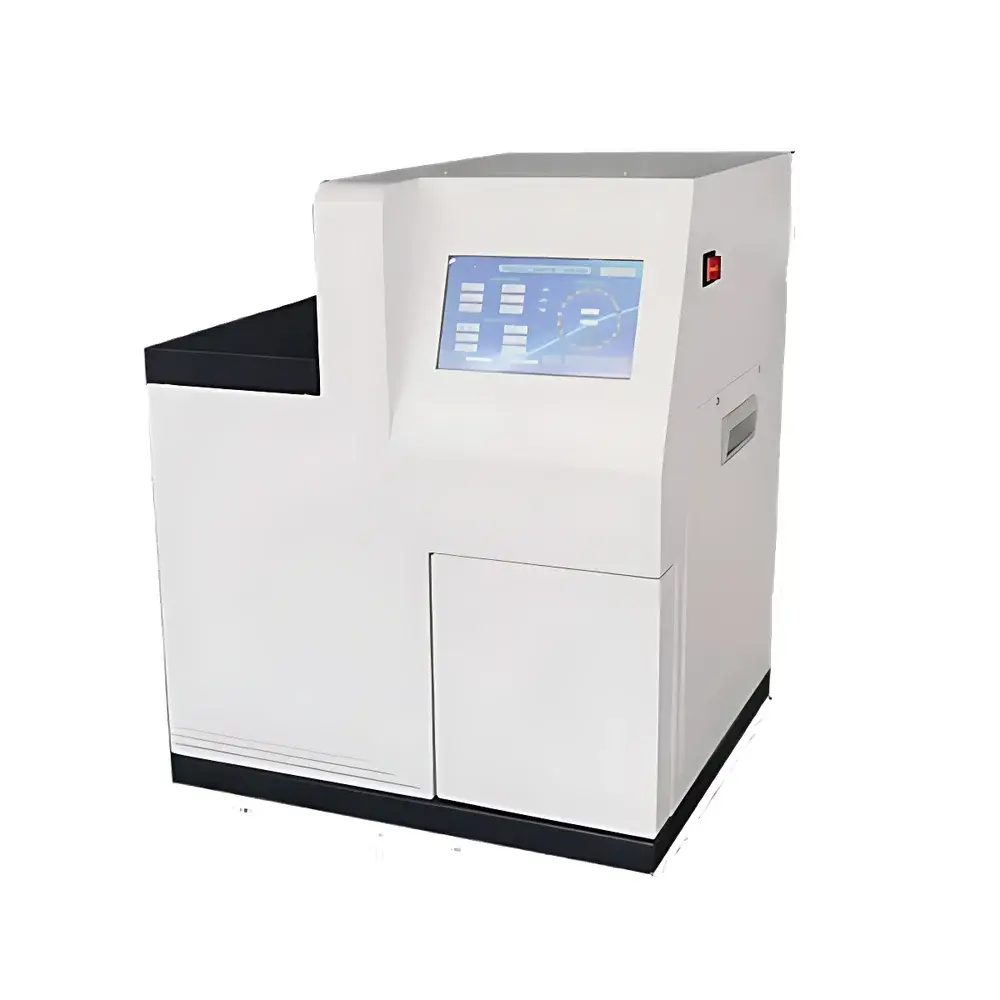
Beifen Sanpu AHS-20A Plus Fully Automated Headspace Sampler
| [Brand | Beifen Sanpu |
|---|---|
| Origin | Beijing, China |
| Manufacturer Type | Manufacturer |
| Model | BFAHS-20A Plus |
| Sample Capacity | 20 positions |
| Vial Size Compatibility | 10 mL or 20 mL (customizable up to 100 mL) |
| Quantitation Loop Volume | 1 mL (optional: 0.5 / 2 / 5 mL) |
| Sample Heating Range | 40–220 °C (up to 300 °C optional), ±0.5 °C stability |
| Valve & Transfer Line Heating Range | 40–220 °C (up to 300 °C optional) |
| Pressure Control Range | 0–0.25 MPa (continuously adjustable) |
| Pressurization Time | 0–999 s |
| Sampling Time | 0–30 min |
| Injection Time | 0–999 s |
| Bake-out/Flush Time | 0–30 min |
| Time Resolution | 1 ms |
| Carrier Gas Flow Control | EPC-compatible (optional) |
| RSD | <1.0% (for 100 ppm ethanol in water) |
| Inert Flow Path | Deactivated fused-silica and stainless-steel tubing |
| Interface | USB |
Overview
The Beifen Sanpu AHS-20A Plus Fully Automated Headspace Sampler is an engineered solution for precise, reproducible, and unattended volatile organic compound (VOC) extraction from solid and liquid matrices prior to gas chromatographic analysis. It operates on the principle of equilibrium headspace sampling—where a sealed sample vial is heated to promote partitioning of analytes into the vapor phase above the sample matrix. The instrument then applies controlled positive pressure to transfer the equilibrated headspace gas quantitatively into a high-inertness loop, followed by rapid injection into the GC inlet via a thermostatted six-port switching valve. Designed for laboratories requiring robust routine analysis—including environmental testing, pharmaceutical residual solvent determination (per ICH Q3C), food flavor profiling, forensic toxicology, and polymer outgassing studies—the AHS-20A Plus delivers analytical consistency while minimizing manual intervention and carryover risk.
Key Features
- Fully automated 20-position carousel with real-time positional feedback and auto-detection of empty vial slots—prevents mechanical collision and ensures uninterrupted sequence execution.
- Triple-zone independent temperature control: sample block, valve oven, and transfer line—all maintained within ±0.5 °C stability and calibrated to 0.5% accuracy across the full operating range (40–220 °C standard; 300 °C optional).
- Positive-pressure sampling architecture eliminates baseline drift associated with vacuum-based systems and enables direct compatibility with split/splitless, PTV, and cold-on-column GC inlets.
- Entire fluidic path—including quantitative loop, six-port valve, and transfer lines—constructed from imported deactivated fused-silica and electropolished stainless steel to ensure minimal adsorption, zero memory effect, and sub-1.0% RSD performance (validated with 100 ppm ethanol in water).
- Motor-driven actuation system—no external compressed gas required—enhances operational safety and simplifies laboratory infrastructure requirements.
- 7-inch graphical LCD interface with animated workflow guidance; supports both standalone operation and full remote parameter configuration via USB-connected PC.
- Flexible sampling protocols: single-vial multi-injection, single-shot per vial, or multi-vial sequential injection—all programmable with millisecond time resolution (1 ms minimum step).
- Integrated self-diagnostic suite: automatic initialization check, vial position validation, thermal sensor verification, and hardware fault logging compliant with GLP documentation standards.
Sample Compatibility & Compliance
The AHS-20A Plus accommodates standard 10 mL and 20 mL crimp-top headspace vials (with optional support for 50 mL and 100 mL formats). Its inert flow path and thermally stable design meet method requirements outlined in USP Residual Solvents (Chapter 467), EP 2.4.24, and ASTM D7699 for VOC analysis in complex matrices such as soil, blood, polymers, and aqueous pharmaceutical formulations. The device supports audit-trail-capable operation when paired with 21 CFR Part 11-compliant chromatography data systems (CDS), and its deterministic timing engine ensures traceable event logging—including pressurization start, loop fill, valve actuation, and bake-out completion—for regulatory submissions.
Software & Data Management
Instrument control is implemented through a dedicated Windows-based application accessible via USB 2.0 interface. All method parameters—including temperature ramps, pressure profiles, timing sequences, and GC synchronization triggers—are stored in encrypted binary files with version-stamped metadata. The software enforces parameter interlock logic (e.g., preventing injection before thermal equilibrium) and exports raw event logs in CSV format for integration into LIMS environments. Optional EPC (Electronic Pressure Control) module enables closed-loop carrier gas flow regulation during injection, improving retention time stability across long unattended sequences. Firmware updates are delivered via signed package files to maintain integrity and traceability under ISO/IEC 17025 quality management frameworks.
Applications
- Residual solvent quantification in active pharmaceutical ingredients (APIs) and excipients per ICH Q3C guidelines.
- VOC screening in drinking water, wastewater, and soil extracts (EPA Methods 502.2, 524.4, 8260D).
- Flavor and fragrance compound profiling in beverages, dairy, and plant-derived products.
- Forensic analysis of ethanol, acetone, and chlorinated solvents in biological fluids.
- Outgassing characterization of adhesives, coatings, and packaging materials per ASTM F2163 and ISO 11341.
- Quality control of fermentation broths and bioprocess intermediates.
FAQ
Is the AHS-20A Plus compatible with Agilent, Thermo, and Shimadzu GC systems?
Yes—it provides TTL-level GC start trigger output and accepts external start input, enabling bidirectional synchronization with all major GC platforms without proprietary interface modules.
Can the instrument perform multiple injections from a single vial?
Yes—programmable “single vial, multiple injections” mode allows repeated sampling from one vial at defined intervals, supporting kinetic headspace studies or replicate precision assessment.
What maintenance is required for long-term reliability?
Routine maintenance includes quarterly verification of thermal calibration using NIST-traceable reference standards and annual replacement of septa and O-rings in the vial sealing mechanism. No consumable valves or pumps require scheduled replacement.
Does the system support method transfer between laboratories?
Yes—method files contain embedded hardware configuration data (e.g., loop volume, vial type, heating rates), ensuring identical operational behavior across identical AHS-20A Plus units when deployed in multi-site QC networks.
Is remote monitoring supported over LAN or cloud platforms?
While native Ethernet or cloud connectivity is not integrated, the USB interface supports virtual COM port emulation, allowing third-party SCADA or LabWare LIMS integration via middleware drivers compliant with OPC UA specifications.






