
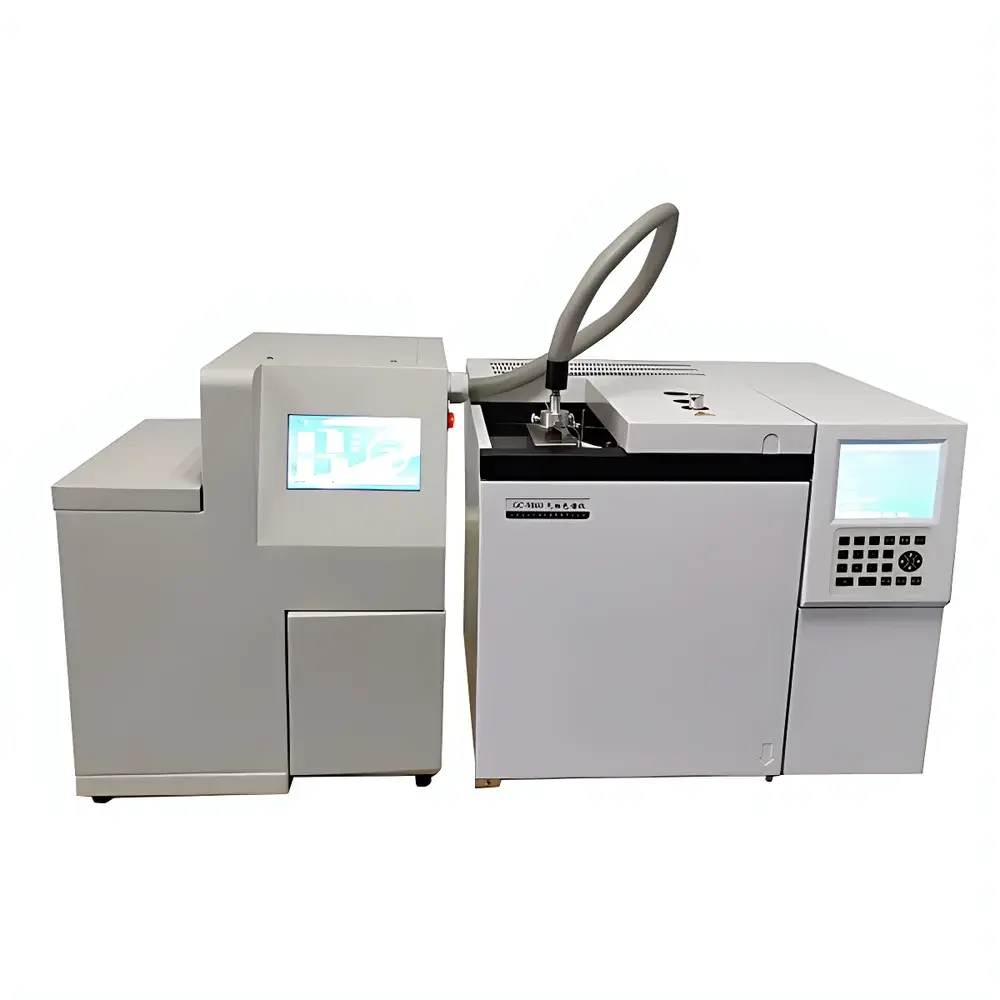
Beifen Sanpu AHS-20A Plus Fully Automated Static Headspace Sampler for Ethylene Oxide Residue Analysis
| [Brand | Beifen Sanpu |
|---|---|
| Origin | Beijing, China |
| Manufacturer Type | Original Equipment Manufacturer (OEM) |
| Product Category | Domestic |
| Model | AHS-20A Plus |
| Instrument Type | Static Headspace Sampler |
| Automation Level | Fully Automatic |
| Vial Heating Range | Ambient to 200 °C (1 °C increments) |
| Valve Temperature Control Range | 40–220 °C (±1 °C accuracy) |
| Sample Loop Volume | 1 mL |
| Vial Capacity | 20 positions |
| Compatible Vial Sizes | 10 mL or 20 mL] |
Overview
The Beifen Sanpu AHS-20A Plus is a fully automated static headspace sampler engineered for precise, reproducible quantification of residual ethylene oxide (EO) in medical devices and pharmaceutical packaging materials. It operates on the principle of equilibrium headspace gas-phase partitioning: after aqueous extraction and thermal equilibration, volatile EO migrates into the headspace above the liquid phase and is transferred via a heated transfer line and precision-controlled sampling loop into a gas chromatograph (GC). This method complies with internationally recognized pharmacopeial and regulatory frameworks—including ISO 10993-7, USP <661>, and ASTM F2875—where static headspace GC remains the reference analytical technique for EO residue validation under controlled sterilization process monitoring and post-sterilization release testing.
Key Features
- Fully automated 20-position carousel with programmable vial selection and priority queue management for unattended operation over extended assay batches.
- Independent dual-zone temperature control: vial oven (ambient to 200 °C, ±0.5 °C stability) and high-fidelity valve/loop assembly (40–220 °C, ±1 °C accuracy), minimizing condensation and carryover risks during EO transfer.
- 1 mL fixed-volume pressurized sampling loop with inert fused-silica internal lining, ensuring consistent injection volume and eliminating memory effects across high-concentration EO standards (up to 100 mg/kg).
- Integrated pressure-balanced vial pressurization system with adjustable fill/vent timing, optimized for aqueous extraction matrices common in ISO 10993-7 compliant sample preparation (e.g., 10 mL water + 2.0 g device fragment, 60 °C, 20 min equilibration).
- Rugged stainless-steel fluid path architecture with electropolished surfaces and zero-dead-volume fittings, validated for long-term compatibility with humidified EO-laden carrier gas streams.
- RS-232 and Ethernet interfaces supporting direct integration with major GC platforms (Agilent, Shimadzu, Thermo Fisher, and domestic GC-9860 series) via standard GC trigger protocols.
Sample Compatibility & Compliance
The AHS-20A Plus accommodates standard crimp-top 10 mL and 20 mL headspace vials, including those sealed with PTFE/silicone septa—critical for maintaining integrity during prolonged aqueous extraction and thermal equilibration steps. Its design supports full alignment with GB/T 16886.7–2015 (identical to ISO 10993-7:2017), GB/T 14233.1–2008, and YY/T 0698.5–2018 requirements for EO residue analysis in Class I–III medical devices. The system’s thermal stability, pressure repeatability, and loop-to-loop precision meet GLP audit criteria for method validation parameters including intermediate precision (RSD ≤ 3.5% at 10 mg/kg level) and system suitability (peak symmetry ≥ 0.9, resolution ≥ 2.0 between EO and adjacent solvent fronts).
Software & Data Management
Controlled via Beifen Sanpu’s HS-Link v3.2 software (Windows 10/11 compatible), the AHS-20A Plus enables full method parameterization—including equilibration time, agitator speed (optional), vial pressurization profile, loop fill/flush cycles, and GC trigger synchronization. Audit-trail functionality logs all user actions, method changes, and instrument status events with timestamp and operator ID, satisfying FDA 21 CFR Part 11 requirements when deployed in regulated QC laboratories. Raw data export supports .csv and .txt formats for integration into LIMS environments and third-party statistical analysis tools (e.g., JMP, Minitab) used in EO process capability studies (Cpk ≥ 1.33).
Applications
- Quantitative determination of EO residuals in single-use syringes, IV sets, catheters, gauze pads, and surgical drapes following ethylene oxide sterilization cycles.
- Stability-indicating release testing of pharmaceutical blister packaging and polymer-based primary containers per ICH Q5C guidelines.
- Method development and validation support for ISO 10993-7 Annex B-compliant extraction protocols using water, saline, or simulated body fluid (SBF) as extractants.
- Multi-analyte headspace screening for co-residuals such as chloroethanol (ECH), formaldehyde, and acetaldehyde—enabled by retention time optimization on SE-54 (30 m × 0.32 mm × 0.5 µm) or similar mid-polarity columns.
- Support for accelerated aging studies where EO desorption kinetics are monitored across storage temperatures (25 °C, 37 °C, 55 °C) per ISO 11607-2.
FAQ
What is the recommended equilibration temperature and time for EO analysis per ISO 10993-7?
The standard specifies 60 °C for 20 minutes using 10 mL aqueous extractant and 2.0 g sample mass—parameters directly supported by the AHS-20A Plus’ vial heating profile and timer resolution.
Can the AHS-20A Plus be used with non-aqueous extractants such as ethanol or hexane?
Yes—provided vial septa and valve seals are verified for chemical compatibility; however, aqueous extraction remains the mandatory approach for regulatory submissions under GB/T 16886.7–2015 and ISO 10993-7.
Does the system support calibration verification with certified EO gas standards?
While liquid-phase standard preparation (per Clause H.3 of GB/T 16886.7) is the norm, the AHS-20A Plus’ pressure-regulated vial pressurization allows direct introduction of certified EO-in-nitrogen gas standards for system suitability checks at trace levels (0.1–10 µg/mL equivalent).
How is carryover mitigated during high-level EO injections (e.g., >50 mg/kg)?
Three-stage loop purge (carrier gas flush + vacuum evacuation + bake-out at 220 °C) is programmable in HS-Link v3.2, reducing carryover to <0.1% across consecutive high/low concentration sequences.
Is method transfer from manual to automated headspace feasible?
Yes—the AHS-20A Plus replicates manual vial handling conditions (temperature ramp rate, agitation, headspace volume) with higher inter-run reproducibility (RSD < 2.0%), enabling seamless transition without re-validation of robustness parameters.
Related Products





