
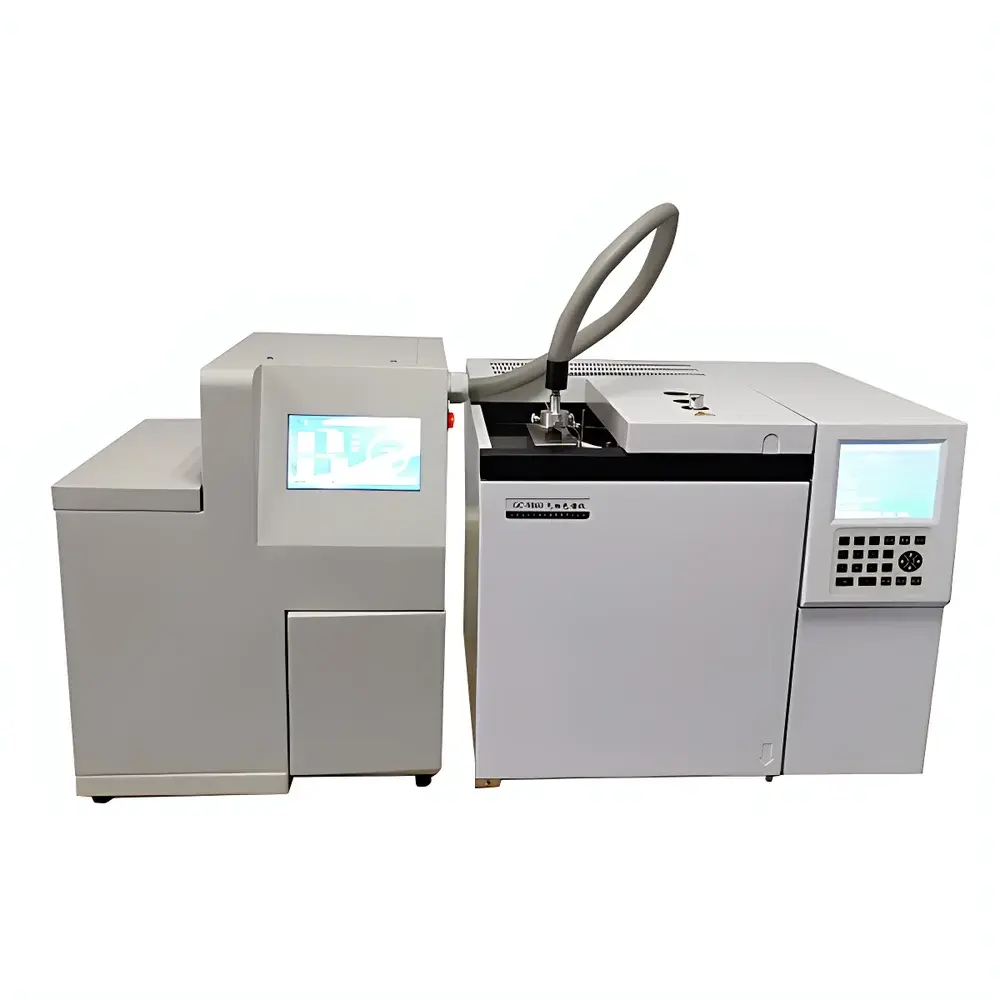
Beifen Sanpu AHS-20A PLUS Fully Automated Static Headspace Sampler for Water Analysis of BTEX and Styrene
| [Brand | Beifen Sanpu |
|---|---|
| Origin | Beijing, China |
| Manufacturer Type | Direct Manufacturer |
| Instrument Type | Static Headspace Sampler |
| Automation Level | Fully Automatic |
| Vial Heating Range | Ambient to 200°C (1°C increments) |
| Valve & Transfer Line Temperature Control Range | 40–220°C (±1°C accuracy) |
| Sample Loop Volume | 1 mL |
| Vial Capacity | 20 positions |
| Compatible Vial Sizes | 10 mL or 20 mL] |
Overview
The Beifen Sanpu AHS-20A PLUS is a fully automated static headspace sampler engineered for precise, reproducible analysis of volatile aromatic hydrocarbons—including benzene, toluene, ethylbenzene, xylenes (o-, m-, p-), isopropylbenzene (cumene), and styrene—in aqueous matrices. It operates on the principle of phase equilibrium partitioning: when an aqueous sample is sealed in a thermostatted vial and heated, volatile analytes distribute between the liquid and headspace gas phases according to their Henry’s law constants. At equilibrium, the vapor-phase concentration correlates linearly with the aqueous-phase concentration within defined dynamic ranges—enabling quantitative determination via gas chromatography with flame ionization detection (GC-FID). Designed to comply with HJ 1067–2019 (“Determination of BTEX and Styrene in Water by Headspace Gas Chromatography”), this instrument delivers robust performance for environmental monitoring laboratories performing routine compliance testing of surface water, groundwater, wastewater, and industrial effluents.
Key Features
- Fully automated 20-position carousel accommodates standard 10 mL or 20 mL crimp-top or screw-cap headspace vials—enabling unattended batch processing of up to 20 samples per run.
- Precise temperature control across three independent zones: vial oven (ambient to 200°C, 1°C resolution), valve manifold (40–220°C), and transfer line (40–220°C), all maintained within ±1°C accuracy per ASTM E260 and ISO 15178 requirements.
- 1 mL fixed-volume sampling loop ensures consistent injection volume and minimizes carryover; loop and valve are actively heated to prevent condensation of high-boiling analytes such as styrene.
- Integrated leak-tight pneumatic system with pressure-controlled vial pressurization and balanced syringe-driven sampling—optimized for high recovery of low-concentration volatiles (e.g., benzene at 2 µg/L method detection limit).
- Modular design supports seamless integration with any GC system equipped with split/splitless inlet, including Agilent, Shimadzu, Thermo Fisher, and domestic platforms such as GC-9860.
- Embedded microprocessor with non-volatile memory retains method parameters, runtime logs, and calibration history—supporting audit-ready operation under GLP and ISO/IEC 17025 frameworks.
Sample Compatibility & Compliance
The AHS-20A PLUS is validated for use with EPA Method 502.2, ISO 15680:2001, and China’s national standard HJ 1067–2019. It supports direct analysis of acidified (pH ≤2) and non-acidified water samples per HJ 91.1 and HJ/T 164 protocols. Sodium chloride (NaCl) salting-out enhancement is fully compatible—vials accept pre-loaded 3 g NaCl pellets or manual addition prior to sealing. The system accommodates both PTFE-silicone septa and crimp-seal configurations, ensuring minimal analyte loss during equilibration and injection. All wetted materials—including vial carriers, needle guides, and loop tubing—are chemically inert (stainless steel, fused silica, PTFE) to prevent adsorption or catalytic degradation of reactive aromatics.
Software & Data Management
Instrument control and sequence management are executed via Beifen Sanpu’s proprietary HS-Link software (Windows-based, English UI), supporting method cloning, multi-step temperature ramping, and real-time status monitoring. Software enforces electronic signature capability and full 21 CFR Part 11 compliance—including user access levels, audit trails for parameter changes, and immutable raw data archiving. Export formats include CSV, TXT, and CDF (compatible with OpenLab CDS, Chromeleon, and Empower). Sequence files may be synchronized with LIMS via ODBC or HL7 interfaces. Calibration verification checks (e.g., system suitability tests using benzene/toluene check standards) can be scheduled automatically and logged with pass/fail flags.
Applications
This headspace sampler is routinely deployed in municipal environmental monitoring stations, third-party testing labs accredited to CNAS (China National Accreditation Service), and industrial QA/QC departments responsible for discharge compliance. Key applications include: (1) Regulatory monitoring of drinking water sources per GB 5749–2022; (2) Wastewater treatment plant influent/effluent profiling under HJ 978–2018; (3) Site investigation of contaminated land where dissolved-phase BTEX migration is suspected; (4) Validation of remediation efficacy in pump-and-treat or air sparging systems; (5) Method development and interlaboratory comparison studies aligned with ISO 5725-2 precision criteria.
FAQ
What is the minimum detectable concentration for benzene when using the AHS-20A PLUS with GC-FID per HJ 1067–2019?
The method detection limit (MDL) for benzene is 2 µg/L when using a 10.0 mL sample volume, 60°C equilibration, and 1 mL headspace injection—consistent with published validation data in the standard.
Can the AHS-20A PLUS be used with non-aqueous samples such as soil leachates or sediment pore water?
Yes—provided samples are homogenized, filtered (0.45 µm), and pH-adjusted as specified in Section 6.1 of HJ 1067–2019; matrix modifiers (e.g., NaCl, antifoaming agents) must be added post-filtration.
Is the 1 mL sample loop replaceable, and what is its typical service life under routine use?
The fused-silica-lined stainless-steel loop is field-replaceable and rated for ≥10,000 injections when operated within specified temperature and pressure limits.
Does the system support dynamic headspace (purge-and-trap) mode?
No—the AHS-20A PLUS is a static headspace platform only; dynamic extraction requires dedicated purge-and-trap instrumentation.
How is carryover mitigated between high- and low-concentration samples?
Carryover is minimized through programmable needle wash cycles (solvent + bake), loop purging with carrier gas, and thermal desorption of the valve manifold between injections—validated to <0.1% for styrene at 12 mg/L.





