
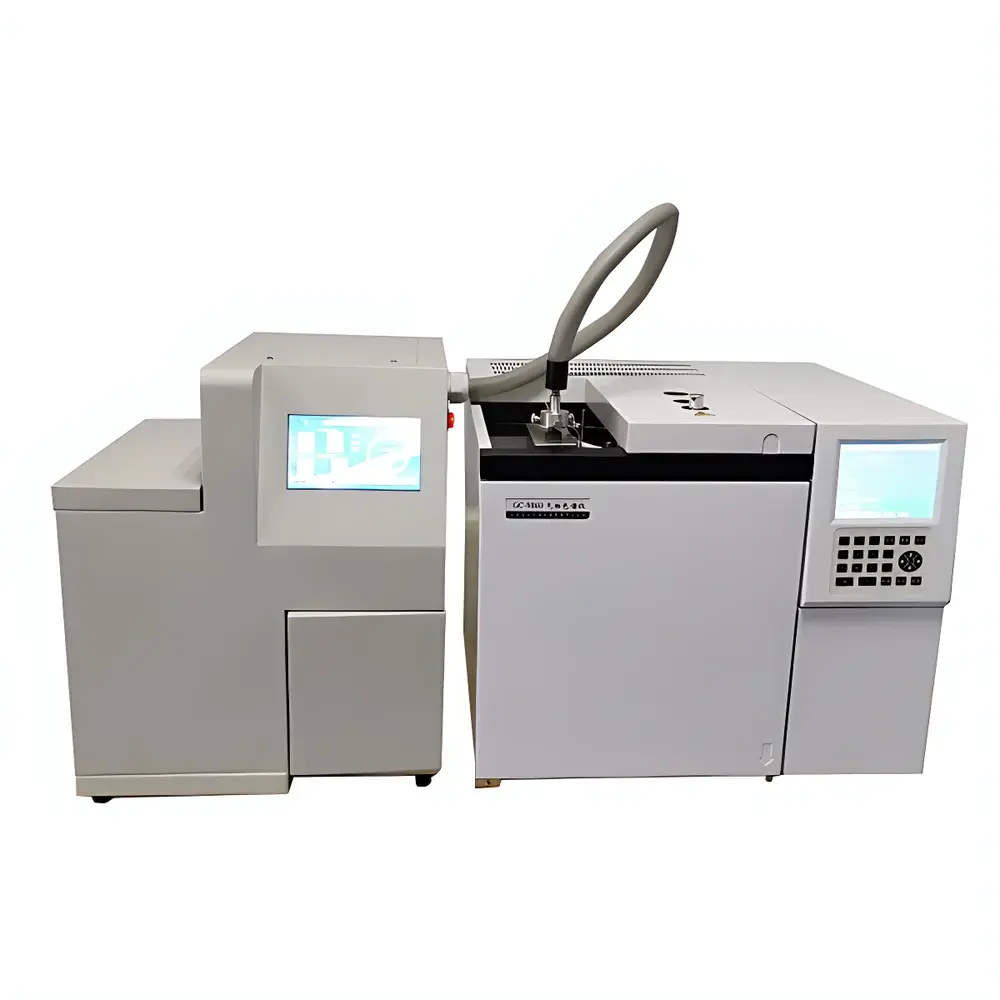
Beifen Sanpu AHS1-20A Plus Fully Automated Static Headspace Sampler for Ethylene Oxide Residue Analysis in Medical Masks
| Brand | Beifen Sanpu |
|---|---|
| Origin | Beijing, China |
| Manufacturer Type | Direct Manufacturer |
| Product Origin | Domestic (China) |
| Model | AHS1-20A Plus |
| Instrument Type | Static Headspace Sampler |
| Automation Level | Fully Automatic |
| Vial Heating Range | Ambient to 200 °C (1 °C increment) |
| Valve & Transfer Line Temperature Control Range | 40–220 °C (±1 °C accuracy) |
| Sample Loop Volume | 1 mL |
| Vial Capacity | 20 positions |
| Compatible Vial Sizes | 10 mL or 20 mL |
Overview
The Beifen Sanpu AHS1-20A Plus is a fully automated static headspace sampler engineered for precise, reproducible quantification of residual ethylene oxide (EO) in sterilized medical devices—particularly surgical masks and other personal protective equipment (PPE). EO is widely used in low-temperature gas sterilization due to its efficacy against spores, viruses, and bacteria; however, its classification as a Group 1 human carcinogen (IARC) and acute neurotoxicant necessitates strict regulatory control of residual levels. This instrument operates on the principle of static headspace equilibrium: sealed sample vials are heated to liberate volatile EO into the vapor phase above the aqueous extract; after thermal equilibration, a precisely metered volume of headspace gas is transferred via a thermostated sampling valve and transfer line directly into a gas chromatograph (GC) for separation and detection—typically using flame ionization (FID) or mass spectrometric (MS) detection. Designed for compliance with ISO 10993-7 and GB/T 16886.7–2015, it serves as a critical component in quality control laboratories performing routine EO residue testing under ISO 13485, FDA 21 CFR Part 820, and GMP-aligned workflows.
Key Features
- Fully automated 20-position carousel with programmable vial handling, eliminating manual intervention and reducing operator-induced variability.
- Independent temperature control for vial oven (ambient–200 °C), sampling valve (40–220 °C), and transfer line (40–220 °C), each with ±1 °C stability—ensuring consistent volatilization and preventing condensation or adsorption losses.
- 1 mL fixed-volume quantitative loop calibrated for high-precision gas-phase injection, supporting method robustness across batch analyses.
- Compatibility with both 10 mL and 20 mL crimp-top headspace vials, enabling flexibility in sample mass (e.g., 1.0 g mask material per GB/T 16886.7–2015) and extraction volume (e.g., 5 mL water).
- Integrated method storage and recall for up to 100 user-defined methods, including equilibration time, incubation temperature, pressurization parameters, and loop purge cycles.
- Robust architecture with corrosion-resistant internal pathways and inert flow path materials (e.g., SilcoNert®-treated stainless steel), minimizing EO carryover and surface reactivity.
Sample Compatibility & Compliance
The AHS1-20A Plus is validated for use with aqueous extracts of EO-sterilized polypropylene-based medical masks, gowns, drapes, and catheter components. It supports sample preparation per GB/T 16886.7–2015 (equilibration at 60 °C for 30 min in 5 mL water) and aligns with ISO 10993-7 Annex B guidance on headspace-GC methodology. Its performance meets the precision requirements of USP , EP 2.2.48, and ASTM D7575 for residual EO analysis. When integrated into a validated GC system (e.g., equipped with SE-54 capillary column, FID detection), the complete workflow satisfies audit readiness for GLP and GMP environments—including full traceability, electronic signatures, and 21 CFR Part 11-compliant data integrity when paired with compliant chromatography data systems (CDS).
Software & Data Management
The instrument communicates via RS-232 or Ethernet to standard GC control software (e.g., Chromeleon, OpenLab CDS, or GC vendor-native platforms). Method parameters—including vial position mapping, temperature ramp profiles, loop fill/flush timing, and sequence scheduling—are configured externally and executed with deterministic timing. Audit trails log all method changes, run start/stop timestamps, temperature deviations, and error events. Raw injection metadata (vial ID, timestamp, temperature setpoints, actual readings) are embedded in GC data files, enabling full chain-of-custody reconstruction during regulatory inspections.
Applications
- Quantitative determination of EO residuals in Class I–III medical devices per GB/T 16886.7–2015 and ISO 10993-7.
- Batch release testing of surgical masks, N95 respirators, and isolation gowns in manufacturing QC labs.
- Stability studies evaluating EO desorption kinetics under accelerated aging conditions (e.g., 40 °C/75% RH).
- Method development and validation for alternative sterilants (e.g., hydrogen peroxide, ozone) where volatile byproduct screening is required.
- Environmental monitoring of EO off-gassing from sterilization chambers or storage areas using passive headspace sampling protocols.
FAQ
What is the minimum detectable level of EO achievable with this system?
Detection limits depend on GC detector sensitivity, column efficiency, and sample matrix; typical method detection limits (MDL) range from 0.1–0.5 µg/g when using FID and optimized SE-54 separation.
Can the AHS1-20A Plus be used with cryogenic trapping or cold injection techniques?
No—it is configured exclusively for static headspace analysis without cryofocusing; dynamic headspace or purge-and-trap applications require dedicated instrumentation.
Is calibration verification supported per ISO/IEC 17025 requirements?
Yes: built-in temperature sensor validation ports and external PT100 probe inputs allow periodic calibration checks against NIST-traceable references.
Does the system support unattended overnight operation?
Yes: the 20-vial capacity, auto-shutdown logic, and power-failure recovery mode enable extended sequence execution without supervision.
How is carryover mitigated between high-concentration and low-concentration samples?
Triple-stage loop purging (carrier gas + vacuum + carrier gas), valve bake-out at 220 °C post-injection, and optional inert liner replacement minimize cross-contamination to <0.1% RSD.




