
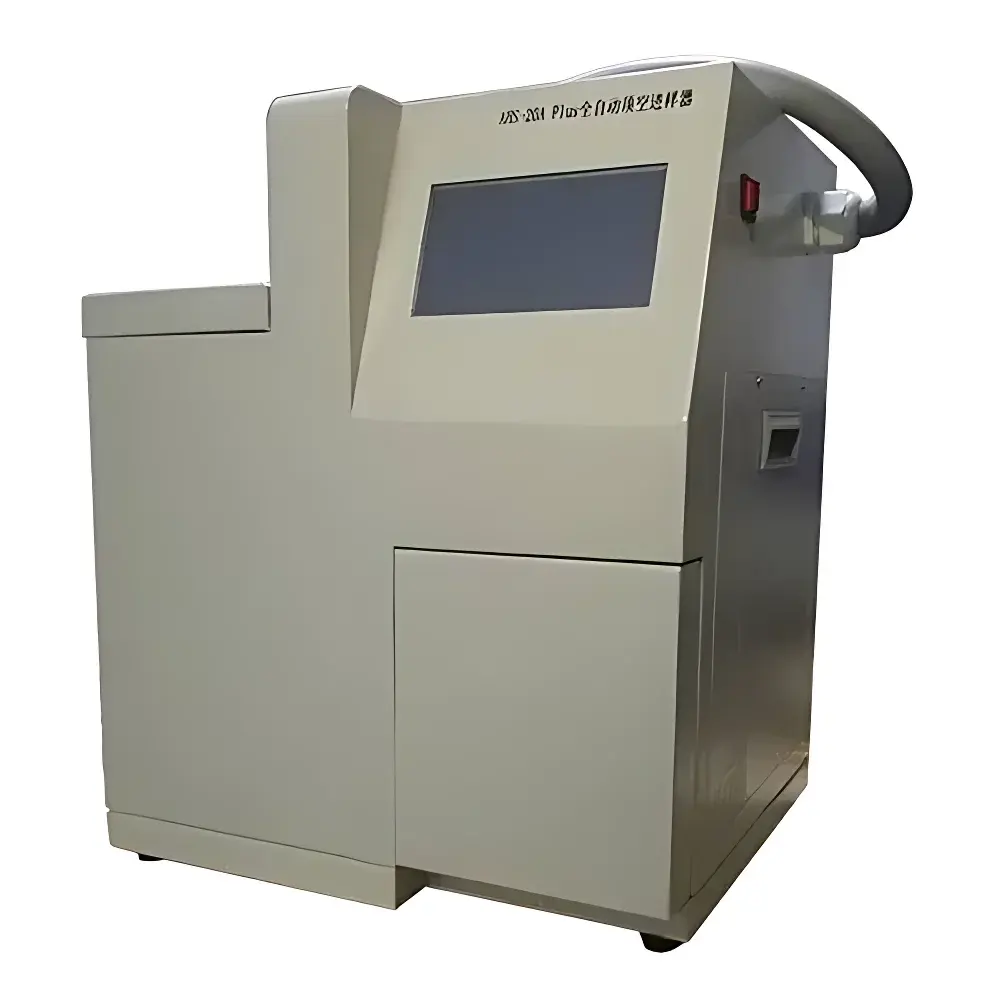
Beifen Sanpu AHSC-20A Plus Fully Automated Headspace Sampler
| Brand | Beifen Sanpu |
|---|---|
| Model | AHSC-20A Plus |
| Origin | Beijing, China |
| Manufacturer Type | Direct Manufacturer |
| Sample Positions | 20 |
| Heating Range (Sample/Valve/Transfer Line) | 40–220 °C (optional up to 300 °C) |
| Temperature Accuracy | ±0.5 °C |
| Temperature Stability | < ±0.5 °C |
| Pressure Control Range | 0–0.25 MPa (continuously adjustable) |
| Pressurization Time | 0–999 s |
| Sampling Time | 0–30 min |
| Injection Time | 0–999 s |
| Purge Time | 0–30 min |
| Minimum Time Resolution | 1 ms |
| Quantitative Loop Volume | 1 mL (customizable: 0.5 / 2 / 5 mL) |
| Vial Capacity | 10 mL or 20 mL (customizable: 50 / 100 mL) |
| Simultaneous Heating | 1 or 2 vials |
| RSD | < 1.0% (for 100 ppm ethanol in water) |
| Purge Flow Rate | 0–100 mL/min (adjustable) |
| Communication Interface | USB |
| Compliance | ASTM D6866, ISO 17025-compatible operation |
Overview
The Beifen Sanpu AHSC-20A Plus Fully Automated Headspace Sampler is a precision-engineered sample introduction system designed for quantitative volatile organic compound (VOC) analysis in gas chromatography (GC). It operates on the principle of equilibrium headspace sampling—where volatile analytes partition between a solid or liquid sample matrix and its overlying vapor phase at controlled temperature and pressure. Following thermal equilibration, the instrument applies precise positive pressure to transfer the headspace vapor through a heated, inert pathway into a fixed-volume quantitative loop, then injects the entire loop volume onto the GC column via a high-reproducibility six-port valve. This method eliminates solvent interference, minimizes matrix effects, and delivers robust, trace-level sensitivity without derivatization or extraction solvents—making it ideal for residual solvents, environmental volatiles, flavor/aroma profiling, pharmaceutical stability testing, and forensic toxicology applications.
Key Features
- 20-position autosampler carousel with automatic vial recognition and collision-avoidance logic—detects empty or misaligned positions and skips them without manual intervention.
- Triple-zone independent temperature control: sample oven, valve block, and transfer line—all heated to 40–220 °C (upgradeable to 300 °C) with stability < ±0.5 °C and accuracy ±0.5 °C.
- Electronically actuated motion system: no external carrier gas required for valve actuation or syringe movement—enhancing safety, reducing operational cost, and eliminating pneumatic dependency.
- High-inertness fluidic path: all internal tubing, quantitative loops (standard 1 mL, optionally 0.5/2/5 mL), and needle assemblies are constructed from silanized fused silica or deactivated stainless steel to prevent adsorption, carryover, or catalytic degradation.
- Zero-dead-volume six-port valve configuration with integrated heating: valve-to-transfer-line junction resides fully within the thermal zone—eliminating cold spots and ensuring quantitative transfer of high-boiling or thermally labile analytes.
- Configurable sampling protocols: single-vial multi-injection, single-shot per vial, or sequential multi-vial analysis—all programmable via intuitive 7-inch graphical LCD interface or remote USB command set.
- Comprehensive self-diagnostics: power-on system check, positional encoder validation, heater fault detection, pressure sensor calibration verification, and real-time error logging with on-screen alerts.
Sample Compatibility & Compliance
The AHSC-20A Plus accommodates standard 10 mL and 20 mL crimp-top or screw-cap headspace vials (custom configurations available for 50 mL and 100 mL formats). It handles liquid samples (aqueous, organic, viscous), solids (polymers, soils, tablets), and semi-solids (creams, gels, food matrices) without modification. Its design aligns with method validation requirements under ISO/IEC 17025:2017 for testing laboratories and supports GLP/GMP workflows when integrated with chromatographic data systems capable of 21 CFR Part 11-compliant electronic records and audit trails. Routine performance verification follows ASTM D6866 (radiocarbon-based VOC quantification) and USP <467> residual solvents guidelines.
Software & Data Management
Local operation is supported via the embedded 7-inch resistive touchscreen with animated workflow guidance—requiring minimal training for new users. All parameters—including temperature ramps, pressurization profiles, injection timing, purge cycles, and synchronization triggers—are configurable either on-device or remotely via USB 2.0 interface using vendor-provided configuration utility. The instrument outputs ASCII-formatted status logs (timestamped, with vial ID, cycle count, temperature/pressure readings, and fault codes) compatible with LIMS ingestion. When interfaced with third-party GC data systems (Agilent OpenLab, Thermo Chromeleon, Shimadzu GCsolution), it supports hardware-triggered start/stop commands and event synchronization—ensuring chromatographic run integrity and traceable method execution.
Applications
- Pharmaceutical quality control: residual solvents (ICH Q3C), extractables/leachables, stability-indicating assays.
- Environmental monitoring: BTEX, chlorinated hydrocarbons, and halogenated VOCs in soil/water per EPA Methods 502.2, 524.4, and 8260.
- Food & beverage safety: ethanol quantification, off-flavor compounds (e.g., acetaldehyde, dimethyl sulfide), packaging migration studies.
- Forensic toxicology: blood alcohol concentration (BAC), volatile substance abuse screening (e.g., toluene, acetone, isopropanol).
- Polymer & materials science: monomer residuals, catalyst traces, curing byproducts in adhesives, coatings, and composites.
FAQ
What sample types can the AHSC-20A Plus process?
It accepts liquids, solids, and semi-solids sealed in standard headspace vials. No derivatization or solvent extraction is required prior to analysis.
Is the instrument compatible with non-Beifen Sanpu gas chromatographs?
Yes—it features universal GC trigger signaling (TTL-level start/stop) and mechanical/electrical interfaces compliant with Agilent, Thermo Fisher, Shimadzu, PerkinElmer, and other major GC platforms.
Can temperature zones be set independently?
Yes—sample oven, six-port valve, and transfer line each have dedicated PID-controlled heaters with independent setpoints and real-time monitoring.
How is carryover prevented between runs?
Through programmable high-flow inert gas purge (0–100 mL/min) of the loop, valve, and transfer line post-injection—combined with surface-passivated fluidic components and optional EPC-controlled flow regulation.
Does the system support regulatory-compliant data integrity?
When paired with a 21 CFR Part 11-enabled GC data system, full audit trail, user access control, and electronic signature capabilities are achievable—the AHSC-20A Plus itself provides timestamped operational logs and parameter change history.




