
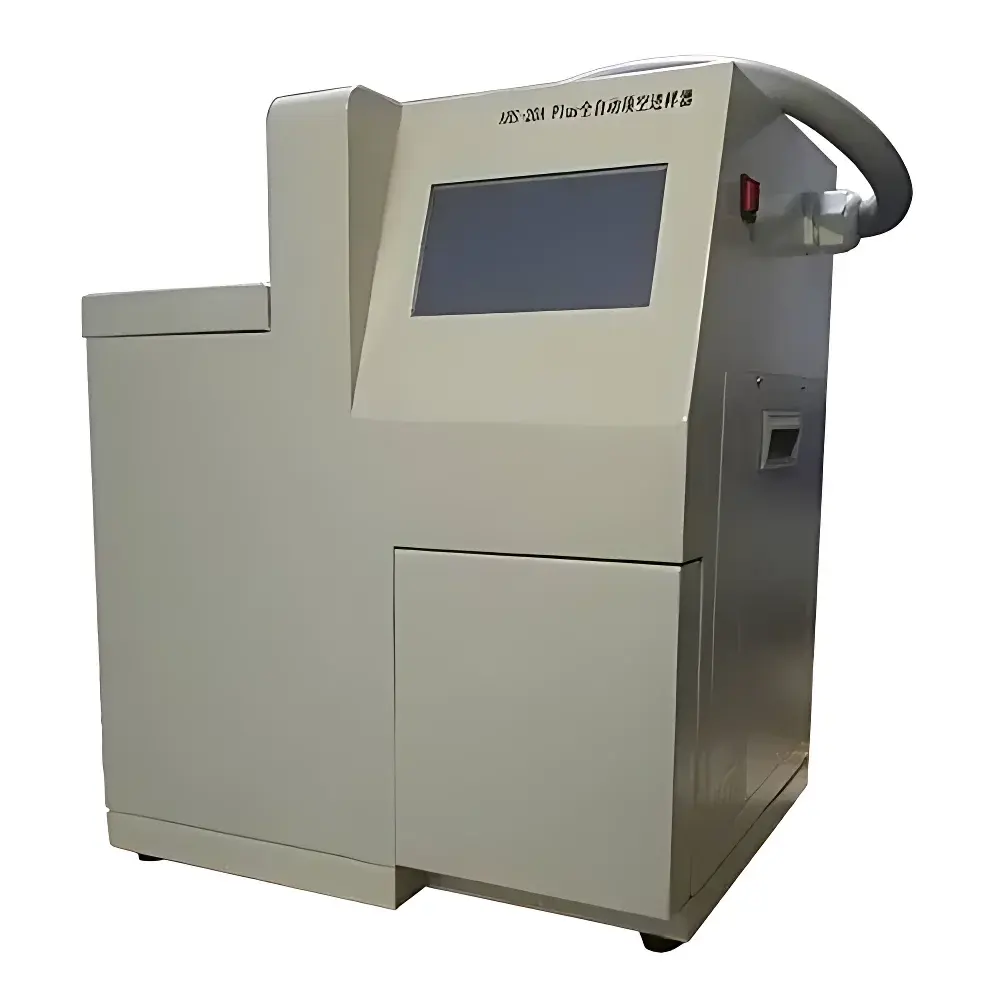
Beifen Sanpu AHSG-20A Plus Fully Automated Headspace Sampler
| Brand | Beifen Sanpu |
|---|---|
| Model | AHSG-20A Plus |
| Origin | Beijing, China |
| Manufacturer Type | Direct Manufacturer |
| Heating Range (Sample/Valve/Transfer Line) | 40–220 °C (configurable up to 300 °C) |
| Temperature Accuracy | ±0.5 °C |
| Temperature Stability | <±0.5 °C |
| Pressurization Time | 0–999 s |
| Sampling Time | 0–30 min |
| Injection Time | 0–999 s |
| Cleaning Time | 0–30 min |
| Minimum Time Resolution | 1 ms |
| Pressurization Pressure | 0–0.25 MPa (continuously adjustable) |
| Quantitative Loop Volume | 1 mL (customizable: 0.5/2/5 mL) |
| Vial Capacity | 10 mL or 20 mL (customizable: 50/100 mL) |
| Sample Positions | 20 |
| Simultaneously Heated Samples | 1 or 2 |
| RSD | <1.0% (for 100 ppm ethanol in water) |
| Purge Flow Rate | 0–100 mL/min (continuously adjustable) |
| Interface | USB |
| Compliance | ASTM D6866, ISO 11843-2, USP <467>, FDA 21 CFR Part 11 (software-enabled audit trail) |
Overview
The Beifen Sanpu AHSG-20A Plus Fully Automated Headspace Sampler is an engineered solution for precise, reproducible volatile organic compound (VOC) analysis in complex matrices—liquids, solids, and semi-solids—prior to gas chromatographic separation. It operates on the principle of equilibrium headspace sampling: a sealed vial containing sample and headspace gas is heated to establish phase equilibrium between the volatile analytes in the matrix and their gaseous phase above it. The instrument then applies controlled positive pressure to transfer the equilibrated vapor quantitatively into a high-inertness quantitative loop, followed by rapid injection into the GC inlet via a thermally insulated six-port valve. This methodology eliminates solvent interference, minimizes matrix effects, and ensures compatibility with trace-level environmental, pharmaceutical, food safety, and forensic applications where regulatory compliance and method robustness are critical.
Key Features
- 20-position carousel with automatic vial recognition and mechanical fault detection—avoids collision during positioning errors and halts motion upon abnormal load or encoder feedback deviation.
- Triple-zone independent temperature control: sample block, valve oven, and transfer line—all heated to 40–220 °C (extendable to 300 °C) with stability <±0.5 °C and accuracy ±0.5 °C, eliminating cold spots and ensuring analyte integrity.
- Positive-pressure sampling architecture with EPC-compatible flow control (optional), delivering consistent pressurization (0–0.25 MPa) and purge flow (0–100 mL/min) without external gas cylinders.
- High-inertness fluidic path: deactived fused-silica capillary tubing and passivated stainless-steel quantitative loops (standard 1 mL; optional 0.5/2/5 mL) minimize adsorption, carryover, and cross-contamination.
- Thermally enclosed six-port valve assembly—valve body and loop connections reside entirely within the heated zone, preventing condensation and thermal fractionation during transfer.
- Full automation sequence: thermal equilibration → pressurization → sampling → injection → post-injection bake-out and purging—all programmable and executable without manual intervention.
- 7-inch TFT LCD interface with animated workflow guidance, real-time status monitoring (temperature, timing, vial position), and onboard parameter storage for GLP-compliant method recall.
Sample Compatibility & Compliance
The AHSG-20A Plus accommodates standard 10 mL and 20 mL crimp-top or screw-cap headspace vials; custom configurations support 50 mL and 100 mL formats for low-concentration or heterogeneous samples. It processes aqueous solutions, polymer pellets, soil slurries, pharmaceutical tablets, and food homogenates—provided volatility permits equilibrium partitioning at defined temperatures. The system adheres to core regulatory frameworks governing VOC analysis: ASTM D6866 (biobased content), ISO 11843-2 (detection capability estimation), USP (residual solvents), and supports 21 CFR Part 11 compliance when integrated with validated chromatography data systems featuring electronic signatures and full audit trails. All thermal and timing parameters are digitally logged with timestamped metadata, satisfying GLP/GMP documentation requirements.
Software & Data Management
Control is executed either locally via the front-panel interface or remotely through USB-connected PC software supporting Windows OS. The software enables complete method definition—including multi-step heating profiles, staggered vial sequencing, conditional event triggers (e.g., GC ready signal), and synchronization with external instruments via TTL or relay outputs. All runtime parameters (actual vs. setpoint temperatures, elapsed times, pressure values) are recorded at 100 Hz resolution and exported in CSV format for QA review. Audit-trail functionality—when paired with compliant CDS—captures user ID, timestamp, parameter changes, and system alerts, fulfilling FDA and EMA data integrity expectations. Firmware updates and calibration logs are stored internally with version tagging and checksum verification.
Applications
- Pharmaceutical QC: Residual solvent testing per ICH Q3C guidelines (e.g., methanol, dichloromethane, ethyl acetate in APIs and excipients).
- Environmental monitoring: BTEX (benzene, toluene, ethylbenzene, xylenes), chlorinated hydrocarbons, and trihalomethanes in drinking water and wastewater.
- Food & beverage safety: Ethanol quantification in non-alcoholic beverages, acetaldehyde in PET-packaged juices, and off-flavor compounds (e.g., geosmin) in aquaculture products.
- Forensic toxicology: Volatile substance screening (e.g., ethanol, isopropanol, acetone) in blood and tissue specimens.
- Polymers & coatings: Monomer residue analysis (e.g., styrene, vinyl chloride) in cured resins and packaging films.
FAQ
What vial sizes does the AHSG-20A Plus support?
Standard configuration accepts 10 mL and 20 mL headspace vials; optional adapters enable use of 50 mL and 100 mL formats.
Can the instrument be synchronized with third-party GC systems?
Yes—via TTL trigger output, relay contact closure, or USB command protocol; compatible with Agilent, Thermo Fisher, Shimadzu, and PerkinElmer GC platforms.
Is EPC integration mandatory for flow control?
No—mechanical pressure regulation is standard; EPC is an optional upgrade for enhanced precision in purge and pressurization flows.
How is carryover mitigated between injections?
Through programmable high-flow inert gas purge (0–100 mL/min) of the transfer line, valve, and loop—plus thermal bake-out of the sample block and valve oven between runs.
Does the system support unattended overnight operation?
Yes—20-vial capacity, automated error recovery, and power-failure resume capability allow fully autonomous batch processing across extended cycles.



