
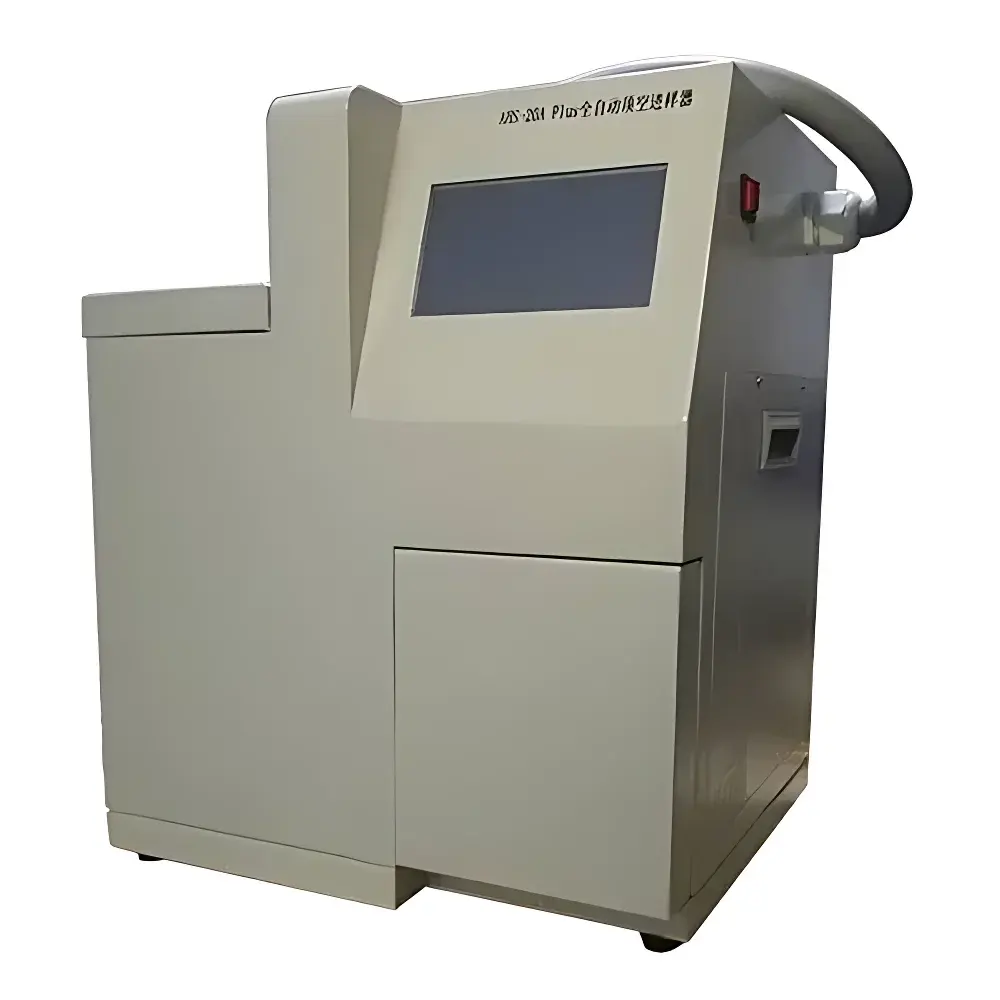
Beifen Sanpu AHSH-20A Plus Fully Automated Headspace Sampler
| [Brand | Beifen Sanpu |
|---|---|
| Origin | Beijing, China |
| Manufacturer Type | Original Equipment Manufacturer (OEM) |
| Product Category | Domestic Instrument |
| Model | AHSH-20A Plus |
| Sample Positions | 20 |
| Heating Range (Sample/Valve/Transfer Line) | 40–220 °C (optional up to 300 °C) |
| Temperature Accuracy | ±0.5 °C |
| Temperature Stability | < ±0.5 °C |
| Pressure Control Range | 0–0.25 MPa (continuously adjustable) |
| Quantitative Loop Volume | 1 mL (customizable: 0.5 / 2 / 5 mL) |
| Vial Capacity | 10 mL or 20 mL (customizable: 50 / 100 mL) |
| Pressurization Time | 0–999 s |
| Sampling Time | 0–30 min |
| Injection Time | 0–999 s |
| Bake-out Time | 0–30 min |
| Minimum Time Resolution | 1 ms |
| Purge Flow Rate | 0–100 mL/min (adjustable) |
| RSD | < 1.0% (for 100 ppm ethanol in water) |
| Interface | USB |
| Compliance | Designed for GLP/GMP-aligned workflows |
Overview
The Beifen Sanpu AHSH-20A Plus Fully Automated Headspace Sampler is an engineered solution for precise, reproducible, and unattended volatile organic compound (VOC) analysis in complex matrices. Based on the principle of equilibrium headspace gas-phase extraction, the instrument thermally equilibrates liquid or solid samples in sealed vials, allowing partitioning of analytes into the vapor phase above the sample. A precisely controlled positive-pressure sampling mechanism then transfers the equilibrated headspace gas—via a heated, high-inertness transfer line—directly into a gas chromatograph (GC) inlet. This method eliminates matrix interference, minimizes carryover, and ensures compatibility with trace-level quantitation required in environmental testing, pharmaceutical residual solvent analysis, food flavor profiling, and forensic toxicology.
Key Features
- 20-position autosampler carousel with automatic vial recognition and collision-avoidance logic—detects missing or misaligned vials and repositions accordingly.
- Triple-zone independent temperature control: sample incubation oven, six-port valve housing, and transfer line—all heated to 40–220 °C (upgradable to 300 °C) with stability < ±0.5 °C and accuracy ±0.5 °C.
- Electronically actuated motion system: no external pneumatic supply required; all positioning, pressurization, sampling, and injection driven by precision stepper motors.
- High-inertness fluidic path: de-activated fused-silica capillary tubing and passivated stainless-steel components throughout the quantitative loop, valve, and needle assembly—validated for minimal adsorption and zero carryover.
- Optimized low-dead-volume configuration: integrated six-port valve mounted inside the heated zone, eliminating cold spots and preserving analyte integrity during transfer.
- Real-time system diagnostics: power-on self-test, positional feedback sensors, thermal fault monitoring, and hardware-level error logging with on-screen alerts.
- Flexible operational modes: single-vial multi-injection, single-injection-per-vial, and batch-mode multi-vial sequencing—all programmable via front-panel interface or remote USB command set.
Sample Compatibility & Compliance
The AHSH-20A Plus accommodates standard 10 mL and 20 mL crimp-top or screw-cap headspace vials, with optional support for 50 mL and 100 mL formats upon request. It accepts both liquid and solid samples—including aqueous solutions, polymers, soils, biological tissues, and packaged consumer goods—without derivatization or solvent extraction. The system supports method validation per ICH Q2(R2), USP “Residual Solvents”, and EPA Method 502.2/8260D. Its deterministic timing resolution (1 ms), pressure-controlled equilibration, and thermal uniformity meet the repeatability requirements for regulatory submissions. When paired with audit-trail-enabled GC data systems, it satisfies 21 CFR Part 11 electronic record integrity criteria for pharmaceutical QC laboratories.
Software & Data Management
Instrument parameters—including temperature ramps, pressurization profiles, sampling durations, purge flows, and GC trigger signals—are fully configurable via intuitive USB-connected software or the built-in 7-inch TFT LCD interface with animated workflow guidance. All method files are timestamped and stored with user ID, instrument serial number, and firmware revision. The system logs operational events (e.g., vial insertion, valve actuation, thermal deviations) in non-volatile memory, enabling retrospective troubleshooting and GLP-compliant review. Optional EPC (Electronic Pressure Control) module provides closed-loop regulation of carrier gas flow during injection—enhancing retention time stability and peak shape reproducibility across long sequences.
Applications
- Pharmaceutical: Residual solvent testing in APIs and excipients per ICH Q3C guidelines.
- Environmental: VOC screening in groundwater, wastewater, and soil extracts (EPA 502.2, 8260).
- Food & Beverage: Ethanol, acetaldehyde, and flavor ester quantitation in wines, spirits, dairy, and fermented products.
- Polymers & Packaging: Migration testing of monomers, plasticizers, and adhesives from food-contact materials.
- Clinical Toxicology: Blood alcohol concentration (BAC) and volatile drug metabolite detection.
- Forensics: Ignitable liquid residue (ILR) identification in arson investigations.
FAQ
Is the AHSH-20A Plus compatible with Agilent, Thermo Fisher, and Shimadzu GC systems?
Yes—it provides TTL-level synchronization signals and supports GC start triggering via hardware contact closure or software command, ensuring seamless integration with all major GC platforms.
Can the instrument perform multiple injections from a single vial?
Yes—programmable multi-shot mode allows up to 99 repeated injections from one vial without manual intervention, ideal for calibration curve verification or method robustness assessment.
What maintenance is required for long-term reliability?
Routine checks include verifying seal integrity on vial caps, cleaning the needle exterior with solvent, inspecting transfer line connections for thermal insulation integrity, and validating temperature calibration annually using NIST-traceable probes.
Does the system support audit trail and electronic signature functionality?
While the base unit does not embed full 21 CFR Part 11 compliance firmware, its event logging architecture and USB data export capability enable integration with validated third-party LIMS or chromatography data systems that provide full audit trail, role-based access, and electronic signature enforcement.
Can the quantitative loop volume be changed without hardware modification?
No—loop volume is fixed per installed configuration (standard 1 mL); alternative volumes (0.5 mL, 2 mL, 5 mL) require factory-installed replacement kits to maintain calibrated flow dynamics and pressure response characteristics.







