
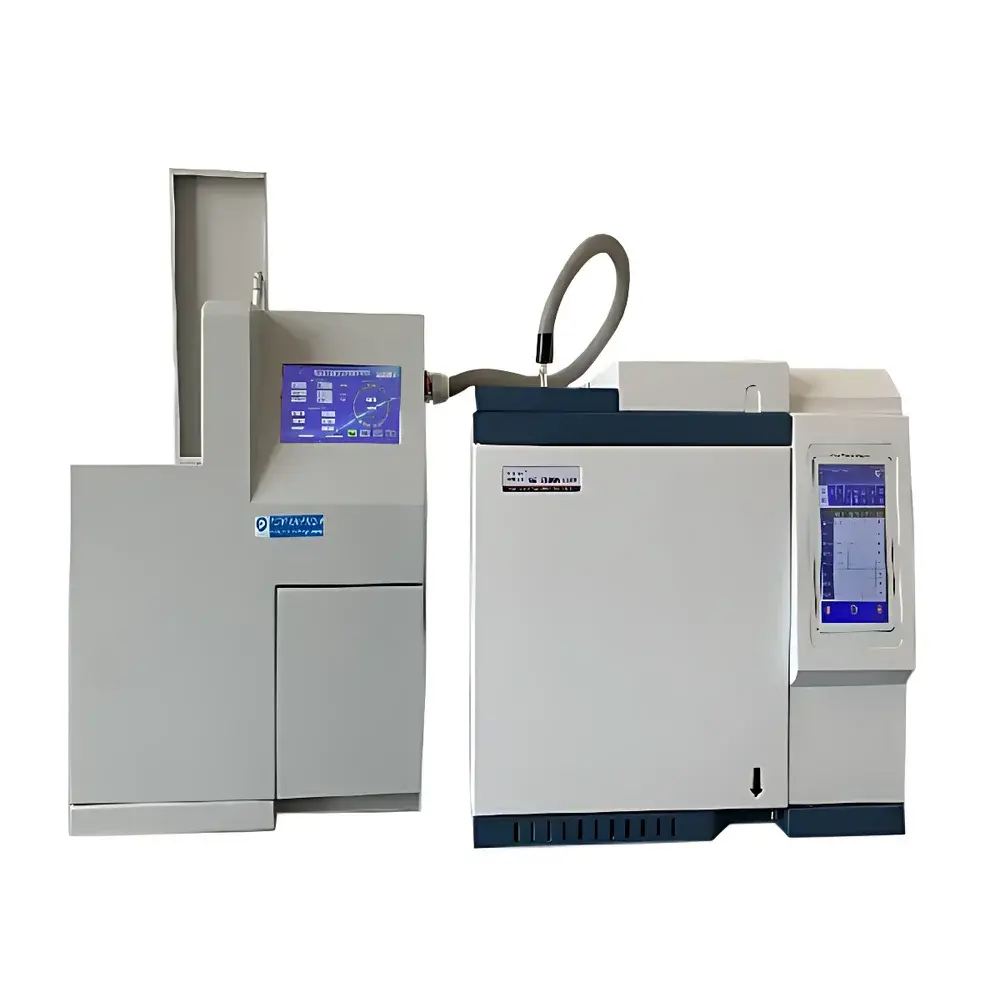
Beifen Sanpu AHsS-20A Plus Fully Automated Static Headspace Sampler
| Brand | Beifen Sanpu |
|---|---|
| Origin | Beijing, China |
| Manufacturer Type | Manufacturer |
| Product Origin | Domestic (China) |
| Model | AHsS-20A Plus |
| Instrument Type | Static Headspace Sampler |
| Automation Level | Fully Automatic |
| Vial Heating Range | Ambient to 200 °C (1 °C increment) |
| Valve Temperature Control Range | 40–220 °C (±1 °C accuracy) |
| Sample Loop Volume | 1 mL |
| Sample Capacity | 20 positions |
| Compatible Vial Sizes | 10 mL or 20 mL |
Overview
The Beifen Sanpu AHsS-20A Plus is a fully automated static headspace sampler engineered for precise, reproducible quantification of volatile residual compounds—particularly ethylene oxide (EO)—in medical devices such as disposable surgical masks, gowns, and sterilized packaging materials. It operates on the principle of equilibrium static headspace analysis: a sealed vial containing a solid or liquid sample is heated to a defined temperature, allowing volatile analytes—including EO—to partition into the gas phase above the sample (the “headspace”). A precisely metered volume of this equilibrated vapor is then transferred via a thermostatted sampling valve and loop into a gas chromatograph (GC) for separation and detection—typically using flame ionization detection (FID). This method eliminates matrix interference from non-volatile components and provides high sensitivity (sub-ppm level), robustness, and regulatory compliance for routine quality control in ISO 13485-certified manufacturing environments.
Key Features
- Fully automated 20-position carousel with programmable vial sequencing and priority queuing for urgent samples.
- Independent dual-zone temperature control: vial oven (ambient to 200 °C, ±0.5 °C stability) and sampling valve/loop (40–220 °C, ±1 °C precision), minimizing condensation and carryover.
- 1 mL fixed-volume quantitative loop ensures volumetric accuracy and inter-run repeatability (RSD < 1.5% for EO at 2 µg/mL).
- Integrated pressure-balanced vial pressurization system with inert gas (N₂ or He) to ensure consistent headspace transfer efficiency.
- Intuitive touchscreen interface with password-protected method storage, audit trail logging, and real-time status monitoring.
- Compliant with GLP/GMP requirements through electronic signature support, user access levels, and full method traceability.
Sample Compatibility & Compliance
The AHsS-20A Plus accommodates standard crimp-top 10 mL and 20 mL headspace vials, compatible with common septa types (PTFE/silicone) and crimping tools used in pharmaceutical QC labs. It supports extraction of EO from polypropylene-based mask materials, Tyvek pouches, and PVC tubing under controlled thermal desorption conditions. The system is validated for use with Chinese national standards GB/T 16886.7–2015 (Biological evaluation of medical devices — Part 7: Ethylene oxide sterilization residuals) and GB/T 14233.1–2008 (Test methods for infusion, transfusion and injection devices — Part 1: Chemical tests). Its performance aligns with ISO 10993-7 for cytotoxicity assessment and supports FDA 21 CFR Part 11-compliant data integrity when paired with compliant GC software.
Software & Data Management
The sampler integrates seamlessly with third-party GC control platforms (e.g., Agilent OpenLab, Shimadzu GCsolution, Thermo Chromeleon) via RS-232 or Ethernet communication. All method parameters—including equilibration time, oven ramp profiles, valve timing, and sequence logic—are stored in encrypted binary files with timestamped revision history. Audit trails record operator ID, parameter changes, run start/stop times, and error events. Raw data export supports CSV and ASCII formats for LIMS integration. Firmware updates are delivered via secure USB or network push, maintaining backward compatibility with legacy method libraries.
Applications
Primary applications include EO residual testing in Class I–III medical devices per ISO 10993-7 limits (e.g., ≤10 µg/g for externally contacting devices; ≤4 µg/g for implantables). Additional validated uses span residual solvent analysis in pharmaceutical excipients (ICH Q3C), monomer migration in food-contact polymers (EU 10/2011), and VOC profiling in environmental water samples (EPA Method 502.2). The system’s thermal stability and low dead-volume flow path make it suitable for analyzing other highly volatile analytes such as chloroform, dichloromethane, and formaldehyde.
FAQ
What is the recommended equilibration time for EO analysis in mask samples?
Standard protocols specify 30–45 minutes at 80 °C for polypropylene mask material, though optimization is required based on sample mass, vial headspace volume, and target LOD.
Can the AHsS-20A Plus be used with cryogenic trapping or cold injection?
No—it is designed exclusively for static headspace analysis without cryofocusing; dynamic headspace or purge-and-trap configurations require dedicated instrumentation.
Is validation documentation provided for IQ/OQ/PQ protocols?
Yes—Beifen Sanpu supplies a comprehensive validation toolkit including URS templates, test scripts, calibration certificates for temperature sensors, and blank/linearity verification reports.
How does the system handle EO’s high volatility and reactivity during analysis?
By maintaining all active surfaces (valve, loop, transfer lines) above EO’s boiling point (10.7 °C) and using deactivated silco-treated stainless-steel pathways to minimize adsorption and degradation.
Does the sampler support custom vial rack configurations or third-party autosamplers?
The 20-position carousel is fixed and not interchangeable; however, external robotic arms can interface via digital I/O triggers for integration into larger automated QC lines.





