
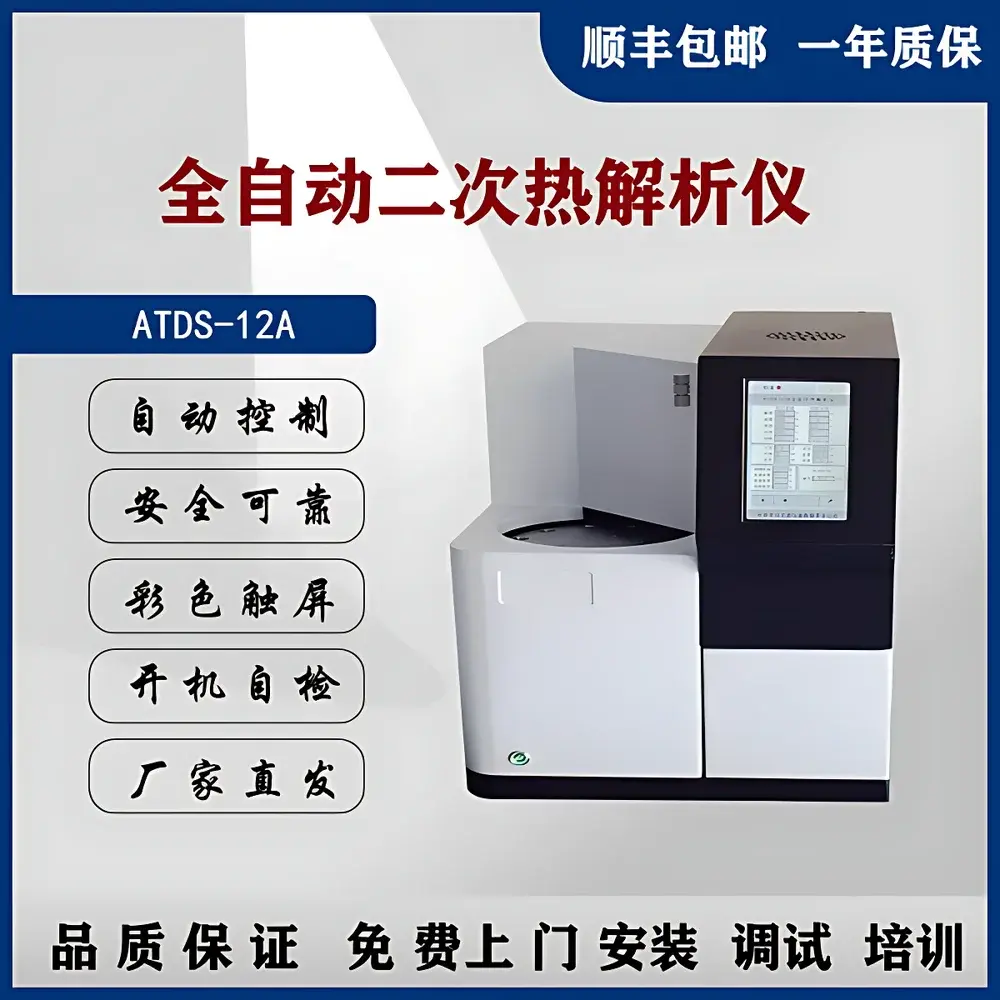
Beifen Sanpu ATDS-12A-I Fully Automated Two-Stage Thermal Desorber
| [Brand | Beifen Sanpu |
|---|---|
| Origin | Beijing, China |
| Manufacturer Type | Direct Manufacturer |
| Instrument Type | Two-Stage Thermal Desorber |
| Automation Level | Fully Automated |
| Sample Capacity | 12 positions |
| Cryo-Focusing Temperature Range | −35 °C to ambient, 1 °C increments |
| Valve & Transfer Line Temperature Range | Ambient to 260 °C, 1 °C increments |
| Primary & Secondary Desorption Temperature Range | Ambient to 450 °C, 1 °C increments |
| Temperature Accuracy | < ±0.5 °C |
| Desorption Recovery Rate | >99% (compound-dependent) |
| Heating Ramp Rate | >3000 °C/min (secondary desorption) |
| Enrichment Time | 0–60 min |
| Injection Time | 0–60 min |
| Back-Flush Flow | 0–500 mL/min, continuously adjustable |
| Simulated Sampling Flow | 0–160 mL/min, continuously adjustable |
| RSD | ≤2.5% (for benzene in 0.05 μg methanol standard) |
| Sample Tube Format | 1/4″ OD × 3.5″ length (ASTM D6196-compliant) |
| Injection Mechanism | Motor-driven 6-port valve |
| Dimensions | 300 × 385 × 550 mm (W × D × H) |
| Weight | ~32 kg] |
Overview
The Beifen Sanpu ATDS-12A-I Fully Automated Two-Stage Thermal Desorber is an engineered solution for trace-level volatile and semi-volatile organic compound (VOC/SVOC) analysis in environmental, occupational health, food safety, and building material testing laboratories. It operates on the principle of cryogenic focusing and two-stage thermal desorption—first releasing analytes from sorbent tubes under controlled low-temperature conditions, then rapidly transferring and refocusing them into a narrow band at a cryogenically cooled trap, followed by ultra-fast secondary desorption directly into the GC or GC-MS inlet. This architecture significantly enhances sensitivity, chromatographic peak shape, and quantitative reproducibility compared to single-stage systems. Designed for seamless integration with all major GC and GC-MS platforms—including Agilent, Thermo Fisher, Shimadzu, and PerkinElmer—the ATDS-12A-I meets method requirements specified in EPA TO-17, ASTM D6196, ISO 16017-1, and EN 14662, supporting compliance with regulatory frameworks governing indoor air quality (IAQ), workplace exposure limits (OELs), and product emissions testing.
Key Features
- Fully automated 12-position sample carousel with programmable sequence execution, enabling unattended overnight operation and high-throughput batch processing.
- Independent, precision temperature control across five critical zones: primary desorption oven, secondary desorption heater, cryo-focusing trap, valve manifold, and transfer line—all adjustable in 1 °C increments with stability better than ±0.5 °C.
- High-efficiency semiconductor-based cooling system achieving −35 °C without liquid nitrogen or mechanical compressors, ensuring low maintenance and stable cryo-focusing performance.
- Motor-driven 6-port switching valve with inert flow path and low-dead-volume design, minimizing carryover and maximizing transfer efficiency.
- Ultra-rapid secondary desorption heating ramp (>3000 °C/min) ensures sharp, narrow analyte bands and optimal GC resolution.
- Configurable back-flush and simulated sampling flows (0–500 mL/min and 0–160 mL/min, respectively) support method optimization for diverse sorbent tube chemistries and matrix types.
- Compact benchtop footprint (300 × 385 × 550 mm) and 24 V low-voltage heating for transfer lines enhance electrical safety and system reliability in regulated lab environments.
Sample Compatibility & Compliance
The ATDS-12A-I accommodates standard 1/4″ OD × 3.5″ stainless steel or glass sorbent tubes compliant with ASTM D6196 and EPA TO-17 specifications. Compatible with multi-bed sorbents including Tenax TA, Carbopack B/C, Carboxen 1000, and graphitized carbon blacks for broad VOC/SVOC coverage (C2–C24). The instrument supports full audit-trail capability when paired with validated LIMS or chromatography data systems (CDS), satisfying GLP and GMP documentation requirements. Its thermal stability and recovery performance (>99% for benzene, toluene, ethylbenzene, xylenes, and aldehydes) align with US EPA Method TO-17 validation criteria and ISO/IEC 17025 proficiency testing benchmarks.
Software & Data Management
Operation is managed via a built-in industrial-grade 7-inch capacitive touchscreen interface with intuitive icon-driven workflow navigation. All method parameters—including desorption times, temperature ramps, valve timing, flow settings, and sequence scheduling—are stored as editable, password-protected methods. Raw instrument logs (temperature profiles, valve actuation timestamps, pressure events) are timestamped and exportable in CSV format. When interfaced with third-party CDS software (e.g., OpenLab CDS, Chromeleon, or MassHunter), the ATDS-12A-I transmits status signals and accepts external start triggers, enabling synchronized acquisition and metadata embedding. Full electronic records meet FDA 21 CFR Part 11 requirements when deployed with appropriate access controls and electronic signature protocols.
Applications
- Indoor air quality monitoring per ISO 16000-6 and EPA Compendium Method TO-17.
- VOC emissions testing from carpets, adhesives, paints, and composite wood products (e.g., CARB ATCM, EU Ecolabel, LEED v4.1 credits).
- Workplace air sampling for OSHA and NIOSH-regulated compounds (e.g., benzene, formaldehyde, styrene).
- Food packaging migration studies and flavor/aroma profiling in beverages and dairy products.
- Forensic toxicology screening for ignitable liquids and accelerants.
- Pharmaceutical residual solvent analysis per ICH Q3C guidelines (Class 2 solvents).
FAQ
What sorbent tube formats are supported?
The ATDS-12A-I accepts standard 1/4″ OD × 3.5″ (89 mm) tubes conforming to ASTM D6196 dimensions; both stainless steel and quartz-lined variants are compatible.
Does the system require liquid nitrogen or external chillers?
No—cryo-focusing is achieved using solid-state Peltier cooling, eliminating consumables and reducing operational complexity.
Can the instrument be integrated with legacy GC systems lacking digital I/O?
Yes—hardware trigger inputs accept TTL-level start pulses, and analog temperature/status outputs enable basic synchronization with older GC controllers.
Is method validation support available?
Beifen Sanpu provides IQ/OQ documentation templates, system suitability test protocols, and application notes aligned with EPA TO-17 and ISO 16017-1 verification requirements.
What maintenance intervals are recommended?
Valve maintenance is advised every 10,000 cycles; trap cleaning every 500 runs; and annual calibration verification using NIST-traceable reference standards.







