
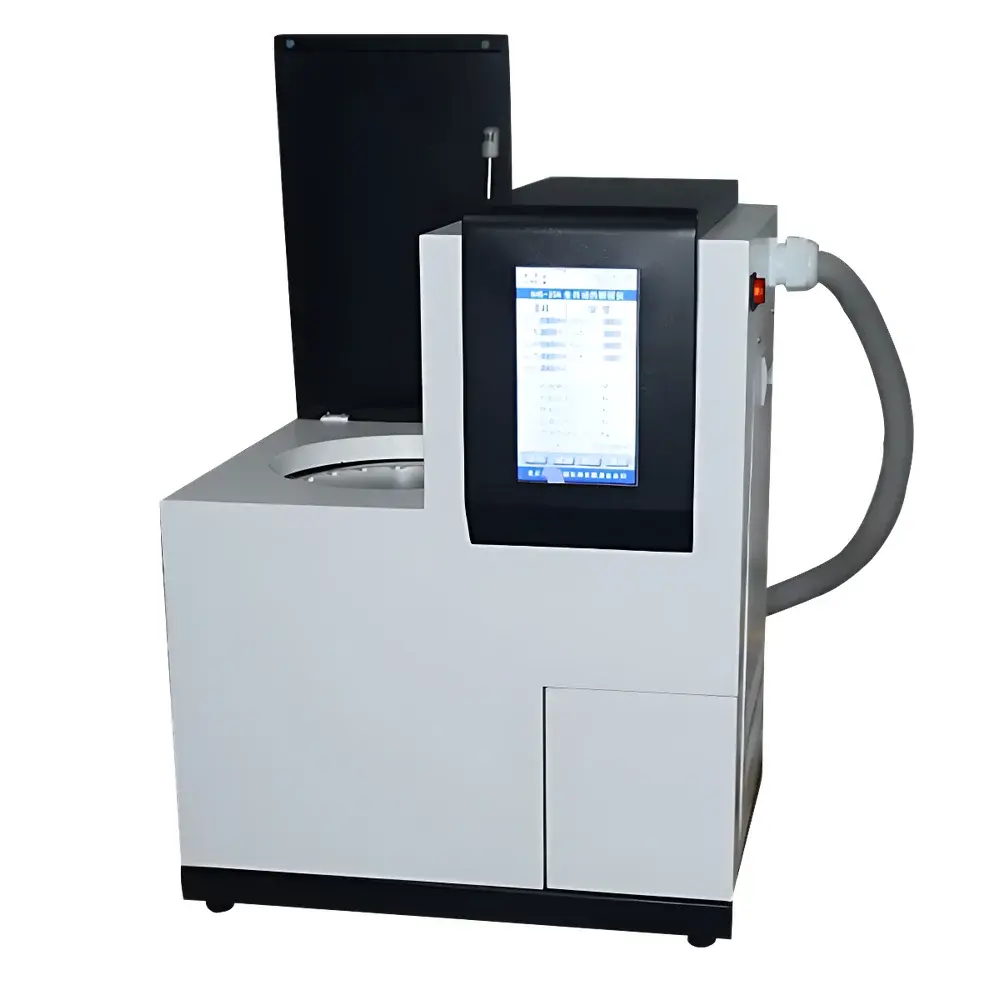
Beifen Sanpu ATDS-20A Cryogenic Cold Trap Fully Automated Two-Stage Thermal Desorber
| Brand | Beifen Sanpu |
|---|---|
| Origin | Beijing, China |
| Manufacturer Type | Direct Manufacturer |
| Product Category | Domestic (China-made) |
| Model | ATDS-20A |
| Pricing | Upon Request |
| Sample Capacity | 20 positions |
| Cold Trap Temperature Range | −35 °C to ambient |
| Primary Desorption Temp | RT–450 °C |
| Secondary Desorption Temp | RT–450 °C |
| Valve & Transfer Line Temp | RT–300 °C |
| Temperature Control Accuracy | < ±0.5 °C |
| Desorption Recovery Rate | >99% (compound-dependent) |
| RSD | ≤2.5% (benzene in 0.05 μg methanol) |
| Enrichment Time | 0–60 min |
| Injection Time | 0–60 min |
| Sampling Tube Format | 1/4″ OD × 3.5″ (ASTM D6196-compliant) |
| Carrier Gas Flow (Purge/Backflush) | 0–100 mL/min |
| Simulated Sampling Flow | 0–160 mL/min |
| Heating Ramp Rate (2nd Stage) | >3000 °C/min |
| Dimensions (L×W×H) | 350 × 450 × 510 mm |
| Weight | ~40 kg |
Overview
The Beifen Sanpu ATDS-20A Cryogenic Cold Trap Fully Automated Two-Stage Thermal Desorber is an engineered solution for trace-level volatile organic compound (VOC) and semi-volatile organic compound (SVOC) analysis in environmental, occupational health, and industrial hygiene applications. It operates on the principle of thermal desorption coupled with cryofocusing — a two-stage process wherein analytes are first thermally released from sorbent tubes under controlled inert gas flow (primary desorption), then refocused into a narrow band within a cryogenically cooled trap (−35 °C), followed by rapid flash-heating (secondary desorption) directly into the injection port of a gas chromatograph (GC) or GC–MS system. This architecture delivers high sensitivity, quantitative reproducibility, and minimal peak broadening—critical for compliance with stringent regulatory methods such as EPA TO-17, ISO 16017-1, and Chinese national standards HJ 644–2013, HJ 583–2010, and GB/T 18883–2002. The instrument is designed for unattended operation across 20 sample positions, integrating precise temperature zoning, motor-driven six-port valve actuation, and programmable sequence logic to support full method automation without manual intervention.
Key Features
- Fully automated 20-position sample carousel with self-calibrating tray positioning and real-time system diagnostics
- Independent four-zone temperature control: primary desorption furnace (RT–450 °C), secondary desorption zone (RT–450 °C), valve oven (RT–300 °C), and transfer line (RT–300 °C), all adjustable in 1 °C increments
- Integrated Peltier-based cryogenic cold trap capable of stable operation from −35 °C to ambient, enabling sharp focusing of low-boiling compounds (e.g., C2–C12 hydrocarbons, formaldehyde precursors)
- High-speed secondary desorption ramp (>3000 °C/min) ensures narrow bandwidth injection and optimal chromatographic resolution
- Automated backflush functionality for valve and transfer line, minimizing carryover between samples (RSD ≤2.5% demonstrated for benzene at 0.05 μg level)
- Onboard simulated sampling module and tube activation protocol support calibration curve generation and routine sorbent tube regeneration
- Modular configuration options: field-upgradable to ambient-temperature or cryo-enhanced secondary desorption modes
- GC synchronization interface compatible with Agilent, Thermo Fisher, Shimadzu, and PerkinElmer systems via TTL or Ethernet-triggered start
- Elastic quartz transfer tubing option available for reactive analyte handling (e.g., aldehydes, sulfur compounds)
Sample Compatibility & Compliance
The ATDS-20A accepts standard 1/4″ OD × 3.5″ stainless steel or glass sorbent tubes compliant with ASTM D6196 and ISO 16017-1 dimensional specifications. It supports multi-bed sorbents (e.g., Tenax TA, Carbopack B/C, Carboxen 1000) and accommodates both single- and dual-tube configurations. Method validation data confirm adherence to key regulatory frameworks including HJ 644–2013 (ambient air VOCs), HJ 734–2014 (stationary source emissions), GB 50325–2020 (indoor air in civil construction), and HJ/T 400–2007 (in-vehicle air quality). All thermal zones maintain stability within ±0.5 °C, satisfying GLP-aligned instrument qualification requirements. System logs record time-stamped temperature profiles, valve actuation events, and error flags—supporting audit readiness per FDA 21 CFR Part 11 when integrated with compliant LIMS or chromatography data systems.
Software & Data Management
Operation is managed via a 7-inch capacitive touchscreen running embedded Linux-based firmware. Users define complete analytical sequences—including desorption times, temperature ramps, purge/backflush durations, and GC trigger delays—through intuitive graphical workflow editors. All method parameters are stored with version timestamps and user authentication. Raw event logs (including cold trap status, heater faults, and valve position feedback) are exportable in CSV format. The system supports external scheduling via RS-232 or TCP/IP commands, enabling integration into centralized laboratory automation environments. No proprietary software installation is required on host PCs; remote monitoring and method push are achievable using standard HTTP APIs.
Applications
The ATDS-20A serves laboratories performing accredited testing for environmental monitoring (ambient and indoor air, soil headspace), occupational exposure assessment (NIOSH/OSHA method equivalents), building material emissions (CARB, LEED VOC screening), and product safety verification (e.g., toys, textiles, adhesives). Typical target analytes include BTEX, chlorinated solvents, terpenes, carbonyls (via derivatization-compatible trapping), and C10–C20 n-alkanes. Its cryofocusing capability extends detection capability to highly volatile species (e.g., vinyl chloride, acetaldehyde) that would otherwise elute coherently or be lost during conventional thermal desorption. The instrument is routinely deployed in third-party testing labs, municipal environmental agencies, and corporate EHS departments conducting TVOC, SVOC, and targeted toxicant profiling per ISO 16000 series and China’s “Three Norms” (GB/T, HJ, JC).
FAQ
How does two-stage thermal desorption differ from static headspace or purge-and-trap?
Two-stage thermal desorption provides superior sensitivity and broader volatility coverage than headspace (limited to equilibrium partitioning) or purge-and-trap (prone to water interference and limited to <C12). Cryofocusing enables quantitative recovery of compounds boiling below 0 °C while maintaining robustness for heavier SVOCs.
Can the ATDS-20A be validated for ISO/IEC 17025 accreditation?
Yes—the instrument’s deterministic thermal control, full audit trail logging, and repeatable recovery (>99%) meet technical requirements for method validation under ISO/IEC 17025:2017 Clause 7.2. Supporting IQ/OQ documentation packages are available upon request.
Is electronic refrigeration maintenance-free compared to liquid nitrogen traps?
Peltier-based cooling eliminates consumables, cryogen handling hazards, and dew-point-related condensation issues—ideal for high-throughput labs requiring continuous uptime and simplified operational logistics.
What GC interfaces are supported out-of-the-box?
Standard fittings include universal 1/4″ VCR and Swagelok compression ports; dedicated adapter kits are provided for Agilent 7890/8890, Thermo ISQ, Shimadzu GC-2030, and Waters Alliance GC systems.
Does the system support unattended overnight runs?
Yes—20-sample capacity, auto-shutdown after sequence completion, and hardware-level fault detection ensure reliable unattended operation for extended batch processing.
Related Products





