
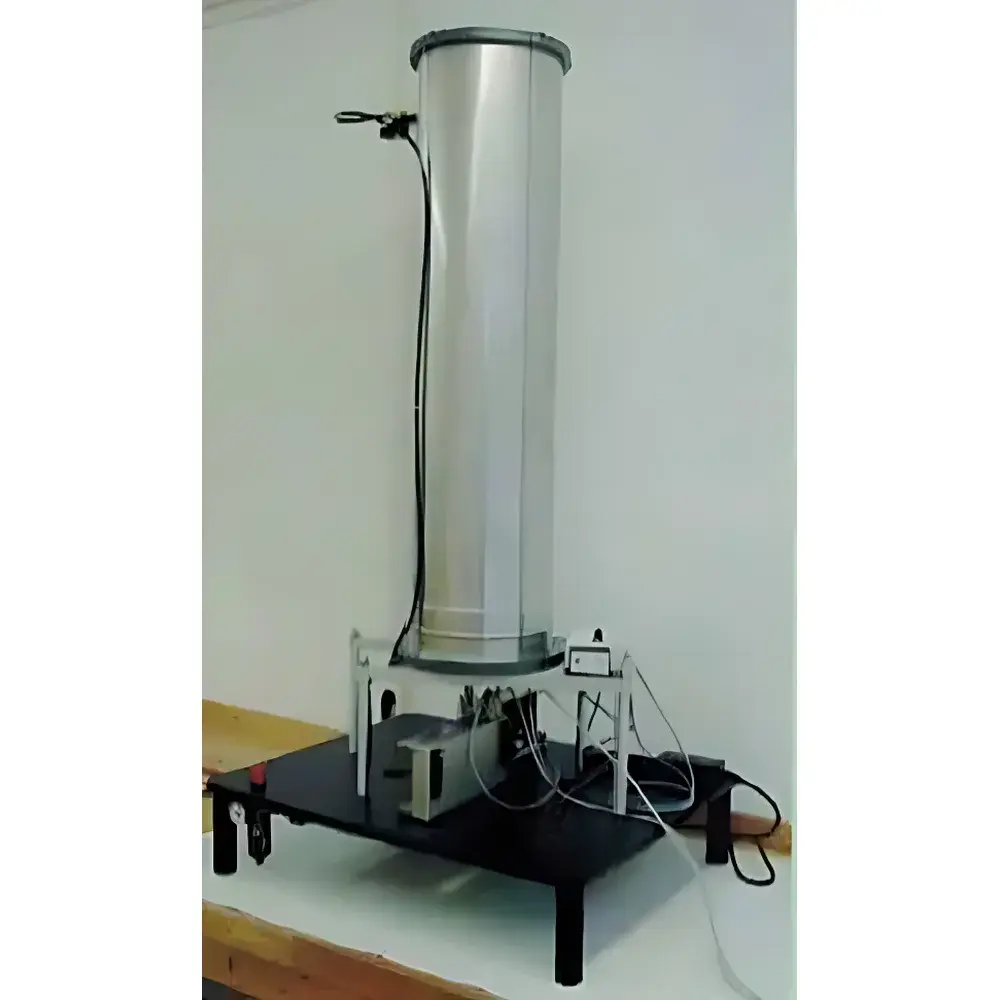
GRIMM 7851 Aerosol Calibration Tower
| Brand | GRIMM |
|---|---|
| Origin | Germany |
| Model | 7851 |
| Calibration Aerosol | Dolomite Powder (0.25–32 µm) |
| Aerosol Generation Method | Pneumatic Dispersion via High-Pressure Nozzle System (up to 6 bar) |
| Software Platform | LabVIEW-based 32-/64-bit Calibration Suite |
| Compliance Support | ISO 21501-4, ISO 14644-1, USP <788>, GLP/GMP-aligned Audit Trail Capabilities |
| Accessories | 7853 Indoor Air Calibration Kit, 7856 Dolomite Powder (0.4 kg), 7910 High-Pressure Disperser (4-nozzle, 6 bar) |
Overview
The GRIMM 7851 Aerosol Calibration Tower is a precision-engineered reference system designed for traceable, repeatable calibration of optical particle counters (OPCs), condensation particle counters (CPCs), and aerosol spectrometers operating in the environmental monitoring, cleanroom qualification, pharmaceutical manufacturing, and occupational hygiene sectors. It functions on the principle of controlled pneumatic dispersion and turbulent mixing to generate stable, spatially uniform polydisperse aerosol clouds with defined size distributions—enabling simultaneous multi-instrument comparison against a common reference condition. Unlike static or diffusion-based calibration methods, the 7851 employs dynamic aerosol generation using high-purity dolomite powder (0.25–32 µm), selected for its chemical inertness (oxygen-free crystalline structure), hygroscopic stability, long-term storage integrity, and spectral compatibility with standard OPC detection ranges (e.g., GRIMM 11-R and 11-E spectrometers). The tower integrates dual compressed-air inlets—one at the top for aerosol entrainment and one at the base for active mixing—to ensure laminar-free, statistically representative particle distribution throughout the calibration chamber volume.
Key Features
- Modular stainless-steel calibration tower (height: 1.2 m; internal diameter: 200 mm) with integrated flow-controlled inlet and outlet manifolds
- Automated, software-driven calibration sequence managed via LabVIEW-based 32-/64-bit control suite with configurable exposure duration, flow rate, and dispersion pressure profiles
- High-pressure disperser (Model 7910, up to 6 bar) featuring four precisely aligned nozzles for reproducible aerosol cloud initiation and minimal agglomeration
- Dual-air-path architecture: primary aerosol delivery from top-mounted disperser + secondary sheath air injection at base to suppress sedimentation and enhance homogeneity
- Integrated isolation valves for indoor air calibration mode (enabled via optional 7853 upgrade kit), supporting ambient particulate background subtraction and zero-point verification
- Compliant with ISO 21501-4 (calibration of light-scattering airborne particle counters) and aligned with ISO 14644-1 cleanroom certification protocols
Sample Compatibility & Compliance
The 7851 supports calibration of instruments measuring particles across the full 0.25–32 µm aerodynamic diameter range. Its dolomite-based aerosol standard (supplied as 0.4 kg lot under part number 7856) meets ISO 21501-4 requirements for certified reference materials used in OPC calibration. Each batch undergoes independent metrological characterization (via cascade impactor and electron microscopy) to verify mass median aerodynamic diameter (MMAD), geometric standard deviation (GSD), and count-based size distribution fidelity. The system accommodates up to three test instruments simultaneously alongside a reference-grade GRIMM spectrometer (e.g., 11-R), enabling side-by-side performance evaluation under identical aerosol conditions. All calibration logs—including timestamped instrument readings, dispersion pressure, volumetric flow rates (measured via calibrated thermal mass flow meters), and environmental parameters (temperature, RH)—are recorded with electronic signatures and tamper-proof audit trails compliant with FDA 21 CFR Part 11 and EU Annex 11 expectations.
Software & Data Management
Calibration execution and data acquisition are fully managed through the proprietary GRIMM LabVIEW platform, which provides real-time visualization of aerosol concentration stability, inter-instrument response correlation, and statistical deviation metrics (e.g., coefficient of variation across repeated runs). Raw datasets export in CSV and HDF5 formats for integration into LIMS or enterprise QA/QC systems. The software supports automated report generation per ISO/IEC 17025 requirements, including uncertainty budgeting based on instrument repeatability, aerosol generation variability, and environmental drift compensation. Optional 7853 firmware extension enables indoor air mode—allowing sequential measurement of ambient background, filtered air baseline, and challenge aerosol—thereby fulfilling USP particulate matter testing validation criteria for injectables and ophthalmic preparations.
Applications
- Periodic performance verification of continuous particle monitors in ISO Class 5–8 cleanrooms and isolators
- Validation of environmental monitoring systems (EMS) in pharmaceutical Grade A/B/C/D zones per EU GMP Annex 1
- Traceable calibration of portable OPCs used in occupational exposure assessment (e.g., mining, construction, nanomaterial handling)
- Method development and inter-laboratory comparison studies for aerosol science research groups
- Supporting regulatory submissions requiring documented calibration traceability to national metrology institutes (e.g., PTB, NIST)
FAQ
What aerosol material is used in the GRIMM 7851, and why is dolomite selected?
Dolomite powder (CaMg(CO₃)₂) is used due to its oxygen-free lattice structure, negligible hygroscopicity, mechanical stability during dispersion, and well-characterized polydisperse size distribution (0.25–32 µm), making it ideal for optical calibration across multiple detector types.
Can the 7851 calibrate instruments other than GRIMM spectrometers?
Yes—the tower outputs standardized aerosol clouds compatible with any OPC, CPC, or laser diffraction system that accepts 0.1–30 L/min sampling flow and operates within the 0.25–32 µm detection range.
Is the 7851 compliant with FDA 21 CFR Part 11?
When operated with validated software configuration and electronic signature workflows, the system supports Part 11 compliance through audit-trail logging, role-based access control, and data integrity safeguards.
What maintenance is required for long-term operational reliability?
Routine inspection of nozzle integrity, periodic recalibration of mass flow sensors (annually recommended), and replacement of desiccant filters in the compressed air supply line every six months ensure sustained aerosol uniformity and pressure stability.
How is traceability to national standards established?
Each 7856 dolomite batch includes a certificate of analysis referencing gravimetric and cascade impactor characterization performed at an ISO/IEC 17025-accredited laboratory, with traceability to PTB (Physikalisch-Technische Bundesanstalt) reference methods.







