
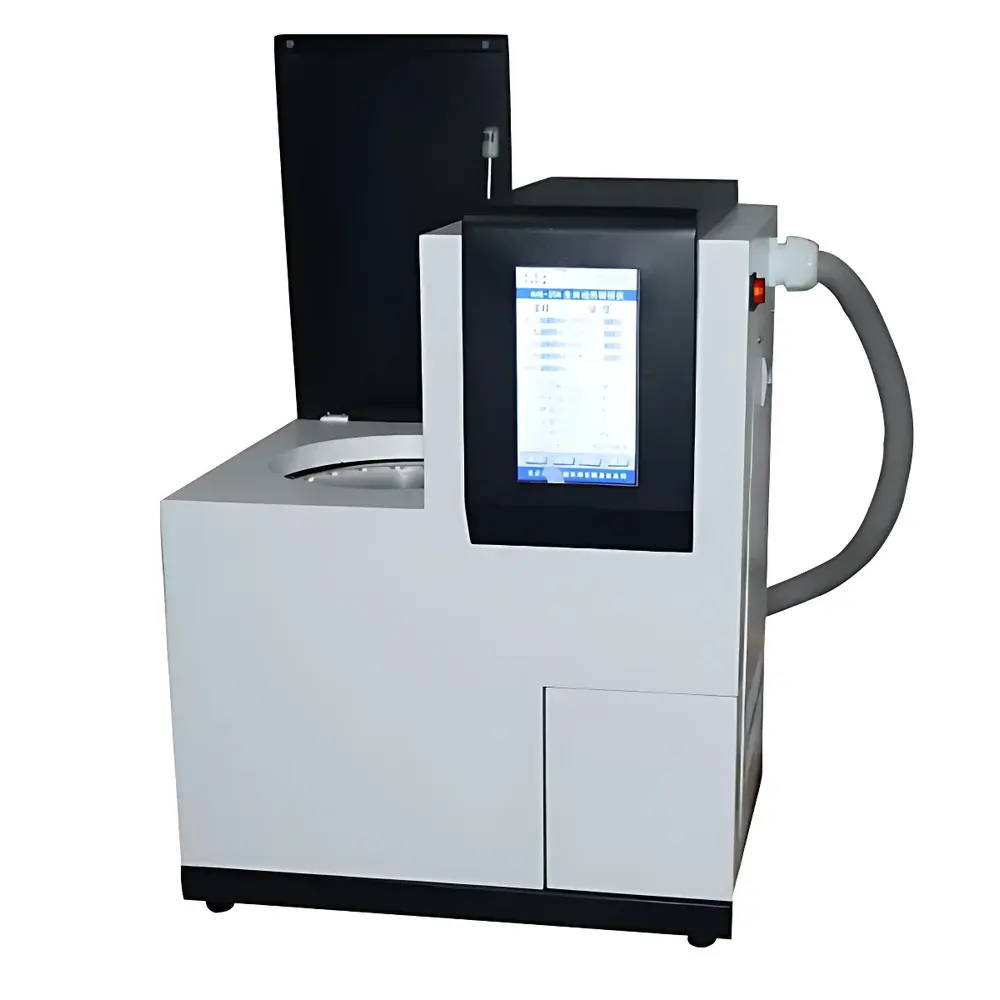
Beifen Sanpu ATDS-20A Cryogenic Cold Trap Fully Automated Two-Stage Thermal Desorber
| Brand | Beifen Sanpu |
|---|---|
| Origin | Beijing, China |
| Manufacturer Type | Manufacturer |
| Product Origin | Domestic (China) |
| Model | ATDS-20A |
| Pricing | Upon Request |
Overview
The Beifen Sanpu ATDS-20A Cryogenic Cold Trap Fully Automated Two-Stage Thermal Desorber is an engineered solution for high-fidelity, quantitative analysis of volatile and semi-volatile organic compounds (VOCs and SVOCs) in air, indoor environments, building materials, food packaging headspace, and industrial emission samples. It operates on the principle of two-stage thermal desorption coupled with cryofocusing — a technique standardized in ASTM D6196, ISO 16017-1, and EPA TO-17 — where analytes pre-concentrated on sorbent tubes are first thermally desorbed into a transfer line, cryogenically trapped at sub-ambient temperatures (down to −35 °C), and then rapidly re-desorbed as a narrow, solvent-free plug directly into the GC or GC-MS inlet. This process delivers superior chromatographic resolution, enhanced sensitivity (sub-pg level detection achievable with compatible detectors), and minimal peak broadening compared to single-stage or ambient-focused systems. Designed for unattended operation across regulatory-compliant environmental and occupational hygiene laboratories, the ATDS-20A meets functional requirements outlined in HJ 644–2013, HJ 583–2010, HJ 734–2014, and GB/T 18883–2002. Its architecture supports full traceability and method reproducibility under GLP and ISO/IEC 17025 frameworks.
Key Features
- Fully automated 20-position sample carousel with motor-driven six-port valve and self-calibrating carousel positioning — enables walk-away analysis without manual intervention.
- Independent, precision temperature control (±0.5 °C) across four critical zones: primary desorption oven (RT–450 °C), secondary desorption/focusing zone (RT–450 °C), valve manifold (RT–300 °C), and heated transfer line (RT–300 °C, 24 V low-voltage design).
- Integrated Peltier-based cryogenic cold trap capable of stable operation from −35 °C to ambient, enabling sharp focusing of C2–C16 VOCs and improving chromatographic peak shape and signal-to-noise ratio.
- Programmable time-sequence control for desorption, purge, refocusing, injection, and back-flush cleaning — all configurable via intuitive touchscreen interface with real-time status animation.
- Dual functionality: field-upgradeable to either ambient or cryogenic secondary desorption mode, supporting method flexibility for diverse analyte volatility profiles.
- Onboard tube activation protocol with programmable heating and purging cycles — eliminates need for external conditioning stations and ensures consistent sorbent bed readiness.
- Automatic back-flush of valve and transfer line using adjustable carrier gas flow (0–100 mL/min) — prevents carryover and cross-contamination between samples.
- Standardized 1/4″ × 3.5″ (US specification) sorbent tube compatibility; optional fused silica transfer lines available for active compound analysis (e.g., aldehydes, acids, amines).
- GC synchronization capability: triggers external gas chromatographs and data systems via TTL or contact closure; also accepts remote start commands from third-party software.
Sample Compatibility & Compliance
The ATDS-20A accommodates standard stainless steel or glass sorbent tubes packed with multi-bed media (e.g., Tenax TA, Carbopack B/C, Carboxen 1000), suitable for sampling airborne VOCs at flow rates up to 160 mL/min. It complies with method-defined sampling and analytical workflows referenced in Chinese national standards including HJ 644–2013 (air VOCs by TD-GC/MS), HJ 583–2010 (benzene series), HJ 734–2014 (stationary source emissions), and GB 50325–2020 (indoor environmental quality). The system supports audit-ready operation when integrated with chromatography data systems compliant with FDA 21 CFR Part 11 (electronic signatures, audit trails) and ISO/IEC 17025 documentation requirements. All thermal zones feature calibrated Pt100 sensors and digital PID control, ensuring long-term stability and inter-laboratory comparability.
Software & Data Management
Operation is managed through an embedded Linux-based controller with a 7-inch capacitive touchscreen interface. Method files store complete thermal and timing parameters (primary/secondary desorption temps, cold trap setpoint, purge durations, valve actuation sequences), with version-controlled saving and password-protected user roles. Each run logs timestamped metadata including actual zone temperatures, valve status, pressure events, and error flags — exportable as CSV for LIMS integration. Optional Ethernet or RS-232 connectivity allows centralized monitoring in multi-instrument labs. No proprietary drivers required for GC interfacing; TTL-level trigger outputs and input-ready logic ports ensure compatibility with Agilent, Thermo Fisher, Shimadzu, and PerkinElmer platforms.
Applications
- Environmental monitoring: Ambient air, stack emissions, landfill fugitives per HJ 734–2014 and EPA Method TO-17.
- Indoor air quality (IAQ): TVOC, benzene, toluene, ethylbenzene, xylenes (BTEX), and carbonyls per GB/T 18883–2002 and HJ/T 400–2007.
- Materials testing: VOC emissions from carpets, adhesives, paints, and composite panels (ISO 16000-6, ASTM D5116).
- Occupational hygiene: Workplace exposure assessment per GBZ 159 and OSHA Method 05.
- Food and packaging: Residual solvents, migration compounds, and flavor volatiles in sealed headspace matrices.
FAQ
How does two-stage thermal desorption differ from single-stage desorption?
Two-stage desorption incorporates a cryofocused re-concentration step that sharpens analyte bands prior to GC injection, significantly improving sensitivity and resolution — especially for light VOCs and complex mixtures.
Can the ATDS-20A be used with GC-MS systems?
Yes. Its narrow, solvent-free injection profile and precise timing control make it fully compatible with both quadrupole and time-of-flight GC-MS platforms.
What maintenance is required for the cryogenic module?
The Peltier cooling system is solid-state with no refrigerants or moving parts; routine verification of cold trap temperature accuracy (using NIST-traceable probe) is recommended quarterly.
Is method validation support provided?
Instrument documentation includes calibration templates, recovery test protocols (per HJ 644–2013 Annex C), and RSD verification procedures using certified VOC standards.
Does the system meet 21 CFR Part 11 requirements?
While the base firmware supports electronic logs and user access controls, full Part 11 compliance requires integration with validated chromatography data systems (CDS) that provide audit trails, electronic signatures, and secure data storage.





