
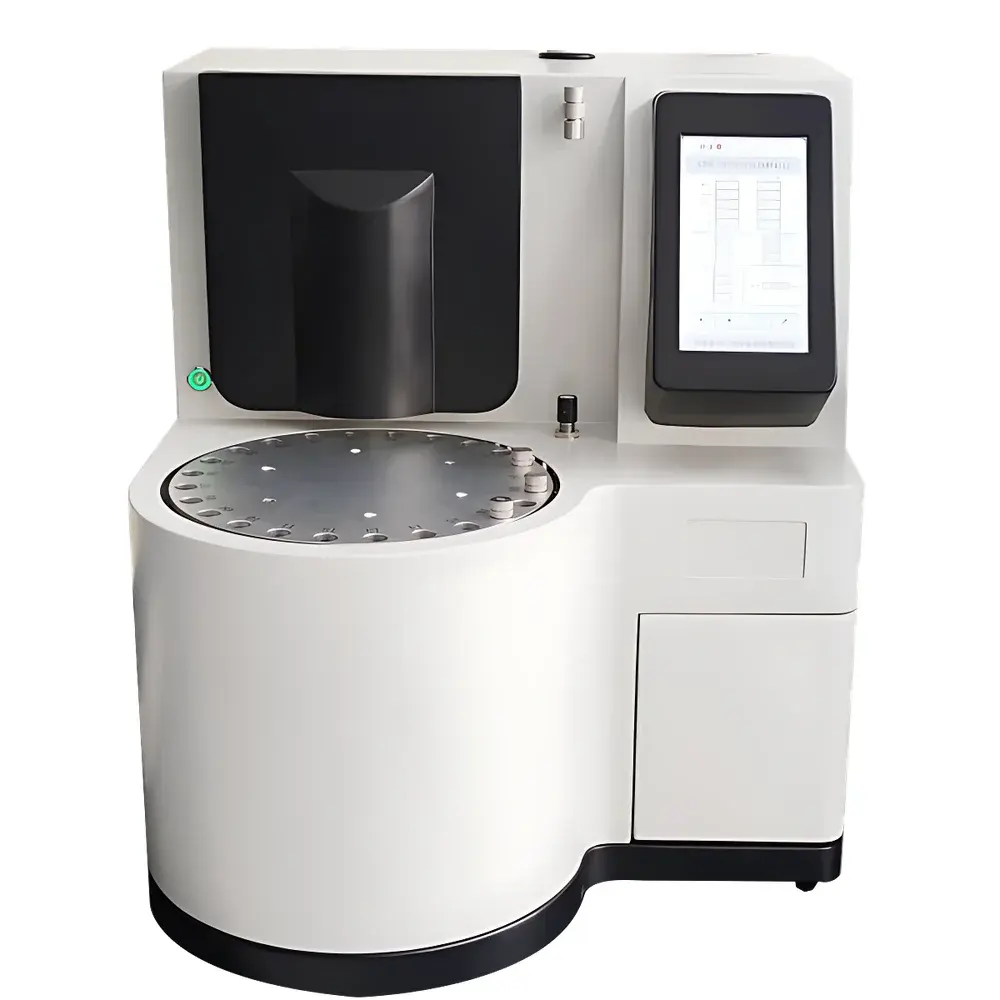
Beifen Sanpu ATDS-24A Fully Automated Two-Stage Thermal Desorber
| Brand | Beifen Sanpu |
|---|---|
| Origin | Beijing, China |
| Manufacturer Type | Direct Manufacturer |
| Instrument Type | Two-Stage Thermal Desorber |
| Automation Level | Fully Automated |
| Primary Desorption Temperature Range | Ambient to 450 °C (1 °C increments) |
| Valve Injection Zone Temperature Range | Ambient to 300 °C (1 °C increments) |
| Transfer Line Temperature Range | Ambient to 300 °C (1 °C increments) |
| Cryo-Focusing Trap Temperature Range | −35 °C to ambient (1 °C increments) |
| Temperature Control Accuracy | < ±0.5 °C |
| Analyte Recovery Rate | >99% (compound-dependent) |
| Sample Capacity | 24 positions |
| Cooling Rate | ≤ −35 °C with rapid thermal stabilization |
| Secondary Desorption Ramp Rate | >3000 °C/min |
| Carryover Reduction | Integrated valve and transfer line back-flush (0–100 mL/min, adjustable) |
| Calibration & Activation | Onboard tube activation protocol and simulated sampling flow control (0–160 mL/min) |
| Precision | RSD ≤ 2.5% (for 0.05 μg benzene in methanol) |
| Sample Tube Format | 1/4″ OD × 3.5″ length (ASTM D6196-compliant stainless steel or quartz-lined tubes) |
| Interface | Motor-driven 6-port switching valve |
Overview
The Beifen Sanpu ATDS-24A Fully Automated Two-Stage Thermal Desorber is an engineered solution for trace-level volatile and semi-volatile organic compound (VOC/SVOC) analysis in environmental, occupational health, food safety, and building materials testing laboratories. It operates on the principle of two-stage thermal desorption—first releasing analytes from sorbent tubes under controlled heating and inert gas flow, followed by cryo-focusing in a thermally isolated trap at sub-ambient temperatures, then rapid secondary desorption directly into the gas chromatograph (GC) or GC-MS inlet. This architecture eliminates solvent use, minimizes analyte degradation, and delivers high sensitivity (sub-pg level detection limits when paired with modern GC systems), narrow peak widths, and exceptional reproducibility. Designed for compliance with EPA Method TO-17, ASTM D6196, ISO 16017-1, and Chinese HJ 644–2013 standards, the ATDS-24A supports regulatory-grade data acquisition workflows in GLP- and ISO/IEC 17025-accredited environments.
Key Features
- Fully automated 24-position sample carousel with robotic positioning, eliminating manual intervention during unattended overnight runs.
- Independent four-zone temperature control: primary desorption oven, secondary desorption chamber, valve manifold, and transfer line—each programmable in 1 °C increments with stability < ±0.5 °C.
- Integrated solid-state cryogenic trap capable of reaching −35 °C with fast thermal equilibration, enabling efficient focusing of C2–C16 compounds and sharp chromatographic peaks.
- Motor-driven 6-port valve with precise timing and low-dead-volume design ensures repeatable injection and minimal carryover between samples.
- Onboard tube activation protocol with programmable flow and temperature profiles reduces preparation time and improves sorbent consistency across batches.
- Simulated sampling mode allows direct generation of calibration curves without external flow controllers or manual spiking.
- Transfer line and valve back-flush functionality (0–100 mL/min, adjustable) prevents cross-contamination and extends system uptime.
- Universal GC interface kit included—compatible with Agilent 7890/8890, Thermo ISQ/GC-MS, Shimadzu GC-2010/2030, and PerkinElmer Clarus series via standardized mechanical and electrical adapters.
- Embedded 7-inch capacitive touchscreen with intuitive workflow navigation, real-time status animation, and method storage for up to 100 user-defined sequences.
Sample Compatibility & Compliance
The ATDS-24A accommodates standard 1/4″ OD × 3.5″ sorbent tubes (e.g., Tenax TA, Carbopack B/X, Carboxen 1000) compliant with ASTM D6196 and EPA TO-17 specifications. Optional quartz-lined transfer lines minimize adsorption of polar or reactive species (e.g., formaldehyde, acetaldehyde, amines). The system supports both single- and dual-tube configurations and integrates seamlessly with passive and active air sampling methodologies. Its hardware and software architecture are designed to support audit-ready operation under ISO/IEC 17025, GLP, and FDA 21 CFR Part 11 requirements—retaining full method parameters, run logs, error timestamps, and operator identification metadata for each analysis sequence.
Software & Data Management
Controlled via embedded firmware with USB and Ethernet connectivity, the ATDS-24A enables bidirectional communication with third-party chromatography data systems (CDS), including OpenLab CDS, Chromeleon, LabSolutions, and Empower. All temperature ramps, valve events, flow settings, and timing parameters are stored as ASCII-based method files with checksum verification. Audit trails record every user action—including method edits, system calibrations, and emergency stops—with immutable timestamps. Export formats include CSV and XML for LIMS integration. Remote monitoring and diagnostics are supported through secure HTTP API endpoints (TLS 1.2 encrypted), allowing centralized fleet management in multi-instrument laboratories.
Applications
- Indoor air quality (IAQ) monitoring per ISO 16000-6 and GB/T 18883–2022, including formaldehyde, benzene homologues, and terpenes.
- Testing of VOC emissions from construction materials (carpets, adhesives, particleboard) per EN 16516 and CNS 15343.
- Food packaging migration studies targeting residual solvents (e.g., toluene, ethyl acetate, isopropanol).
- Occupational hygiene assessments in manufacturing and printing facilities using NIOSH 1501/1600 methods.
- Forensic analysis of ignitable liquid residues (ILR) in fire debris, aligned with ASTM E1618 guidelines.
- Pharmaceutical excipient screening for residual solvents (ICH Q3C) using USP compliant workflows.
FAQ
Is the ATDS-24A compatible with GC-MS systems?
Yes—the instrument features a low-dead-volume, heated transfer line and synchronized trigger output to initiate MS acquisition upon valve actuation.
Can it perform single-stage desorption?
Yes; the firmware supports configurable desorption modes, including primary-only, cryo-focused two-stage, and cold trap bypass protocols.
What maintenance intervals are recommended for long-term reliability?
Valve lubrication every 6 months, trap cleaning quarterly, and annual calibration verification against NIST-traceable reference standards.
Does it support remote method upload and scheduling?
Yes—via Ethernet-connected CDS or standalone PC using the provided configuration utility with version-controlled method templates.
How is data integrity ensured during power interruption?
Non-volatile memory retains all active method parameters and run history; upon restart, the system resumes from the last completed step with fault logging.






