
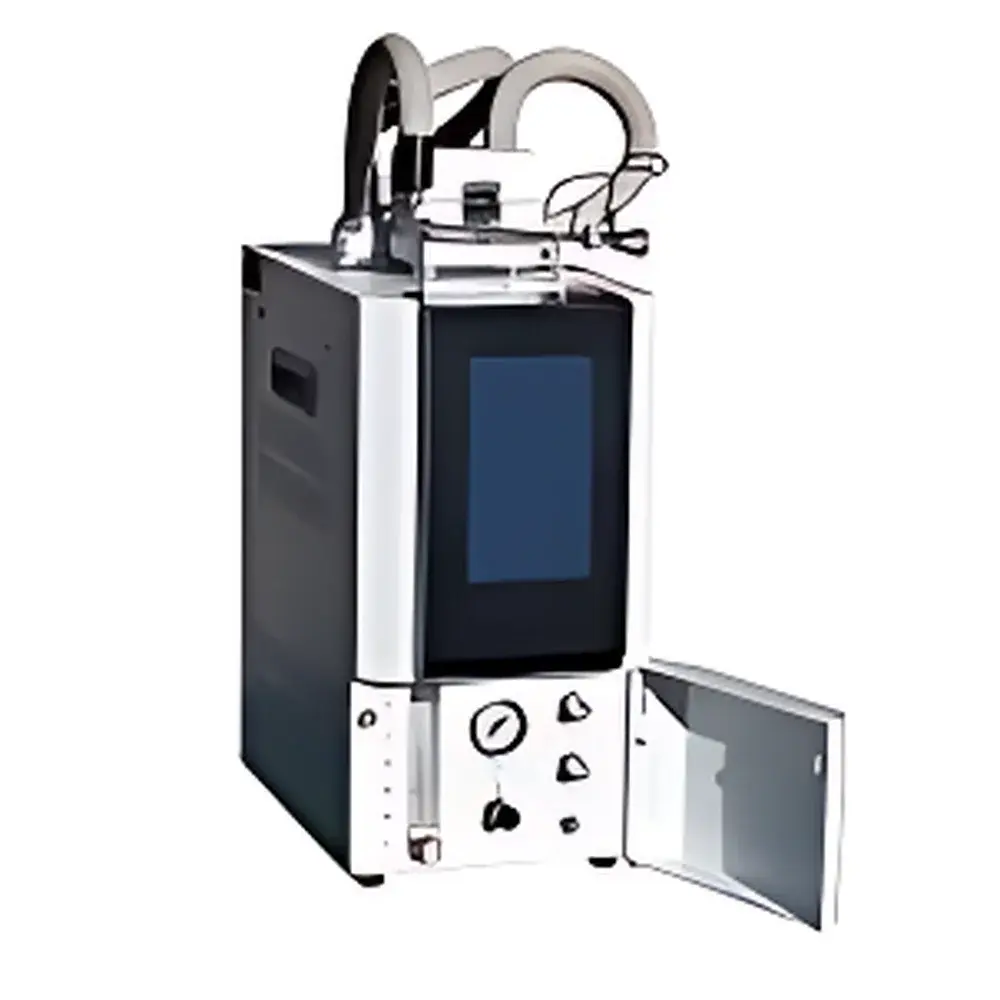
Beifen Sanpu ATDS-3430 Dual-Stage (Cryo-Trap) Thermal Desorber
| Brand | Beifen Sanpu |
|---|---|
| Origin | Beijing, China |
| Manufacturer Type | Direct Manufacturer |
| Model | ATDS-3430 |
| Instrument Type | Dual-Stage Thermal Desorber |
| Primary Desorption Temperature Range | Ambient to 450 °C |
| Cryo-Trap Temperature Range | −35 °C to Ambient |
| Desorption Recovery Rate | >99% (compound-dependent) |
| Sample Position Capacity | 1 tube |
Overview
The Beifen Sanpu ATDS-3430 Dual-Stage (Cryo-Trap) Thermal Desorber is an engineered solution for trace-level volatile organic compound (VOC) and semi-volatile organic compound (SVOC) analysis in environmental, industrial hygiene, and materials testing laboratories. It operates on the principle of two-stage thermal desorption: primary thermal release from sorbent tubes followed by cryofocusing in a thermoelectrically cooled trap, then rapid secondary desorption directly into the gas chromatograph (GC) or GC–MS inlet. This architecture eliminates cold spots, minimizes band broadening, and delivers high-fidelity transfer of thermally labile analytes with peak widths <3 s and effective enrichment factors exceeding 100×. Designed for full compatibility with domestic and international GC/GC–MS systems—including Agilent, Thermo Fisher, Shimadzu, and PerkinElmer—the ATDS-3430 meets the instrumental performance requirements specified in key regulatory methods such as HJ 644–2013, HJ 583–2010, HJ 734–2014, GB 50325–2020, and GB/T 18883–2002.
Key Features
- Integrated dual-stage desorption with Peltier-based cryo-trap (−35 °C to ambient), enabling sharp focusing of VOCs without liquid nitrogen or mechanical refrigeration
- Four independently controlled heated zones: primary desorption oven, six-port valve manifold (rated to 240 °C), transfer line (up to 260 °C), and secondary desorption/focusing zone (up to 450 °C)
- High-speed secondary desorption with programmable ramp rates >3000 °C/min, optimized for narrow chromatographic peaks and improved resolution of co-eluting compounds
- Full inert flow path: all sample-contact surfaces use de-activated fused silica or SilcoNert®-treated stainless steel tubing to prevent adsorption, carryover, or catalytic degradation
- Motor-driven high-temperature six-port valve with internal heating—no external heat blankets required; valve-to-transfer-line junction housed within insulated thermal chamber
- Automated sequence control via embedded microprocessor with 7-inch full-color LCD interface; supports method storage, real-time status animation, and time-programmed operation (desorption, purge, re-desorption, injection, backflush)
- Dual-flow capability: programmable sample loading (0–160 mL/min) and post-injection backflush (0–100 mL/min) to eliminate cross-contamination between samples
- Built-in calibration mode for simulating dynamic tube sampling—enabling direct generation of multi-point calibration curves without external gas standards
- Universal GC interface kit included, with mechanically matched adapters for split/splitless inlets across major OEM platforms
Sample Compatibility & Compliance
The ATDS-3430 accepts standard 6 mm OD × 150 mm (minimum) sorbent tubes (e.g., Tenax TA, Carbopack B/C, Carboxen series) and supports both single-tube and multi-tube configurations via optional accessories. Its temperature stability (<±0.5 °C) and reproducible desorption kinetics ensure RSD ≤2.5% (n=6, 0.05 μg benzene in methanol matrix), satisfying GLP data integrity expectations for routine environmental monitoring. The instrument complies with hardware-level requirements for ISO/IEC 17025-accredited laboratories and supports audit-ready operation when paired with chromatography data systems (CDS) that implement 21 CFR Part 11-compliant electronic signatures and audit trails. All thermal zones are calibrated traceably to NIST-certified references, and firmware logs include timestamped event records for each run cycle.
Software & Data Management
The ATDS-3430 operates autonomously via its onboard controller—no PC dependency required for routine runs. Method parameters (temperatures, timing, flow rates) are stored in non-volatile memory with password-protected access levels for operator and administrator roles. Synchronization signals (TTL pulses) enable precise coordination with GC oven start, detector acquisition, and CDS injection markers. For integrated laboratory workflows, the unit supports RS-232 and USB virtual COM port communication, allowing remote triggering and status polling from third-party software (e.g., OpenLab CDS, Chromeleon, Empower). Raw event logs—including actual vs. setpoint temperatures, valve actuation timestamps, and error codes—are exportable as CSV for QA review and regulatory submission.
Applications
This thermal desorber is routinely deployed in accredited environmental labs for compliance monitoring under Chinese national standards including HJ 644–2013 (ambient air VOCs), HJ 734–2014 (stationary source emissions), and GB 50325–2020 (indoor air quality in civil construction). It is also validated for automotive cabin air analysis (HJ/T 400–2007), polymer outgassing profiling, packaging material emissions testing, and forensic fire debris analysis. Its low detection limits (sub-pg level for BTEX on Tenax TA) and robust recovery (>99% for C2–C12 aliphatics and aromatics) make it suitable for method development in occupational health settings and reference material certification programs.
FAQ
What sorbent tube dimensions are supported?
Tubes with outer diameter ≤6.5 mm and length ≥150 mm are compatible. Standard 1/4″ OD × 3.5″ or 6″ tubes fit without modification.
Does the system require liquid nitrogen or external chillers?
No. The cryo-trap uses solid-state thermoelectric cooling, eliminating consumables and infrastructure dependencies.
Can the ATDS-3430 be used with GC–MS systems?
Yes. Its fast secondary desorption and inert transfer path preserve molecular integrity for reliable mass spectral identification.
Is method validation documentation available?
Instrument-specific IQ/OQ protocols and performance verification reports (including recovery, precision, linearity) are provided upon request for GLP/GMP implementation.
How is carryover mitigated between analyses?
Programmable backflush of the transfer line and valve, combined with high-temperature bake-out cycles (up to 260 °C), ensures residual-free operation across diverse sample matrices.






