
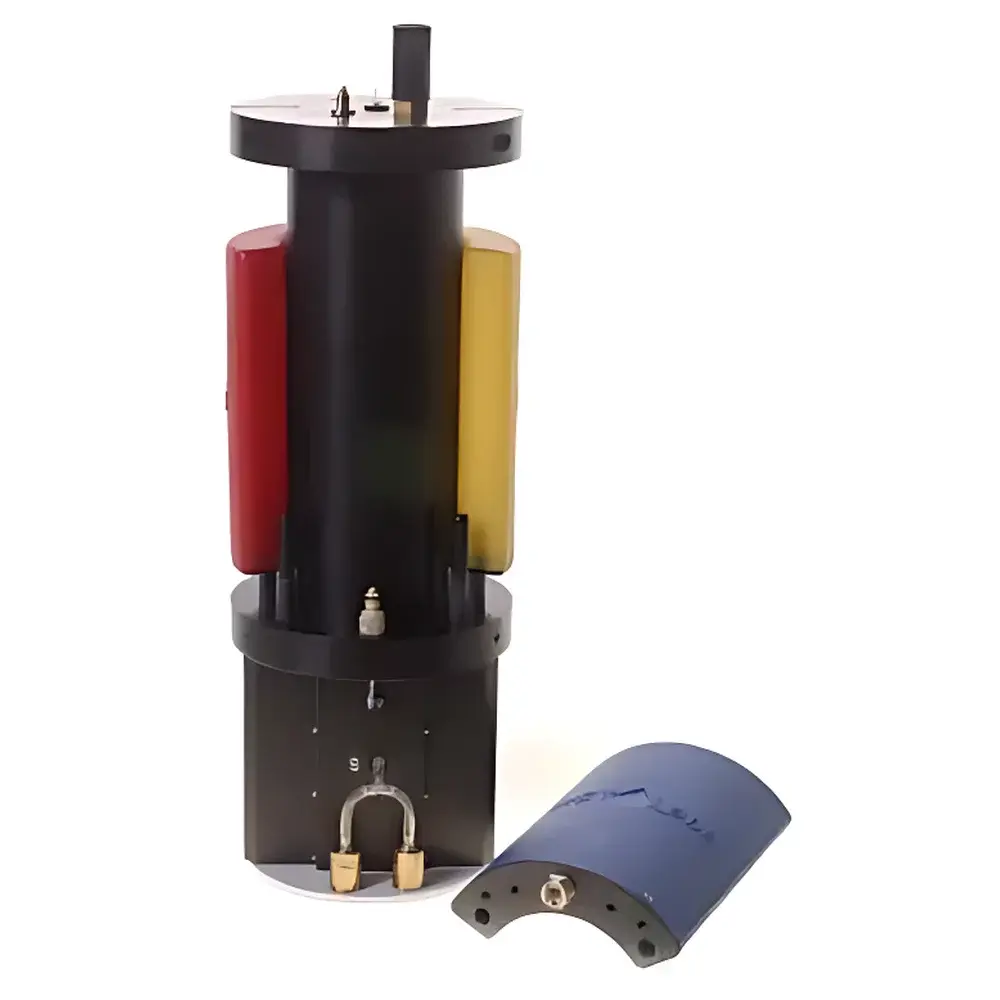
WET Labs CYCLE-PO4 Phosphate Analyzer
| Brand | WET Labs |
|---|---|
| Origin | USA |
| Model | CYCLE-PO4 |
| Detection Principle | Colorimetric Analysis via LED-based Optical Absorption (Molybdenum Blue Method) |
| Wavelength | 870 nm |
| Optical Path Length | 5 cm |
| Linearity | ≥95% R² |
| Detection Limit (3σ in 18 MΩ·cm water) | ≤75 nM PO₄-P (≤0.0023 mg P/L or ≤0.0071 mg/L PO₄) |
| Measurement Frequency | Up to 2 samples/hour |
| Operating Temperature Range | 0–30 °C |
| Pressure Rating | 200 m depth (IP68) |
| Dimensions (H×W) | 56 cm × 18 cm |
| Air Weight | 6.8 kg |
| Power Input | 9.5–18 VDC |
| Data Storage | 1 GB internal flash memory |
| Interface | RS-232 serial |
| Sample Throughput | >1000 measurements per deployment |
| Autonomous Operation Duration | >3 months on typical profiling or moored duty cycle |
| Calibration | Field-deployable two-point (zero/span) optical calibration with automated drift compensation |
Overview
The WET Labs CYCLE-PO4 Phosphate Analyzer is a purpose-built, single-parameter submersible sensor engineered for long-term, unattended in situ monitoring of orthophosphate (PO₄-P) in marine, estuarine, and freshwater environments. Unlike multiplexed nutrient analyzers, the CYCLE-PO4 implements a dedicated, miniaturized wet-chemistry module based on the standardized molybdenum blue colorimetric method—fully compliant with ISO 15681-1 and ASTM D515-89 protocols for phosphate quantification. Its core measurement architecture integrates a precision microfluidic manifold, temperature-stabilized 870 nm LED light source, and matched photodetector pair operating across a fixed 5 cm optical path. This design eliminates spectral interference from turbidity and organic chromophores common in coastal and eutrophic waters, delivering high specificity and reproducibility under dynamic field conditions. The instrument operates autonomously via programmable sampling schedules, making it suitable for moored buoys, gliders, AUVs, and fixed-platform deployments where power, data bandwidth, and maintenance access are constrained.
Key Features
- Field-calibratable two-point optical calibration (zero and span) with onboard reference solution reservoirs and automated baseline correction
- Nanomolar-level detection sensitivity: ≤75 nM PO₄-P (3σ in ultrapure water), enabling detection of oligotrophic background concentrations
- Robust pressure housing rated to 200 m depth (stainless steel and titanium components; IP68-certified sealing)
- Low-power intelligent sampling logic—adaptive trigger modes reduce average current draw to <150 mA during standby, extending battery life beyond 3 months
- Integrated 1 GB non-volatile flash memory with timestamped, binary-encoded data logging (UTC-synchronized via optional GPS input)
- RS-232 serial interface compatible with standard oceanographic data acquisition systems (e.g., Sea-Bird Electronics, RBR, Teledyne Webb)
- Self-diagnostic firmware with real-time status reporting (reagent level, pump health, LED intensity decay, thermal drift compensation status)
Sample Compatibility & Compliance
The CYCLE-PO4 is validated for use in natural waters ranging from open-ocean oligotrophic systems (PO₄-P: 10–100 nM) to moderately eutrophic estuaries (up to 2 µM PO₄-P). It accommodates salinities from 0–40 PSU without recalibration and tolerates suspended solids up to 50 NTU through its silt-resistant inlet filter and pulse-flush cleaning cycle. All wetted materials—including fluidic tubing, reaction chamber, and optical windows—are FDA-compliant, USP Class VI-certified polymers and fused silica. The analyzer meets GLP data integrity requirements via immutable metadata tagging (instrument ID, firmware version, calibration epoch, operator code), and supports audit-trail-enabled data export for regulatory reporting under EPA Method 365.3 and ISO/IEC 17025-accredited laboratories.
Software & Data Management
Instrument configuration, calibration, and data retrieval are managed via WET Labs’ CYCLE Control Suite—a cross-platform desktop application (Windows/macOS/Linux) supporting secure command-line scripting and batch processing. Raw absorbance values, temperature-compensated concentration outputs, and diagnostic logs are exported in CF-compliant NetCDF-4 format with embedded units, coordinate metadata (lat/lon/depth), and ISO 8601 timestamps. For integration into enterprise environmental monitoring networks, the CYCLE-PO4 supports Modbus RTU over RS-232 and can be bridged to MQTT or NMEA 2000 via third-party gateways. All calibration events and firmware updates are cryptographically signed and logged with SHA-256 hashes to satisfy FDA 21 CFR Part 11 electronic record requirements.
Applications
- Long-term nutrient time-series on moored observatories (e.g., OceanSITES, IOOS nodes)
- High-resolution phosphate profiling during autonomous underwater vehicle (AUV) surveys
- Real-time eutrophication early-warning systems in drinking water reservoirs and wastewater outfall zones
- Validation of satellite-derived chlorophyll-a and primary productivity models using in situ PO₄-P baselines
- Process monitoring in aquaculture recirculation systems requiring sub-100 nM phosphate control
- Climate-driven biogeochemical studies assessing phosphate regeneration rates in oxygen minimum zones
FAQ
What reagents does the CYCLE-PO4 consume, and how often must they be replenished?
The analyzer uses acidified ammonium molybdate and ascorbic acid reagents stored in sealed, replaceable cartridges. At a sampling frequency of 1 sample/hour, a full set lasts approximately 6 weeks. Cartridge replacement requires no tools and takes <90 seconds.
Can the CYCLE-PO4 operate in ice-covered or highly turbid riverine environments?
Yes—its pressure-compensated fluidics and anti-fouling inlet design support operation under seasonal ice cover (with appropriate deployment housing) and in rivers with sustained turbidity up to 100 NTU. Optional ultrasonic transducer cleaning mode mitigates biofilm accumulation.
Is remote firmware update supported?
Firmware updates are performed via RS-232 connection only and require physical access. No over-the-air (OTA) capability is implemented to preserve data integrity and cybersecurity compliance in regulated research settings.
How is temperature compensation applied during measurement?
An integrated Pt1000 thermistor measures reaction chamber temperature in real time. Concentration outputs are corrected using empirically derived polynomial coefficients (validated across 0–30 °C), traceable to NIST SRM 1640a.
Does the instrument meet requirements for regulatory compliance reporting?
Yes—the CYCLE-PO4 satisfies data quality objectives outlined in EPA Guidance for Nutrient Monitoring (EPA 841-B-19-001) and provides full chain-of-custody metadata required for submission to state and federal water quality databases (e.g., STORET, WQX).
Related Products







