
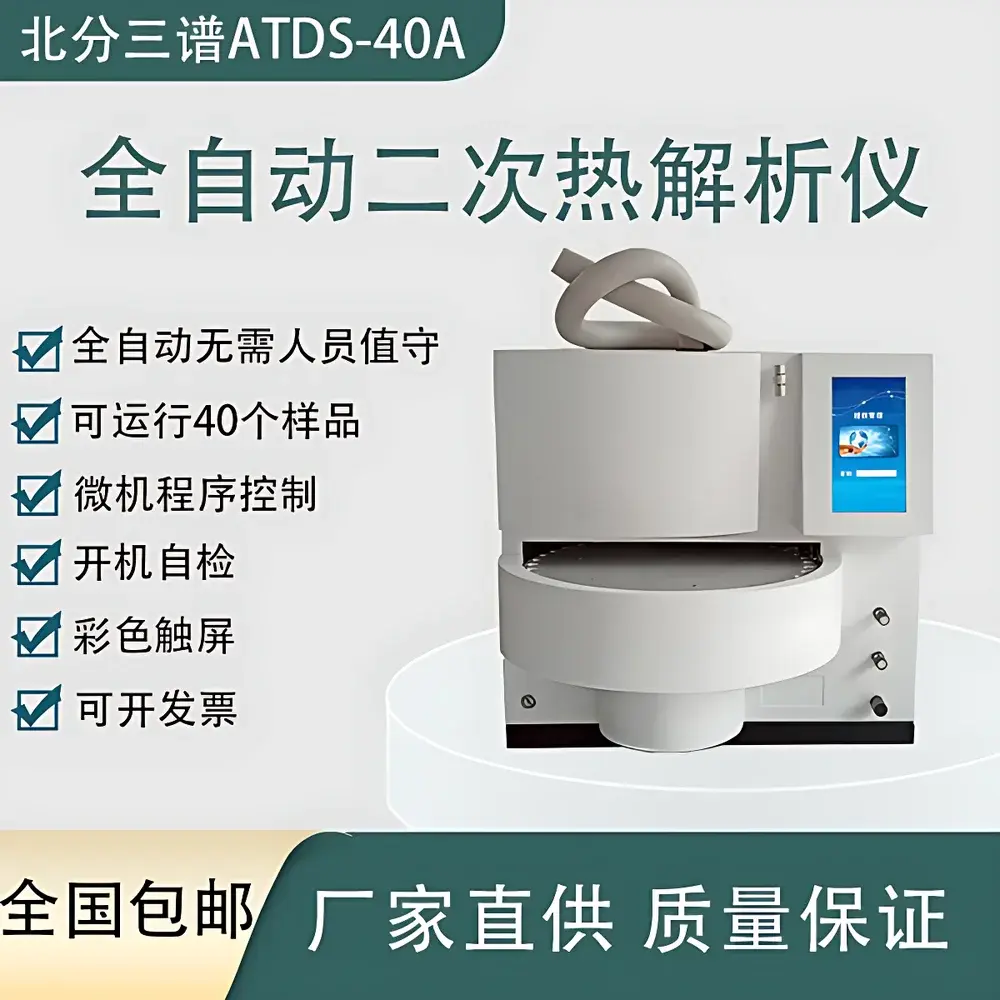
Beifen Sanpu ATDS-40A Fully Automated Two-Stage Thermal Desorber
| Brand | Beifen Sanpu |
|---|---|
| Origin | Beijing, China |
| Manufacturer Type | Direct Manufacturer |
| Model | ATDS-40A |
| Instrument Type | Two-Stage Thermal Desorber |
| Automation Level | Fully Automated |
| Primary Desorption Temperature Range | Ambient to 450 °C (1 °C increments) |
| Valve Injection Zone Temperature Range | Ambient to 300 °C (1 °C increments) |
| Transfer Line Temperature Range | Ambient to 300 °C (1 °C increments, 24 V low-voltage heating) |
| Secondary Desorption Temperature Range | Ambient to 450 °C (1 °C increments) |
| Cryo-Focusing Trap Temperature Range | −35 °C to Ambient (1 °C increments |
| Temperature Control Accuracy | < ±0.5 °C |
| Desorption Recovery Rate | >99% (compound-dependent) |
| Sample Capacity | 40 positions |
| Sample Tube Specification | 1/4″ OD × 3.5″ length (ASTM D6196-compliant) |
| Carryover Mitigation | Automated back-flush of valve and transfer line (0–100 mL/min, continuously adjustable) |
| Quantitative Reproducibility | RSD ≤2.5% (benzene at 0.05 μg in methanol) |
| Enrichment Time | 0–60 min |
| Injection Time | 0–60 min |
| Simulated Sampling Flow | 0–160 mL/min (continuously adjustable) |
| Dimensions | 350 × 450 × 550 mm (W × D × H) |
| Weight | ~45 kg |
Overview
The Beifen Sanpu ATDS-40A Fully Automated Two-Stage Thermal Desorber is an engineered solution for quantitative trace volatile organic compound (VOC) and semi-volatile organic compound (SVOC) analysis in environmental, occupational health, food safety, and building material testing applications. It operates on the principle of two-stage thermal desorption: first, analytes are thermally released from sorbent tubes under controlled inert gas flow and cryogenically refocused in a narrow zone within a Peltier-cooled trap; second, the trapped analytes are rapidly heated (>3000 °C/min) and transferred as a sharp, solvent-free plug into the injection port of a gas chromatograph (GC) or GC–MS system. This architecture eliminates solvent use, improves detection sensitivity by 10–100× over direct injection, and delivers high-fidelity peak shapes essential for accurate integration and identification. Designed for compliance with ISO 16017-1, ASTM D6196, EPA TO-17, and EN 16755 methodologies, the ATDS-40A supports validated workflows in GLP and ISO/IEC 17025-accredited laboratories.
Key Features
- Fully automated unattended operation for up to 40 standard 1/4″ × 3.5″ sorbent tubes—no manual intervention required between runs.
- Independent, precision temperature control across four zones: primary desorption furnace (ambient–450 °C), secondary desorption trap (ambient–450 °C), six-port motorized valve (ambient–300 °C), and heated transfer line (ambient–300 °C), all with ±0.5 °C stability.
- Integrated Peltier-based cryo-focusing module with programmable cooling down to −35 °C, enabling efficient trapping of C2–C16 VOCs and enhanced resolution of early-eluting compounds.
- Automated back-flush functionality for both the multi-position valve and transfer line, minimizing carryover and ensuring inter-sample integrity (<2.5% RSD demonstrated for benzene at trace levels).
- Onboard tube activation protocol with programmable heating, purge, and cool-down cycles—eliminates need for external conditioning ovens.
- Simulated sampling mode with adjustable flow (0–160 mL/min) for direct calibration curve generation using certified gas standards or liquid spiking.
- Time-programmable sequence logic supporting full method automation: desorption → trap focusing → secondary flash desorption → GC trigger → post-injection line/valve back-flush.
- Native compatibility with major GC and GC–MS platforms via standardized electrical and pneumatic interfaces; optional quartz-lined transfer lines available for reactive analyte handling.
Sample Compatibility & Compliance
The ATDS-40A accommodates industry-standard 1/4″ OD sorbent tubes (e.g., Tenax TA, Carbopack B/C, Carboxen 1000), including dual-bed configurations. Its design adheres to critical regulatory requirements for environmental monitoring: it satisfies the hardware and performance criteria outlined in U.S. EPA Method TO-17 (Determination of Volatile Organic Compounds in Ambient Air Using Active Sampling Onto Sorbent Tubes), ISO 16017-1 (Indoor, ambient and workplace air — Sampling and analysis of volatile organic compounds using sorbent tubes, thermal desorption and gas chromatography), and ASTM D6196 (Standard Practice for Selecting Generic Sampling and Analysis Methods for Volatile Organic Compounds). All temperature zones are calibrated traceably to NIST-traceable references, and system suitability tests—including recovery, precision, and blank assessment—are fully scriptable and documented per ISO/IEC 17025 clause 7.7.
Software & Data Management
Controlled via a dedicated Windows-based application with intuitive touchscreen interface (10.1″ capacitive display), the ATDS-40A supports audit-trail-enabled operation compliant with FDA 21 CFR Part 11 requirements when deployed in regulated environments. The software records all method parameters, real-time temperature profiles, valve actuation timestamps, and error logs with user authentication and electronic signature capability. Raw data export is supported in CSV and XML formats for seamless integration with LIMS and third-party chromatography data systems (CDS). Remote monitoring and method synchronization across multiple instruments are enabled via Ethernet TCP/IP protocol, facilitating centralized QC oversight in multi-lab networks.
Applications
- Environmental air monitoring: quantification of BTEX, aldehydes, chlorinated solvents, and oxygenated VOCs in ambient, indoor, and stack emissions.
- Building product emission testing: determination of formaldehyde, acetaldehyde, and other SVOCs from carpets, adhesives, paints, and composite wood panels per ISO 16000 series.
- Food packaging migration studies: screening for residual monomers, plasticizers, and printing ink volatiles in PET, PE, and multilayer films.
- Pharmaceutical stability testing: headspace VOC profiling of active pharmaceutical ingredients (APIs) and excipients under accelerated conditions.
- Forensic toxicology: sensitive detection of ignitable liquid residues (ILRs) in fire debris samples per ASTM E1492.
FAQ
What sorbent tube formats does the ATDS-40A support?
It accepts standard 1/4″ OD × 3.5″ (89 mm) stainless steel or glass tubes compliant with ASTM D6196 and EPA TO-17 specifications.
Can the instrument be integrated with third-party GC software?
Yes—it provides TTL and RS232 triggers for synchronized start/stop with Agilent, Thermo Fisher, Shimadzu, and PerkinElmer GC systems; GC vendor-specific macros are preloaded.
Is cold trap deactivation required between analyses?
No—the Peltier-cooled trap is automatically regenerated during each cycle via programmed heating and inert gas purge, eliminating manual maintenance.
How is system performance verified?
Built-in diagnostic routines include temperature mapping, valve timing validation, and recovery testing using certified reference standards; results are auto-generated in PDF reports.
Does the ATDS-40A meet GLP documentation requirements?
When configured with audit-trail mode enabled and user access controls, it fulfills ALCOA+ principles (Attributable, Legible, Contemporaneous, Original, Accurate) for regulated laboratory use.




