
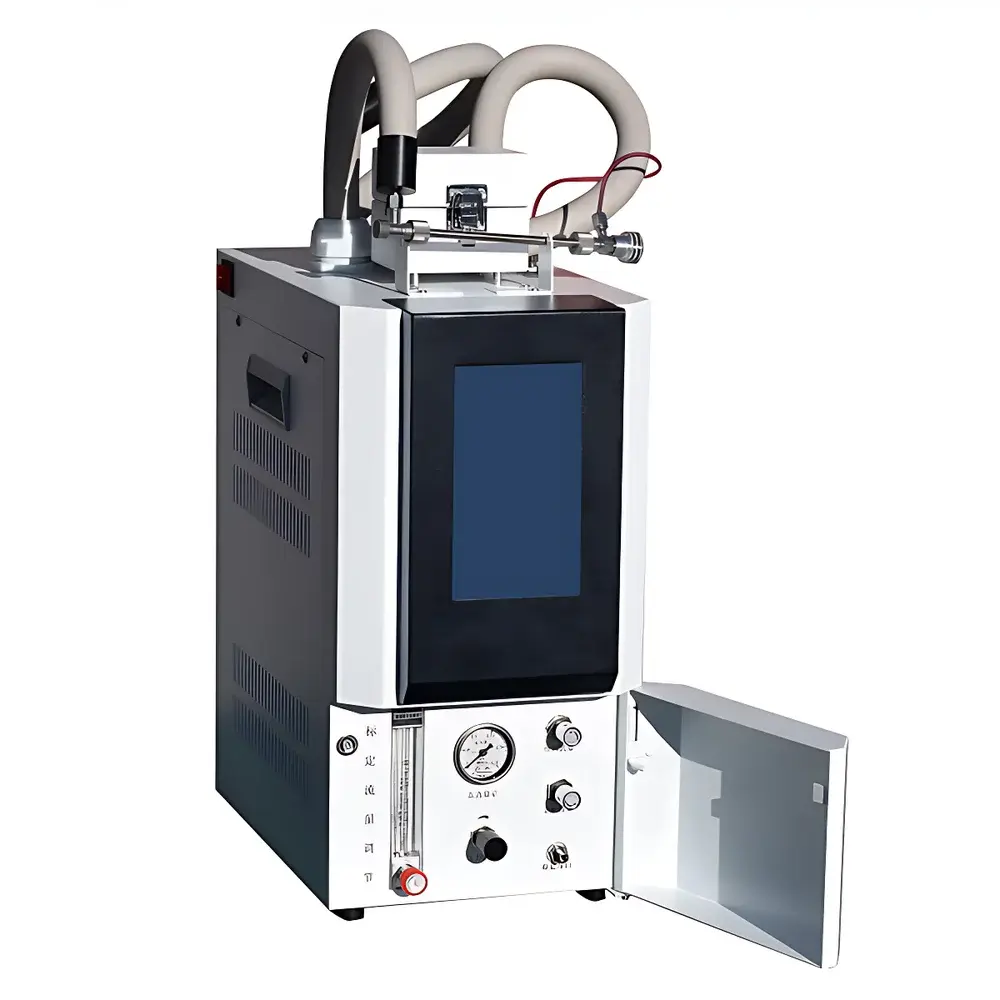
Beifen Sanpu DSAT-3430 Dual-Stage Thermal Desorber – Direct Manufacturer Supply
| Brand | Beifen Sanpu |
|---|---|
| Model | DSAT-3430 |
| Origin | Beijing, China |
| Manufacturer Type | OEM Manufacturer |
| Instrument Type | Dual-Stage Thermal Desorber |
| Desorption Temperature Range | Ambient to 450 °C |
| Cold Trap Temperature Range | −35 °C to Ambient |
| Desorption Recovery Rate | >99% (compound-dependent) |
| Sample Capacity | 1 tube per run |
| Cooling Method | Semiconductor-based Peltier cooling |
| Secondary Desorption Heating Rate | >3000 °C/min |
| Peak Width (Secondary Desorption) | <3 s |
| Valve Type | High-Temperature 6-Port Switching Valve (up to 240 °C) |
| Sample Transfer Line | Deactivated Silica Capillary Tubing (inert, zero carryover) |
| Control Interface | 7-inch Full-Color Touchscreen with Embedded Microprocessor |
| GC Synchronization | TTL/Relay Trigger Output & External Start Input |
| Compliance Ready | ASTM D6196, ISO 16017-1, US EPA TO-17, HJ 644–2013, HJ 734–2014 |
Overview
The Beifen Sanpu DSAT-3430 is a fully automated, dual-stage thermal desorber engineered for high-fidelity volatile organic compound (VOC) and semi-volatile organic compound (SVOC) analysis in environmental, industrial hygiene, food safety, and building material testing laboratories. It operates on the principle of two-stage thermally assisted desorption: first, analytes are pre-concentrated from large-volume air samples onto a primary sorbent tube (e.g., Tenax TA, Carbopack B/C); second, the trapped compounds are thermally transferred to a narrow-bore, cryogenically focused capillary trap (cold trap), followed by rapid resistive heating and injection into the gas chromatograph (GC) or GC–MS inlet. This two-step process achieves effective removal of water vapor and CO2, eliminates matrix interference, and delivers sharp, symmetrical chromatographic peaks—critical for trace-level quantitation and method robustness under regulatory protocols such as US EPA TO-17 and ISO 16017-1.
Key Features
- Dual-stage desorption architecture: Enables quantitative recovery of polar and non-polar VOCs (C2–C20) with >99% recovery across diverse matrices—including humid ambient air, indoor air, and polymer headspace.
- Peltier-cooled cold trap: Maintains precise temperature control from −35 °C to ambient, ensuring efficient focusing of low-boiling compounds (e.g., formaldehyde, acetaldehyde, benzene) without liquid nitrogen dependency.
- Independent quad-zone heating: Four independently controlled zones—primary desorption oven, six-port valve, transfer line, and secondary desorption chamber—eliminate cold spots and guarantee complete analyte transfer integrity.
- High-speed secondary desorption: >3000 °C/min ramp rate and <3 s peak width enable optimal compatibility with fast-GC and narrow-bore capillary columns (e.g., 0.18 mm ID), maximizing resolution and sensitivity.
- Ultra-inert sample pathway: Entire transport path—from sorbent tube to GC inlet—uses deactivation-treated fused silica tubing and high-temperature valve components (rated to 240 °C), minimizing adsorption, degradation, and carryover.
- Full automation with GC synchronization: Built-in TTL triggering supports seamless integration with all major GC and GC–MS platforms (Agilent, Thermo Fisher, Shimadzu, PerkinElmer); programmable start/stop signals ensure reproducible retention time alignment.
- Onboard calibration functionality: Integrated standard vapor generation mode allows direct preparation of calibration curves using certified gas standards or liquid spiking—reducing external hardware dependencies and method development time.
Sample Compatibility & Compliance
The DSAT-3430 accepts standard 1/4″ OD stainless steel or glass sorbent tubes (e.g., Markes UNITY, Gerstel TDS, or custom-packed tubes) and is compatible with common multi-sorbent configurations (e.g., Carbopack C/Carbopack B/Carboxen 1000). Its design conforms to internationally recognized sampling and analytical frameworks: US EPA Methods TO-11A (for formaldehyde), TO-17 (for ambient VOCs), and Compendium Method IP-10 (for indoor air); Chinese national standards HJ 644–2013 and HJ 734–2014; and ISO 16017-1 for VOC determination in indoor and outdoor air. The instrument’s firmware supports audit-trail logging (user actions, method parameters, timestamps) and is configurable for GLP/GMP environments requiring 21 CFR Part 11–compliant data integrity when paired with validated chromatography data systems (CDS).
Software & Data Management
Control is executed via an embedded real-time operating system with a 7-inch capacitive touchscreen interface. All method parameters—including desorption times, temperatures, purge flows, valve switching sequences, and GC trigger settings—are stored in encrypted, timestamped method files. The system supports up to 99 user-defined methods, each with independent scheduling logic for unattended overnight operation. Raw status logs (oven temperatures, valve positions, error codes) are saved automatically in CSV format for traceability. While the DSAT-3430 does not include proprietary chromatography software, its relay/TTL outputs and RS-232/USB interfaces allow bidirectional communication with third-party CDS platforms (e.g., OpenLab CDS, Chromeleon, Empower) for synchronized acquisition and report generation.
Applications
- Ambient and indoor air quality monitoring (BTEX, aldehydes, terpenes, chlorinated solvents)
- Building material emissions testing (carpet, adhesives, paints, composite wood products per ISO 16000 series)
- Food packaging migration studies (residual solvents, monomers, plasticizers)
- Pharmaceutical residual solvent analysis (ICH Q3C-compliant workflows)
- Automotive cabin air and polymer off-gassing characterization
- Forensic ignitable liquid residue (ILR) profiling per ASTM E1618
FAQ
Is the DSAT-3430 compatible with my existing Agilent 8890 GC?
Yes—the instrument includes universal GC interface kits (including Agilent-specific valve timing and electrical connectors) and supports TTL-triggered start/stop synchronization.
Can I use this unit for method development per US EPA TO-17?
Absolutely—the DSAT-3430 meets all hardware requirements specified in TO-17, including cold trap temperature stability, desorption efficiency (>95% for target analytes), and system blank performance (<0.5 ng for benzene).
Does the system support automated tube conditioning?
Yes—built-in bake-out cycles (programmable up to 400 °C) and inert gas purging allow full tube regeneration prior to analysis, eliminating manual conditioning steps.
What maintenance is required for long-term reliability?
Routine tasks include quarterly verification of cold trap cooling performance, annual calibration of temperature sensors per ISO/IEC 17025 guidelines, and replacement of O-rings and valve seals every 12 months under continuous operation.
Is remote monitoring or network connectivity available?
The DSAT-3430 features USB and RS-232 ports for local PC connection; optional Ethernet-to-serial gateway modules enable integration into lab-wide instrument networks when deployed with middleware such as LabArchives or LabVantage.




