
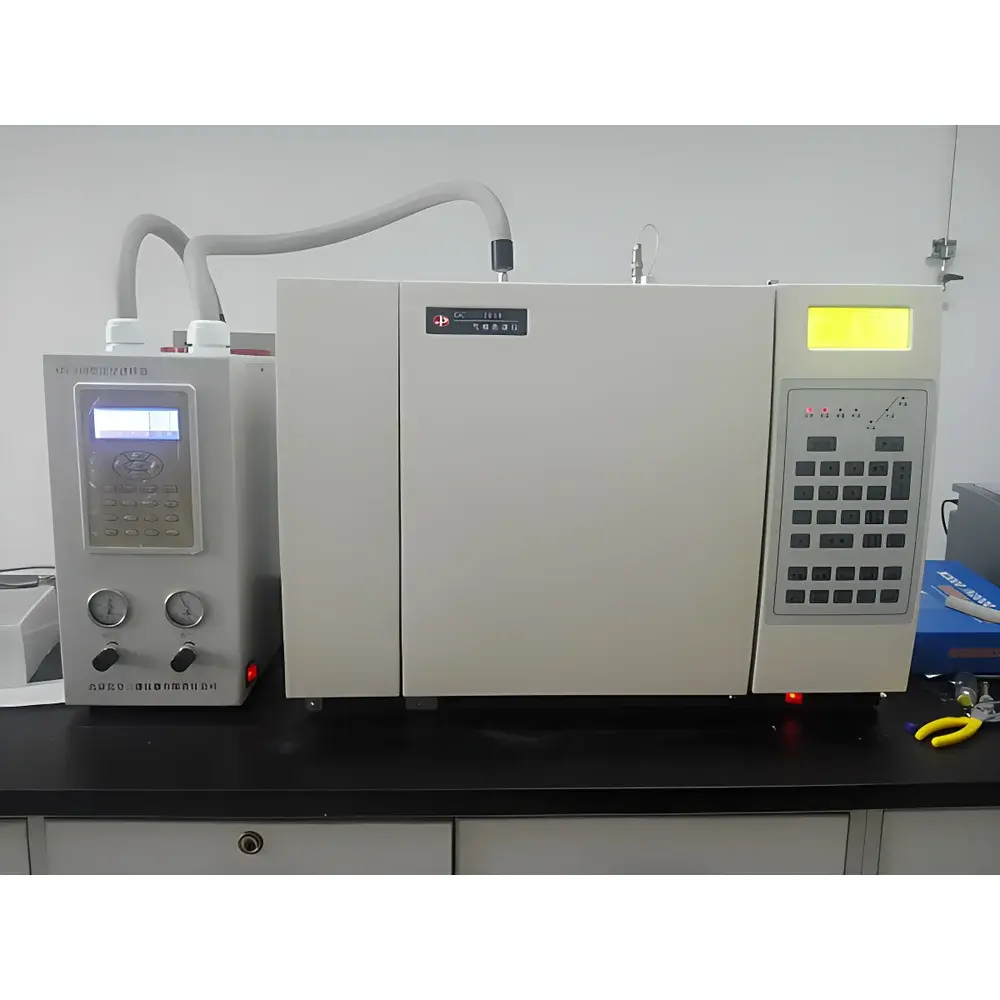
Beifen Sanpu GC-2011A Laboratory Gas Chromatograph for Ethanol Quantification in Tincture of Iodine (ChP 2015, Vol. IV)
| Brand | Beifen Sanpu |
|---|---|
| Origin | Beijing, China |
| Manufacturer Type | Manufacturer |
| Product Origin | Domestic (China) |
| Model | GC-2011A |
| Instrument Type | Laboratory Gas Chromatograph |
| Application Field | Pharmaceutical Analysis |
| Oven Temperature Range | Ambient to 400 °C |
| Oven Ramp Rate | 0.1–40 °C/min |
| Oven Cooling Rate | 400 °C → 50 °C in ≤6 min |
| Carrier Gas Flow Range & Control | 0–1200 mL/min |
| Carrier Gas Pressure Range & Control | 0–800 kPa |
| Injector Maximum Temperature | 400 °C |
| Injector Pressure Setting Range | 0–800 kPa |
| Injector Total Flow Setting Range | 0–1200 mL/min |
Overview
The Beifen Sanpu GC-2011A is a dedicated laboratory gas chromatograph engineered for precise, reproducible quantification of ethanol in iodine tincture formulations, fully compliant with the Chinese Pharmacopoeia (ChP) 2015 Edition, Volume IV, General Chapter 0711 “Determination of Ethanol Content” and General Chapter 0521 “Gas Chromatography”. This system implements headspace-gas chromatography (HS-GC) with flame ionization detection (FID), operating on the internal standard method using n-propanol as the reference compound. The methodology is grounded in vapor-phase partition equilibrium principles, where volatile analytes—ethanol in aqueous alcoholic solutions—are thermally equilibrated in sealed vials prior to injection into the capillary column. Separation relies on differential partitioning between the stationary phase (6% cyanopropylphenyl–94% dimethylpolysiloxane) and mobile phase (carrier gas), enabling resolution of ethanol from matrix interferences and internal standard under strictly defined thermal gradients. The GC-2011A’s robust oven architecture, high-precision pressure/flow control, and stable FID response ensure compliance with ChP system suitability criteria: theoretical plate count ≥10,000 (ethanol peak), resolution >2.0 between ethanol and n-propanol, and relative standard deviation (RSD) of calibration factor ≤2.0%.
Key Features
- Programmable temperature-controlled oven with ramp rates from 0.1 to 40 °C/min and rapid cooling capability (400 °C to 50 °C in ≤6 minutes), essential for high-throughput validation of ChP Method I (capillary column) and Method II (packed column).
- Dual independent pressure and flow control modules for carrier gas (N₂, H₂, or He), allowing precise regulation across 0–800 kPa pressure and 0–1200 mL/min total flow—critical for retention time stability and method transferability.
- High-temperature injector (up to 400 °C) compatible with both split/splitless and headspace injection modes; optimized for 1:1 split ratio per ChP specifications.
- FID detector with temperature range up to 220 °C, low-noise electronics, and linear dynamic range >10⁷, delivering accurate peak area integration for ethanol quantification at pharmacopeial concentration levels (typically 30–50% v/v in iodine tincture).
- Integrated hardware compatibility with AHS-610 automatic headspace sampler (optional), supporting 85 °C vial equilibration for 20 minutes—directly aligned with ChP headspace conditions.
Sample Compatibility & Compliance
The GC-2011A is validated for use in pharmaceutical quality control laboratories performing routine ethanol assays in iodine tincture (Tinctura Iodi), veterinary antiseptic preparations, and other alcohol-containing topical formulations. It supports both ChP-recommended methods: Method I (capillary column: 30 m × 0.53 mm × 3.00 μm, 6% cyanopropylphenyl–94% dimethylpolysiloxane) and Method II (packed column: divinylbenzene–ethylvinylbenzene polymer). All operational parameters—including oven program (40 °C hold 2 min → 3 °C/min → 65 °C → 25 °C/min → 200 °C hold 10 min), injector (200 °C), detector (220 °C), and headspace conditions (85 °C, 20 min)—are pre-configurable within the N2000 chromatography data system. The instrument meets core regulatory expectations for GLP/GMP environments: audit trail-enabled software, electronic signature support (aligned with FDA 21 CFR Part 11 principles), and full traceability of calibration, system suitability testing (SST), and sample runs. System suitability tests—plate count, resolution, tailing factor, and RSD of internal standard response—are programmable and reportable per ICH Q2(R2) guidelines.
Software & Data Management
The bundled N2000 chromatography workstation provides ISO/IEC 17025-aligned data acquisition, processing, and reporting functionality. It supports automated calculation of ethanol content (% v/v at 20 °C) via internal standard calibration curves, applying ChP-defined formulas and acceptance criteria. Raw data files (.dat) are stored with immutable metadata including instrument method, sequence log, SST results, and user authentication stamps. Audit trails record all parameter modifications, integration changes, and report exports with timestamps and operator IDs. Export formats include PDF (for QC release), CSV (for LIMS integration), and XML (for enterprise data lakes). The software accommodates multi-level user permissions (analyst, supervisor, administrator) and supports 21 CFR Part 11-compliant electronic signatures when deployed on validated Windows OS platforms with domain authentication.
Applications
- Quantitative determination of ethanol in iodine tincture (ChP 2015 Vol. IV, Section 0711), including batch release testing and stability studies.
- Residual solvent analysis in antiseptic formulations per ICH Q3C guidelines, where ethanol serves both as active ingredient and processing solvent.
- Method verification and transfer for pharmacopeial compliance in contract manufacturing organizations (CMOs) and regulatory submission packages (e.g., DMF, CEP).
- Support for veterinary drug monographs requiring ethanol content verification in iodine-based disinfectants.
- Adaptation to other ChP ethanol assays—including tinctures of belladonna, digitalis, and chloroform—using identical hardware and validated workflows.
FAQ
Does the GC-2011A meet Chinese Pharmacopoeia 2015 requirements for ethanol assay in iodine tincture?
Yes—the system is configured and validated specifically for ChP Vol. IV General Chapter 0711, including all specified temperature programs, column specifications, detector settings, and headspace parameters.
Is the AHS-610 headspace autosampler required for ChP compliance?
While manual headspace injection is permitted, the AHS-610 ensures precision, repeatability, and full traceability of equilibration time/temperature—strongly recommended for GMP-regulated environments.
Can this system be used for other residual solvent analyses beyond ethanol?
Yes—when paired with appropriate columns (e.g., DB-624, Stabilwax) and method development, it supports ICH Q3C Class 2 and 3 solvents, though ChP 0711 validation applies exclusively to ethanol in specified matrices.
What documentation is provided for regulatory audits?
Factory-issued IQ/OQ protocols, ChP-specific system suitability test templates, electronic audit trail reports, and raw data archiving guidance are included with the instrument and software package.
Is nitrogen the only acceptable carrier gas for this application?
No—hydrogen and helium are also supported; however, nitrogen is preferred per ChP recommendations for optimal resolution and safety in routine QC labs.
Related Products






