
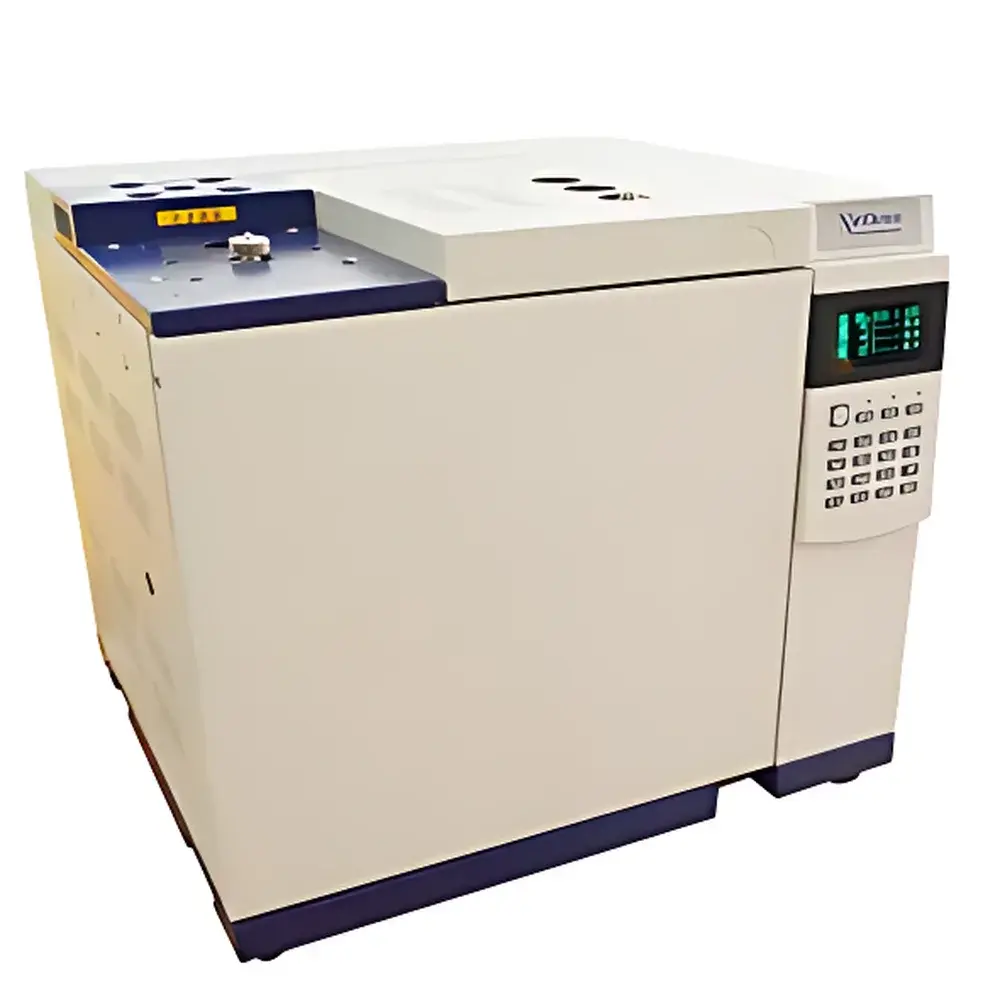
Beifen Sanpu GC-9860-5V Natural Gas & Town Gas Dedicated Gas Chromatograph
| Brand | Beifen Sanpu |
|---|---|
| Origin | Beijing, China |
| Manufacturer Type | Direct Manufacturer |
| Product Origin | Domestic (China) |
| Model | GC-9860-5V |
| Pricing | Upon Request |
Overview
The Beifen Sanpu GC-9860-5V is a dedicated gas chromatograph engineered for comprehensive compositional analysis of natural gas, liquefied petroleum gas (LPG), and multiple types of town gas—including coke oven gas, blast furnace gas, converter gas, water gas, semi-water gas, and synthetic gas. It operates on the fundamental principle of gas-phase separation via differential partitioning in capillary and packed columns, followed by highly selective and sensitive detection using dual-detector architecture (FID and TCD). The instrument delivers quantitative results for up to 23 key gaseous components—including H₂, O₂, N₂, CO, CO₂, CH₄, C₂H₆, C₂H₄, C₂H₂, C₃H₈, cyclo-C₃H₆, C₃H₆, C₃H₄, i-C₄H₁₀, n-C₄H₁₀, C₄H₈ isomers (cis/trans/iso), C₅H₁₂ isomers, 1,3-butadiene, and n-C₆H₁₄—within a single injection cycle. This capability enables precise calculation of calorific value (higher heating value, HHV), Wobbe index, relative density, and volumetric composition—parameters critical for custody transfer, process control, safety compliance, and regulatory reporting in energy distribution and industrial gas applications.
Key Features
- Integrated dual-channel configuration: organic gas analysis channel (6-port valve, fused-silica capillary column, FID) and inorganic gas analysis channel (10-port pneumatic valve with backflush, pre-cut packed column, main packed column, TCD)
- Advanced electronic pressure and flow control (EPC/EFC) for carrier gases (N₂, H₂, He, Ar, air), supporting both constant-flow and constant-pressure modes with 0.01 kPa pressure resolution and 0.01 sccm flow resolution
- Six independently programmable temperature zones with ±0.1 °C stability; operating range from 4 °C above ambient to 450 °C; up to 16 heating ramps at rates of 0.1–80 °C/min
- Network-enabled architecture with embedded Ethernet (IEEE 802.3) interface for remote monitoring, data acquisition, and centralized fleet management across distributed lab or field sites
- 5.7-inch color TFT LCD display with optional touch interface; real-time visualization of temperature profiles, flow parameters, and detector baselines
- Modular detector support: up to three simultaneous detectors (FID, TCD, ECD, FPD, or NPD); factory-configured dual-detector setup optimized for hydrocarbon and permanent gas co-analysis
Sample Compatibility & Compliance
The GC-9860-5V is validated for direct injection of compressed gas samples without derivatization or pre-concentration. Its hardware and method protocols conform to multiple national and industry standards governing gas quality assessment and energy content determination, including GB 17820–1999 (Natural Gas), GB/T 13610–2003 (Gas Chromatographic Analysis of Natural Gas Composition), GB/T 11062–1998 (Calculation of Calorific Value, Density, and Wobbe Index), SH/T 0230–92 (LPG Composition by GC), GB/T 13611 (Town Gas Classification), and GB 10410.1–89 through GB 10410.3–89 (gas-specific GC methods for manufactured gas, natural gas, and LPG). The system supports GLP-compliant operation when paired with audit-trail-enabled chromatography data systems (CDS), and its hardware design facilitates alignment with ISO/IEC 17025 requirements for testing laboratories.
Software & Data Management
The dedicated gas chromatography workstation provides automated peak integration, multi-channel signal synchronization, normalization-based quantification, and real-time calorific value computation per ISO 6976 and GB/T 11062 algorithms. It generates standardized reports compliant with utility billing, pipeline specification, and regulatory submission formats. Raw data files are stored in vendor-neutral formats (e.g., .cdf or .axd) compatible with third-party data review tools. Audit trail functionality records all user actions—including method edits, calibration updates, and result approvals—with timestamps and operator IDs. The software supports 21 CFR Part 11 readiness through optional digital signature modules and role-based access control configurations.
Applications
- Quality assurance of pipeline natural gas and city gate station feedstocks
- Composition verification and energy content certification for LNG regasification terminals
- In-process monitoring of syngas, coke oven gas, and blast furnace off-gas in metallurgical plants
- Calorific value validation for residential and commercial gas supply contracts
- Research-grade quantification of trace impurities (e.g., H₂S, O₂, moisture-related compounds) in high-purity fuel streams
- Method development and validation for ASTM D1945, ISO 6974, and EN 15439-compliant gas analysis workflows
FAQ
Does the GC-9860-5V support unattended operation in remote or hazardous area installations?
Yes—the instrument features Ethernet-based remote control, event-triggered auto-start, and integrated power-loss recovery logic. When deployed with explosion-proof enclosures (optional) and certified gas-handling accessories, it meets ATEX/IECEx Zone 2 requirements for continuous monitoring in utility substations or refinery peripheries.
Can the system be upgraded to include additional detectors such as ECD or FPD?
Yes—its modular detector bay and configurable I/O architecture allow field installation of ECD, FPD, or NPD without hardware replacement. Detector selection is determined during initial configuration but remains service-upgradable with firmware and mechanical adapter kits.
What calibration standards are required for routine operation?
Certified standard gas mixtures traceable to NIM (National Institute of Metrology, China) or NIST SRMs are recommended. Typical blends include permanent gas standards (H₂, O₂, N₂, CO, CO₂, CH₄) and hydrocarbon standards (C₂–C₆ alkanes/alkenes) at certified concentration levels appropriate for the target matrix.
Is method validation documentation available for regulatory submissions?
Yes—Beifen Sanpu provides IQ/OQ documentation templates, system suitability test protocols, and performance qualification reports aligned with CNAS-CL01 and ISO/IEC 17025 frameworks. Full validation support packages are available upon request for GMP-relevant environments.





