
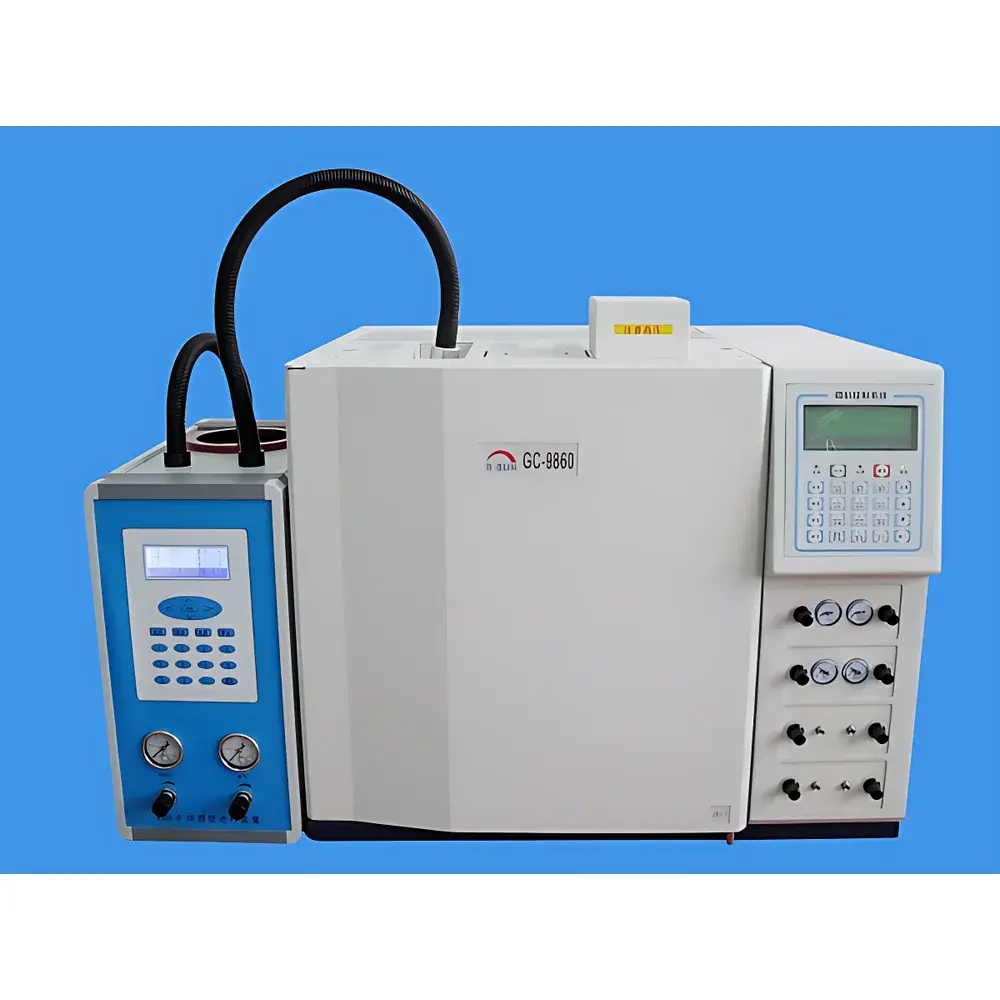
Beifen Sanpu GC-9860/AHS-610 Economic EO Residual Analysis System
| Brand | Beifen Sanpu |
|---|---|
| Model | GC-9860 with FID Detector + AHS-610 Headspace Sampler |
| Origin | Beijing, China |
| Manufacturer | Beifen Sanpu Instrument Co., Ltd. |
| Temperature Control Range | 450 °C |
| Oven Ramp Rate | 39 °C/min |
| Oven Cool-down Rate | 35 °C/min |
| Carrier Gas Flow Range & Control | 0–1200 mL/min |
| Carrier Gas Pressure Range & Control | 0–450 kPa |
| Injector Maximum Operating Temperature | 450 °C |
| Injector Pressure Setting Range | 0–450 kPa |
| Injector Total Flow Setting Range | 0–1200 mL/min |
Overview
The Beifen Sanpu GC-9860/AHS-610 Economic EO Residual Analysis System is a purpose-engineered gas chromatographic solution for the quantitative determination of residual ethylene oxide (EO) in sterilized medical devices and pharmaceutical excipients—particularly hollow capsules. This integrated system combines a robust capillary gas chromatograph equipped with a flame ionization detector (FID), a programmable headspace autosampler (AHS-610), and an EO-specific fused-silica capillary column. It operates on the principle of static headspace gas chromatography (HS-GC), where residual EO is thermally liberated from solid or semi-solid samples into the headspace vapor phase, then injected onto the column for separation and quantification. The method conforms to internationally recognized pharmacopeial and regulatory frameworks, including ISO 10993-7:2008, GB/T 16886.7–2001, and GB 15810–2001, supporting compliance-driven quality control in GMP-regulated environments.
Key Features
- High-precision oven temperature control up to 450 °C with rapid ramping (up to 39 °C/min) and efficient cooling (35 °C/min), enabling reproducible thermal desorption and sharp peak resolution.
- Dual independent pressure and flow control for carrier gas (N₂, H₂, or He), covering 0–450 kPa pressure and 0–1200 mL/min flow range—critical for method transferability and retention time stability.
- Hot-injector design rated to 450 °C with full digital pressure/flow programming, minimizing EO adsorption and ensuring quantitative transfer of volatile analytes.
- AHS-610 headspace sampler with precise vial temperature control (±0.1 °C), equilibration time programming, and automated syringe-based vapor injection—optimized for low-level EO detection (sub-ppm sensitivity).
- FID detector with linear dynamic range >10⁷ and low baseline noise (<0.05 pA), delivering high signal-to-noise ratios essential for trace-level residual analysis.
- Modular architecture supports future expansion with optional data integrity modules compliant with FDA 21 CFR Part 11 requirements.
Sample Compatibility & Compliance
This system is validated for direct analysis of EO residues in polymeric medical devices (e.g., syringes, IV sets), silicone rubber components, and gelatin-based hollow capsules. Sample preparation follows standardized headspace vial protocols per ISO 10993-7 Annex B: samples are weighed, sealed in crimp-top vials with septa, incubated at controlled temperature (typically 60–80 °C), and analyzed without solvent extraction. The configuration meets the technical prerequisites of Chinese National Standards (GB), ISO 10993 series, and aligns with USP , EP 2.2.48, and ASTM F2735 for EO residue testing. All hardware and software components support audit-ready documentation, including electronic signatures, change logs, and raw data archiving—facilitating GLP/GMP audits and regulatory submissions.
Software & Data Management
The N2000 chromatography workstation provides intuitive acquisition, integration, calibration, and reporting functions. It supports external standard, internal standard, and standard addition quantitation modes. Calibration curves are generated with weighted linear regression (1/x or 1/x²), and system suitability criteria—including resolution (>2.0), tailing factor (<2.0), and %RSD of replicate injections (<5%)—are automatically calculated and logged. Audit trail functionality records all user actions, parameter changes, and report modifications with timestamps and operator IDs. Raw data files (.dat) are stored in vendor-neutral formats compatible with third-party LIMS integration. Optional 21 CFR Part 11 add-ons enable electronic signature enforcement, role-based access control, and secure backup protocols.
Applications
- Residual EO quantification in Class I–III medical devices post-sterilization (e.g., catheters, surgical drapes, implant packaging).
- Batch release testing of empty hard gelatin capsules used in oral solid dosage forms.
- Process validation and routine monitoring of EO sterilization cycles in contract manufacturing organizations (CMOs).
- Stability-indicating method development for EO degradation products (e.g., ethylene glycol, diethylene glycol) using column selectivity tuning.
- Supporting ISO 13485 quality management system documentation through traceable instrument qualification (IQ/OQ/PQ) templates.
FAQ
What regulatory standards does this system support for EO residue testing?
It is configured and validated to meet ISO 10993-7:2008, GB/T 16886.7–2001, GB 15810–2001, and harmonized with USP and EP 2.2.48 requirements.
Is the system suitable for analyzing complex matrices such as silicone elastomers or PVC tubing?
Yes—the AHS-610’s temperature-programmed equilibration and GC-9860’s inert flow path minimize matrix interference; method optimization guidance is provided for polymer extraction efficiency validation.
Can the software generate 21 CFR Part 11-compliant reports without additional licensing?
Basic audit trail and electronic log features are included; full Part 11 compliance requires optional security module activation and administrative configuration.
What is the typical detection limit for EO using this configuration?
Under optimized headspace conditions (60 °C, 30 min equilibration), the system achieves a method detection limit (MDL) of ≤0.1 µg/g in capsule matrices, verified per ICH Q2(R2) guidelines.
Does Beifen Sanpu provide installation qualification (IQ) and operational qualification (OQ) documentation?
Yes—comprehensive IQ/OQ protocols, test scripts, and completed reports are supplied with each system, aligned with ISO/IEC 17025 and GMP Annex 15 expectations.





