
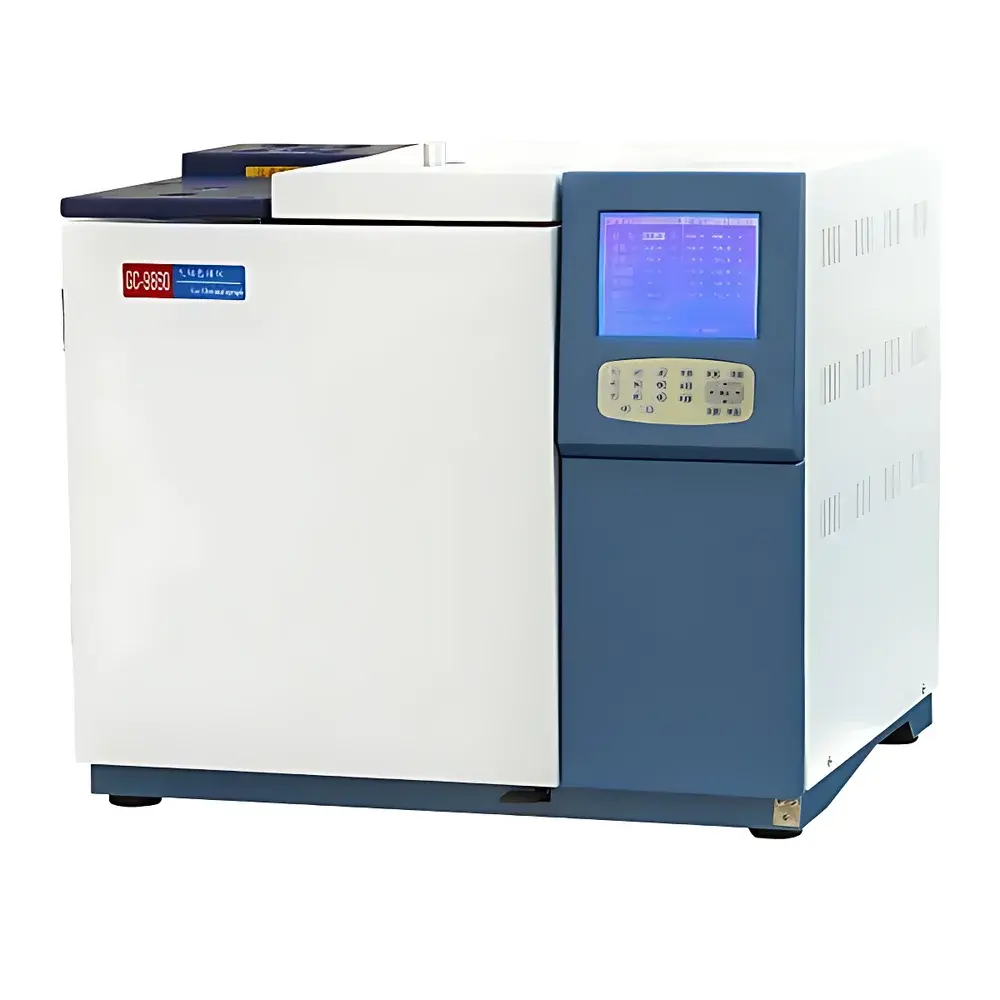
Beifen Sanpu GC-9860 Laboratory Gas Chromatograph for Total Hydrocarbons and Non-Methane Hydrocarbons (NMHC) Analysis
| [Brand | Beifen Sanpu |
|---|---|
| Origin | Beijing, China |
| Manufacturer Type | Direct Manufacturer |
| Instrument Type | Laboratory Gas Chromatograph |
| Application Field | Environmental Air Monitoring |
| Oven Temperature Range | 100–350 °C |
| Ramp Rate | 0.1–40 °C/min |
| Cool-down Time | ~6 min (from 350 °C to 100 °C) |
| Carrier Gas Flow Control Range | 0–1200 mL/min |
| Carrier Gas Pressure Control Range | 0–970 kPa |
| Injector Max Operating Temperature | 100–350 °C |
| Injector Pressure Setting Range | 0–970 kPa |
| Injector Total Flow Setting Range | 0–1000 mL/min] |
Overview
The Beifen Sanpu GC-9860 is a dedicated laboratory gas chromatograph engineered for precise, regulatory-compliant quantification of total hydrocarbons (THC) and non-methane hydrocarbons (NMHC) in ambient air and stack emissions. It implements a validated dual-column, single-flame ionization detector (FID) configuration with a high-precision 10-port switching valve—enabling simultaneous THC and methane separation in a single injection cycle. This architecture eliminates inter-detector response variability inherent in dual-FID systems, thereby enhancing measurement reproducibility and reducing calibration drift. The instrument operates on the fundamental principle of gas-phase partitioning and differential elution kinetics: sample components are separated on parallel packed columns (one optimized for total hydrocarbon summation, the other for methane resolution), followed by sensitive, linear FID detection (detection limit: 0.05 mg/m³ as methane equivalent). Its thermal management system supports rapid, stable temperature programming across the full 100–350 °C range, critical for robust retention time alignment in routine environmental monitoring workflows.
Key Features
- Dual-packed-column parallel flow path with integrated 10-port valve for true one-injection THC + CH₄ analysis
- Single high-stability FID with low-noise electronics and optimized jet geometry for consistent response across C₁–C₁₀ hydrocarbons
- Programmable oven with ±0.1 °C thermal uniformity and ~6-minute cool-down from 350 °C to 100 °C
- Independent, digital pressure and flow control for carrier (N₂), makeup (air), and hydrogen gases—fully traceable and repeatable
- Injector temperature programmable up to 350 °C with active heat-sink cooling to prevent thermal degradation of adsorbed VOCs
- Compliance-ready hardware architecture: supports audit trails, electronic signatures, and method locking per FDA 21 CFR Part 11 requirements when paired with N2000 workstation software
Sample Compatibility & Compliance
The GC-9860 is validated for gaseous environmental matrices collected via glass syringes (10 mL and 100 mL), Tedlar® bags (1 L), or online sampling interfaces. It meets the instrumental performance criteria specified in multiple Chinese national standards, including GB/T 15263–1994 (Determination of Total Hydrocarbons in Ambient Air by GC), HJ 38–2017 (Determination of NMHC in Stationary Source Exhaust Gas by GC), and the Method Compilation for Air and Waste Gas Monitoring (4th Edition). All system suitability tests—including retention time stability (<0.2% RSD), peak area repeatability (<2.1% RSD for THC; <1.8% RSD for CH₄), and linearity (r² ≥ 0.999 over 5–100 μmol/mol CH₄)—are documented per GLP principles. The BF-4 hydrocarbon scrubber (included in standard configuration) delivers certified hydrocarbon-free zero air (<0.02 mg/m³ THC), essential for accurate blank subtraction in NMHC calculation (NMHC = THCsample − THCblank − CH₄).
Software & Data Management
Controlled via the N2000 chromatography data system (CDS), the GC-9860 supports fully automated sequence execution, real-time baseline correction, and multi-point external calibration with quadratic fitting. The CDS generates compliant audit trails—including user logins, method modifications, integration parameter changes, and raw data reprocessing events—with timestamps and operator IDs. All chromatograms and quantitative reports are saved in vendor-neutral .CDF format, compatible with LIMS integration. Electronic signature capability satisfies 21 CFR Part 11 Subpart B requirements for regulated laboratories conducting EPA-equivalent or CNAS-accredited environmental testing. Batch reporting templates align with HJ 38–2017 Annex B, automatically calculating NMHC concentrations and flagging out-of-spec results against GB 16297–1996 site boundary limits (5 mg/m³).
Applications
- Ambient air quality monitoring networks (urban, industrial, background sites)
- Compliance testing for stationary emission sources (e.g., chemical plants, refineries, coating operations)
- Indoor air quality assessments in manufacturing cleanrooms and laboratories
- Method validation and reference material certification per ISO/IEC 17025
- Research on atmospheric photochemical reactivity and ozone formation potential (POCP)
FAQ
What regulatory standards does this system support?
It is fully aligned with GB/T 15263–1994, HJ 38–2017, and the Air and Waste Gas Monitoring Methods (4th Edition), and its performance characteristics meet ISO 8573-1 purity class requirements for carrier gases.
Is dual-FID configuration necessary for NMHC analysis?
No—this system uses a proven single-FID, dual-column approach with valve switching, eliminating inter-detector sensitivity drift and reducing maintenance complexity while maintaining <2% RSD precision.
How is the air blank handled for NMHC calculation?
The included BF-4 hydrocarbon removal unit generates verified zero air (THC <0.02 mg/m³); blank subtraction is performed automatically in N2000 software using user-defined blank integration windows.
Can the system be upgraded for EPA TO-14/TO-15 speciation?
Yes—the GC-9860 platform supports optional cryogenic trapping, capillary column modules, and electron capture detection (ECD) for halogenated VOC expansion, subject to hardware retrofit and method validation.
What is the minimum detectable concentration for NMHC under standard conditions?
At 1 mL injection volume and optimized FID settings, the practical quantitation limit is 0.05 mg/m³ (as methane), verified per HJ 38–2017 Section 8.3.2.
Related Products




