
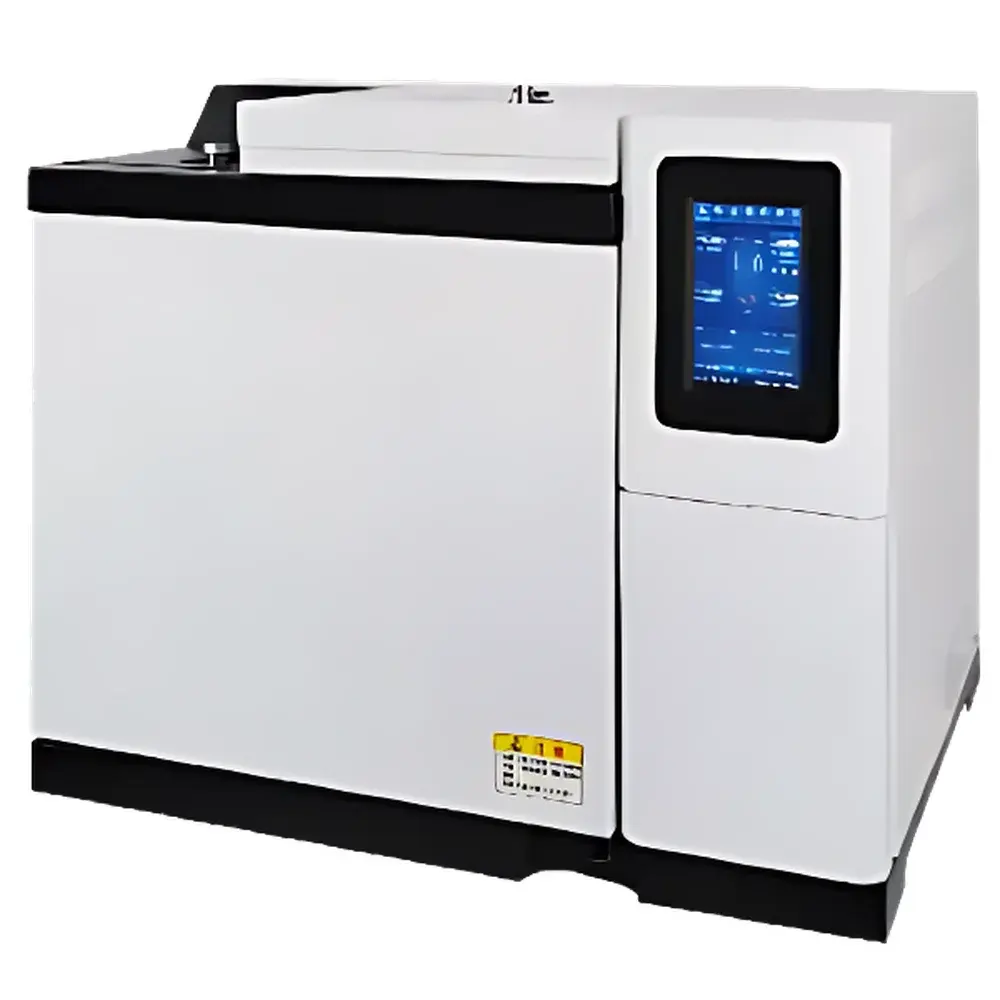
Beifen Sanpu GC-9860 Laboratory Gas Chromatograph
| Brand | Beifen Sanpu |
|---|---|
| Model | GC-9860 |
| Origin | Hebei, China |
| Manufacturer Type | Direct Manufacturer |
| Instrument Type | Benchtop Laboratory Gas Chromatograph |
| Application Focus | Environmental Analysis |
| Temperature Control Range | Ambient ±8 °C to 450 °C (1 °C increment) |
| Ramp Rate | 0.1–40 °C/min (0.1 °C increment) |
| Oven Cooling | Motor-driven rear door with intelligent stepper control |
| Detector Compatibility | FID, TCD, ECD, FPD, Ni-converter furnace |
| Inlet Configurations | Two independent inlets + one valve inlet |
| Autosampler Ready | Compatible with multi-position liquid autosamplers, headspace samplers, and thermal desorbers |
| Data System | Embedded bidirectional control software with valve timing control (e.g., 6-port, 10-port) |
| Pressure Protection | Automatic power cutoff at carrier gas pressure <0.1 MPa |
| Power | 220 V, 50 Hz, 2000 W |
| Dimensions | 59 × 48 × 49 cm |
| Weight | 40 kg |
| Temperature Zones | 10 independently controlled zones |
| Programmed Temperature | 16-step ramping |
Overview
The Beifen Sanpu GC-9860 is a benchtop laboratory gas chromatograph engineered for precision, reliability, and operational flexibility in regulated environmental and industrial quality control laboratories. Built on classical capillary gas chromatography principles, it separates volatile and semi-volatile organic compounds via differential partitioning between a mobile phase (inert carrier gas) and a stationary phase coated inside a fused-silica column. The system employs temperature-programmed elution to resolve complex mixtures—including benzene homologues, total volatile organic compounds (TVOC), ethylene oxide (EO), epichlorohydrin (ECH), ethanol (for forensic breath analysis), petrochemicals, and natural gas components—with high resolution and reproducibility. Its modular architecture supports dual-detector configurations and advanced inlet options, enabling method scalability from routine screening to multi-dimensional GC (GC×GC-ready via timed valve switching) without hardware replacement.
Key Features
- Intelligent Thermal Management: A 10-zone temperature-controlled system delivers ±0.1 °C to ±0.2 °C stability across the oven, detector compartments, and inlet modules. The motorized rear door—driven by a closed-loop stepper mechanism—enables rapid cooling (<3.5 min from 450 °C to 50 °C) and precise ramp termination, minimizing cycle time while preserving column integrity.
- Stable Pneumatic Architecture: Carrier and auxiliary gas flows are regulated via digitally calibrated diaphragm-based mechanical valves. Each unit undergoes offline flow reproducibility testing to ensure inter-instrument consistency—critical for method transfer and long-term QC monitoring under ISO/IEC 17025 or EPA Method-compliant workflows.
- Multi-Inlet & Multi-Detector Flexibility: Supports two independent split/splitless inlets, one dedicated valve inlet (e.g., for loop injection or heart-cutting), and simultaneous operation of two detectors—including FID (detection limit ≤5×10⁻¹² g/s for n-hexadecane), TCD (S ≥ 8000 mV·mL/mg), ECD (≤1×10⁻¹⁴ g/s for β-HCH), and FPD (S/P selectivity with dual-channel output).
- Integrated Control & Safety Logic: The embedded 5-inch capacitive touchscreen runs firmware with real-time graphical chromatogram display, automated flame ignition sequencing, and carrier gas pressure monitoring. Power is automatically interrupted if inlet pressure falls below 0.1 MPa—protecting columns from thermal degradation and ensuring GLP-compliant instrument safety protocols.
- Valve Timing Precision: Eight programmable external event channels synchronize solenoid valves (e.g., 6-port, 10-port) with oven temperature profiles, enabling center-cut multidimensional GC, backflushing, and column switching—essential for ASTM D5504, EPA TO-15, and ISO 16000-6 compliant analyses.
Sample Compatibility & Compliance
The GC-9860 accommodates liquid, gaseous, and thermally desorbed samples through interchangeable inlet modules. It interfaces seamlessly with third-party headspace autosamplers (e.g., PerkinElmer TurboMatrix, Shimadzu HS-20), thermal desorption units (e.g., Markes UNITY-xr), and multi-position liquid autosamplers (up to 150 vials). All signal paths utilize shielded, high-impedance (>1010 Ω) analog circuitry with low-noise amplification—ensuring robust quantitation of trace analytes (sub-ppt level in optimized FID/ECD modes). The system meets baseline requirements for ISO 17025-accredited labs, supports audit trails for 21 CFR Part 11 compliance when paired with validated LIMS integration, and aligns with method validation parameters outlined in USP , ICH Q2(R2), and EPA SW-846.
Software & Data Management
Embedded bidirectional control software enables full instrument parameterization—including oven ramp tables, detector voltage settings, valve timing events, and data acquisition rates—via intuitive touchscreen navigation. Raw data are saved in standard .CDF format (compatible with OpenLab CDS, Chromeleon, and Empower). The software logs all user actions, method changes, and hardware status events with timestamps—supporting ALCOA+ data integrity principles. Optional Ethernet or RS-232 connectivity allows remote monitoring and centralized fleet management in multi-instrument labs. No proprietary drivers or dongles are required for data export or report generation.
Applications
- Environmental monitoring per EPA Methods 8260D (VOCs), 8021B (aromatics), and ISO 16000-6 (indoor air TVOC)
- Residual solvent analysis in pharmaceuticals (ICH Q3C) and medical devices (ISO 10993-12)
- Trace EO sterilant residue testing in packaging and implants
- Forensic ethanol quantification in blood/headspace (ASTM E2901)
- Petrochemical hydrocarbon profiling (PIONA, D86 distillation simulation)
- Natural gas composition (C1–C6+ hydrocarbons, H2S, CO2) per ASTM D1945 and GPA 2145
FAQ
Does the GC-9860 support 21 CFR Part 11 compliance?
Yes—when operated with validated third-party chromatography data systems (CDS) that provide electronic signatures, audit trails, and role-based access control. The instrument’s embedded firmware logs all critical events and supports secure data export.
Can I upgrade from single- to dual-detector configuration post-purchase?
Yes—the GC-9860’s electrical and pneumatic architecture is factory-prepared for dual-detector installation. Detector modules are field-replaceable and require only mechanical mounting and cable connection.
Is the oven cooling performance validated per ASTM E1510?
Cooling rate and thermal uniformity are verified during final QA using NIST-traceable PT100 sensors. Typical cooldown from 450 °C to 50 °C is ≤3.5 min under standard lab conditions (25 °C ambient, no forced airflow).
What maintenance intervals are recommended for the FID jet and TCD cell?
FID quartz jets should be inspected and cleaned every 200 injections or monthly (whichever occurs first); TCD cells require annual cleaning with ultrasonic isopropanol. Both procedures are documented in the English-language service manual provided with shipment.
Are method transfer packages available for EPA or ISO standard methods?
Pre-validated method templates—including instrument parameters, calibration curves, and reporting formats—for EPA 8260D, ISO 16000-6, and ASTM D1945 are available upon request and can be loaded directly into the onboard software.
Related Products




